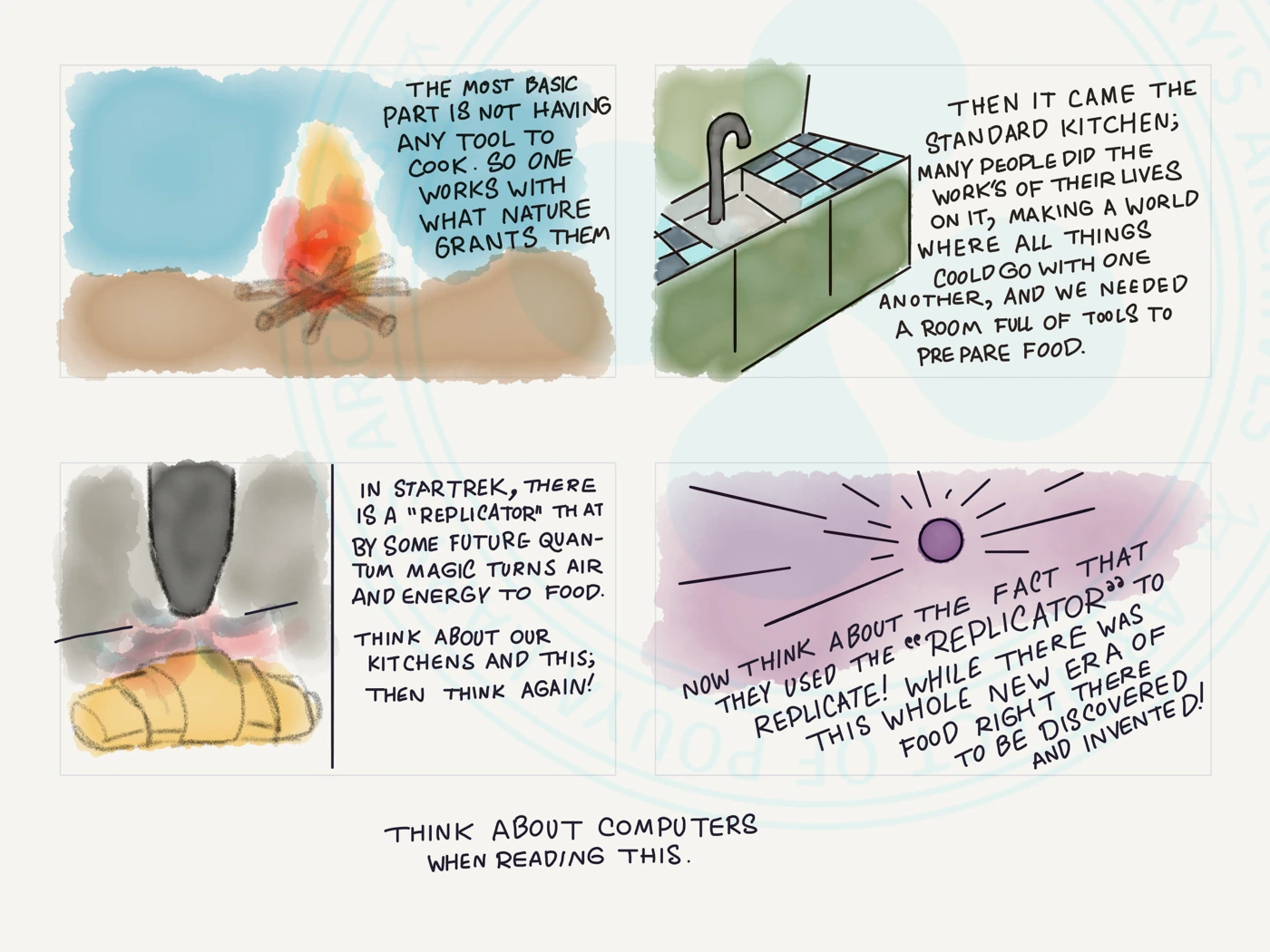
They Used The Star Trek Replicator To Replicate Not To Invent
![The idea of actually having multiple mentalities in the mind is fascinating but then the all more interesting part is them having to compete for control.
[A digital sketch set against a soft pink background showing the profile of a human head. Inside the mind area, four small stick figures are depicted, representing distinct mentalities. Three of these figures are labeled with the terms enactive, figurative, and symbolic. The person is shown holding and gazing at a glowing tablet or screen.]](/photographs/automatic/2025/03/07/artifact-7d241ce252-1-of-1.webp)
The idea of actually having multiple mentalities in the mind is fascinating; but then, the all more interesting part of it is them competing for control.
![What if the 'Plane' was the building block of the world. You may say that in such devices like GUIs, web and what have you, it is. But I'm saying something else
[A technical-style sketch on a blue background showing three overlapping rectangular planes. These planes are drawn with white outlines and filled with a translucent, lighter blue-gray color. Yellow highlight lines connect the corners of the planes, suggesting a 3D relationship or a projection between them, resembling a architectural or UI-component primitive.]](/photographs/thoughts/2025/03/07/planes-as-atoms-1.webp)
Planes As Atoms (1/4) — What if the geometric planes were the building block of the universe. Just like currently text is in a text editor. What if one could do whatever they wish with just planes and they could go together and worked with each other?
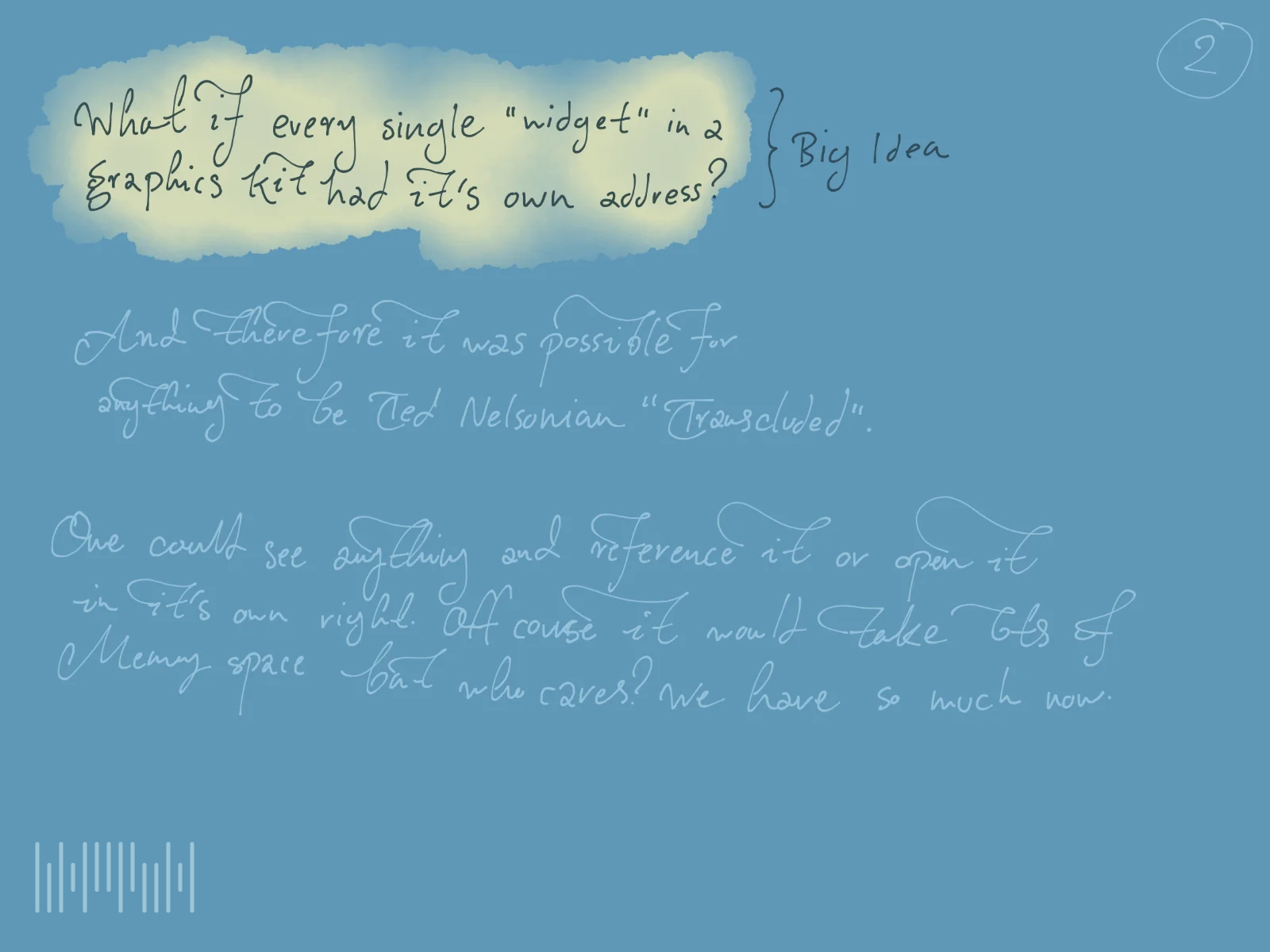
Planes As Atoms (2/4)
![In a system like this all things can be equally referenced and used. Making it possible to have a page dedicated to all subparts + having a live system at all levels.
[A diagram illustrating the concept of addressing sub-components using a mathematical metaphor.
On the left, a summation symbol ($\sum$) ranges from $i=0$ to $S$. Next to it is a fraction $\frac{i}{S}$ enclosed in a glowing yellow box.
A yellow arrow points from this boxed sub-part to a second rectangle on the right.
Inside the right rectangle, only the isolated sub-part $\frac{i}{S}$ is shown.
This ==notational== diagram suggests that any individual element within a set can be extracted and addressed as a standalone entity.]](/photographs/thoughts/2025/03/07/planes-as-atoms-3.webp)
Planes As Atoms (3/4)
![This of course raises a garbage collection concern where if a mother equation is deleted its children are removed as well. But what if there is another equation using the subpart?
Basic garbage collection problem.
[A blue background with a conceptual diagram illustrating a data dependency conflict.
On the left, a square containing several small shapes is crossed out with a large 'X,' indicating deletion.
An arrow points from this deleted 'mother' container toward a second, larger rectangle on the right.
This second rectangle contains a complex mathematical expression ($\sqrt{0} \times \sum$).
A large, glowing yellow question mark (?) sits next to this second rectangle, highlighting the uncertainty of whether the shared subpart should persist after its original source is deleted.]](/photographs/thoughts/2025/03/07/planes-as-atoms-4.webp)
Planes As Atoms (4/4)
My cats grow to adulthood pretty much within one or two years. They learn, or seem to know, what to do to manage their daily lives. They know how to defend themselves, seek shelter, provide food, take care of their children, be social, and that is about all they need.
What is striking is that previously, the average life expectancy for a person was around 35 years. If they were to be educated in a university and grow professionally like we do today, their graduation and becoming part of society would have come in the last years of their lives. But it was not. In the past, people had families and managed their lives when they were 16–17. Having children by this age today usually makes it to the news. If anything, the character of Lorelai in Gilmore Girls is shaped by her pregnancy at 16 and the controversy that made her run away from her parents to a small town.
In our times, the average life expectancy is around 72, and people often live into their 90s. Given that, we finish basic education by 18, higher education by around 22, and most take years to develop professionally, becoming established in their 30s. Things are becoming harder, and there is more and more to learn.
Now, what I sometimes think about is this: With the bar to being a grown-up rising every day due to societal pressure, what happens to our psyche that needs to feel it has matured? Where does the conveyed sense of inadequacy go?