0
1
2
3
4
5
6
7
8
9
0
1
2
3
4
5
6
7
8
9
0
1
2
3
4
5
6
7
8
9
0
1
2
3
4
5
6
7
8
9
–
0
1
2
3
4
5
6
7
8
9
0
1
2
3
4
5
6
7
8
9
–
0
1
2
3
4
5
6
7
8
9
0
1
2
3
4
5
6
7
8
9
0
1
2
3
4
5
6
7
8
9
0
1
2
3
4
5
6
7
8
9
0
1
2
3
4
5
6
7
8
9
0
1
2
3
4
5
6
7
8
9
/
0
1
2
3
4
5
6
7
8
9
0
1
2
3
4
5
6
7
8
9
/
0
1
2
3
4
5
6
7
8
9
0
1
2
3
4
5
6
7
8
9
ANNO·VICESIMO·NONO·DIE·SEPTVAGESIMO·NONO·VITÆ·POVYA
![[A conceptual flowchart illustrating the cycle of perception, creation, and human connection:
*The Source: On the far left, a fluffy cloud-shaped bubble contains the phrase 'Something exists.'
Step 1 (Perception): A large hollow arrow pointing right, labeled 'WE SEE,' connects the source to a single humanoid stick figure.
The Transformation: Curving over the head of this figure is a smaller arrow with the caption: 'it puts a fingerprint on us and ==alters== us.' This suggests an internal change caused by the observation.
Step 2 (Expression): From the humanoid figure, another large hollow arrow labeled 'WE CREATE' points right toward a scattered cluster of geometric shapes (three triangles, two squares, and three circles).
The Quality of Creation: To the right of these shapes, a bracket groups them together with the explanation: 'we come up with all these things that have the feeling of that first thing.'
Step 3 (The Result): A third hollow arrow, labeled 'THIS RESULTS,' points downwards from the shapes toward a group of three humanoid figures.
The Social Impact: Below this group, the text reads: 'Others like us will see the creations and feel the same footprint.'
The Connection Loop: A curved dashed line originates from the feet of the first 'creator' figure and connects to the group of 'others.' Next to this dashed line, written in all caps, is the final realization: 'AND THEN WE SOMEHOW CONNECT.']](/photographs/thoughts/2025/03/28/artifact-966e7f8581f612b730e3f98701205f86.webp)
We Somehow Connect
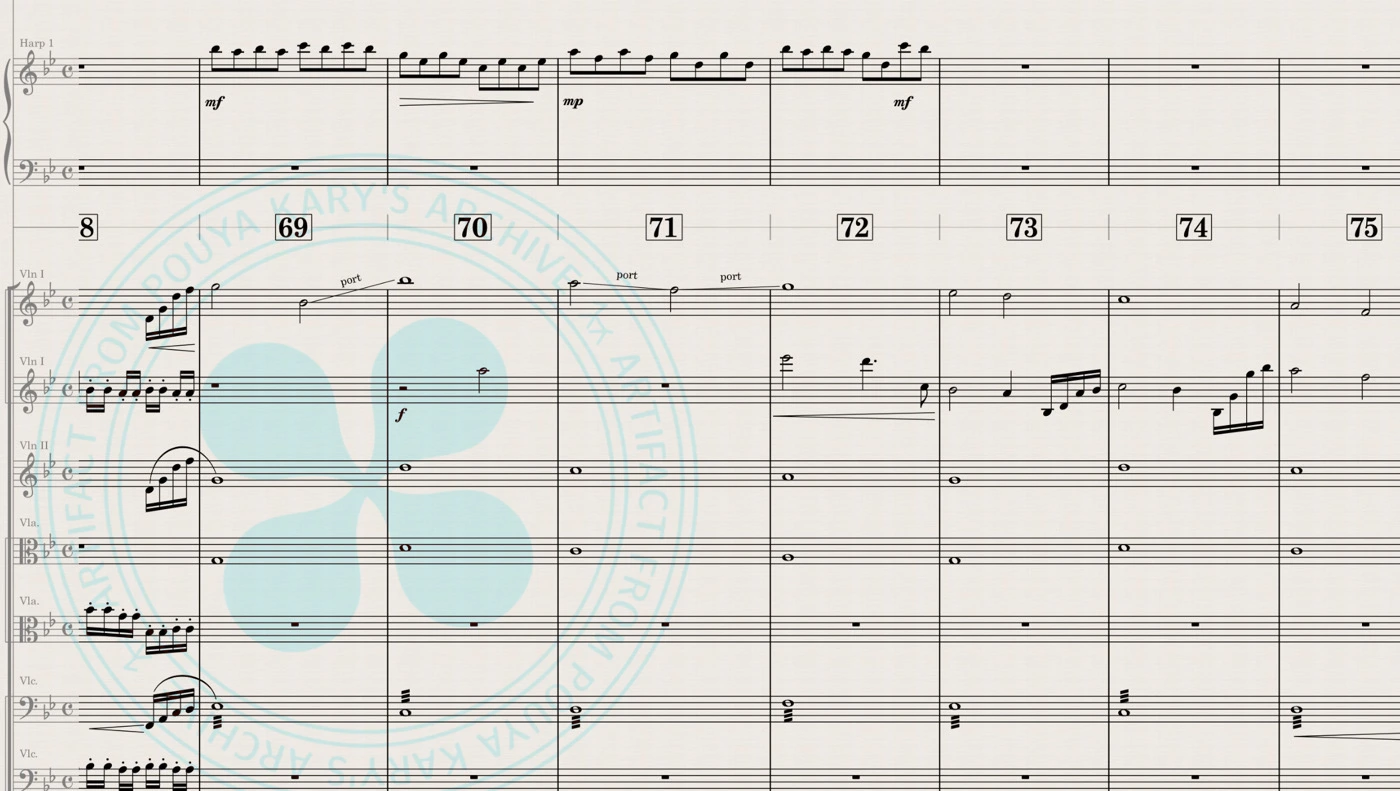
One of My Best Compositions • Exotic Dreams Bars 69 to 75, the Strings Section + Harp.
Quotes & Excerpts
If you design a system to do something specific, don’t be surprised if it does it. If you run an education system based on standardization and conformity that suppresses individuality, imagination, and creativity, don’t be surprised if that’s what it does.
The success of those who do well in the system comes at a high price for the many who do not.
Too often, those who are succeeding are doing so in spite of the dominant culture of education, not because of it.
Day's Context