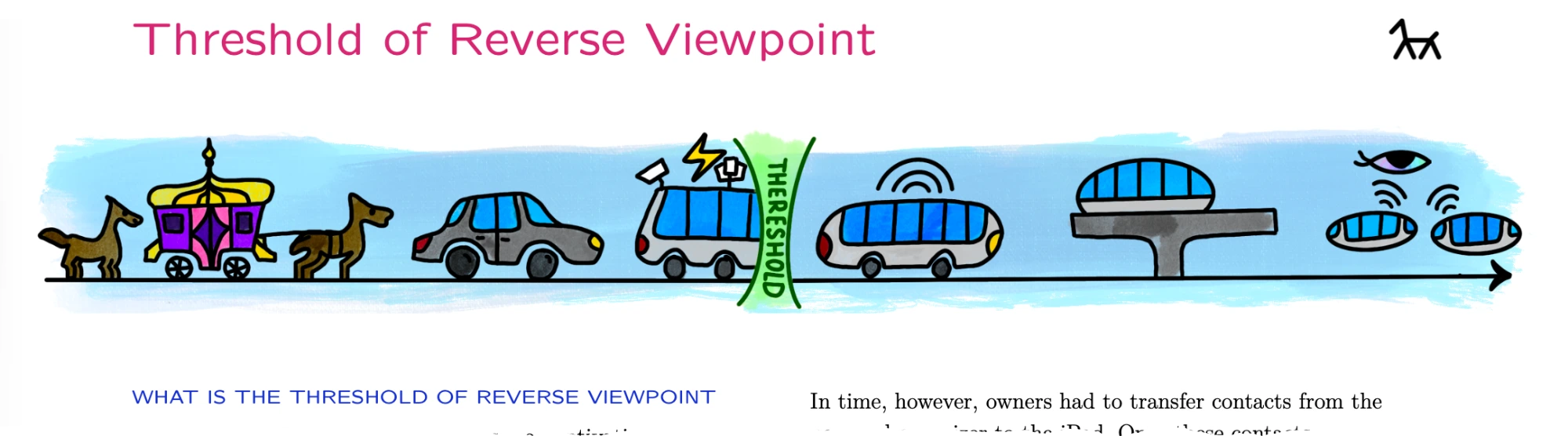
WHAT IS THE THRESHOLD OF REVERSE VIEWPOINT
The invention of each concept possesses a captivating quality, initially appearing as a potential solution to a current problem and thereby enhancing the existing state of affairs. However, with rapid advancement, a more profound questioning emerges, hinting at a “right future.” (For those familiar with the works of Marshall McLuhan, similarities may be perceived. Nevertheless, I assure you that the distinction will become evident.)
The introduction of the iPhone and iPad coincided with the continued use of planners and personal organizers. Initially, these devices were perceived as companions, augmenting the capabilities of personal organizers. Consequently, manufacturers created binder notebooks specifically designed with an iPad slot within them. They effectively regarded the iPad as a page in their organizers.
In time, however, owners had to transfer contacts from the personal organizer to the iPad. Once these contacts were integrated, the necessity for the personal organizer diminished. The need to manually make calls was eliminated, as the iPad could automatically initiate phone calls. Consequently, the contacts section of the binder notebook was gradually phased out, followed by notes, calendars, and to-do lists. Eventually, the binder that once viewed the iPad as a component became an accessory to the iPad itself. Neil Postman aptly described this situation as “pity for the blacksmith who believed the industrial revolution would be a significant augmentation for their craft, only to discover that their entire industry had become obsolete.”
I refer to this pivotal moment as the “threshold of the reverse viewpoint,” where an advancement reverses the perspective from improving the originating device to taking the remaining steps toward an end device.
Consider the evolution of communication methods such as mail, fax, and email. Mail involves the production, printing, and physical distribution of paper, resulting in a process that can span days or even months. Fax, a faster alternative, still relies on paper transmission, albeit at a significantly accelerated pace. Email, on the other hand, revolutionized communication by enabling instantaneous text-based messages. This marked the threshold of the reverse viewpoint for communication. While any improvement to the original design prior to the threshold of reverse viewpoint constitutes an augmentation, anything beyond the threshold involves envisioning a future made possible by the enhanced original design and examining why the current state of affairs lacks certain qualities of that imagined future.
With the advent of email, the question arose: “Why can’t I monitor the conversation?” Consequently, the concepts of threads and replies emerged. Another concern was the inconvenience of checking emails every hour, to which notifications provided a solution. Some individuals disliked the tediousness of subject lines and CCs. Within a few years, instant messaging applications became popular. I recall the service Shortmail, which utilized email as a backbone for instant messaging. Good times.
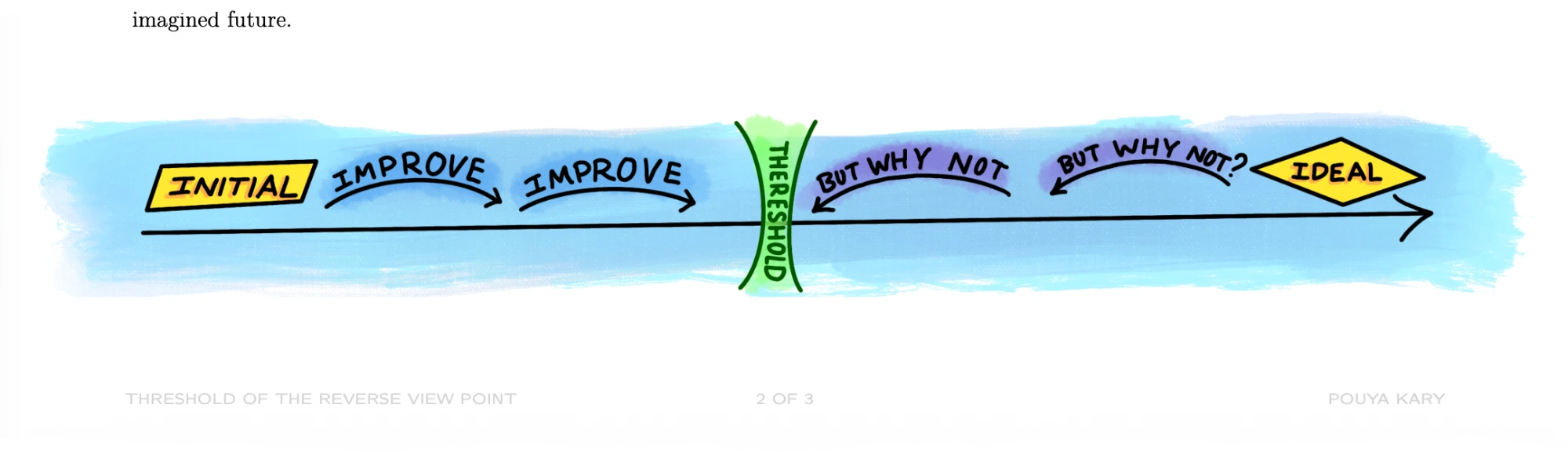
The threshold of reverse viewpoint holds immense significance. Once we cross this threshold, progress in the original form effectively stalls, and we are left questioning why certain practices persist rather than being replaced by alternative solutions. This phenomenon arises from the formation of an ideal future in our minds. The threshold of reverse viewpoint represents the precise moment when this envisioned future begins to materialize.
Consider the concept of self-driving cars. This technology raises questions about traditional road paths and hints at alternative rail systems, potential reductions in speed limits, and new forms of coordination. As self-driving cars gain dominance, the question of allowing humans to directly operate these vehicles emerges. This gives birth to the idea of a central synchronization system, eliminating the need for each car to drive itself and removing much of the associated complexity and friction. In turn, this would eliminate nearly everything we currently recognize as the modern concept of a car.
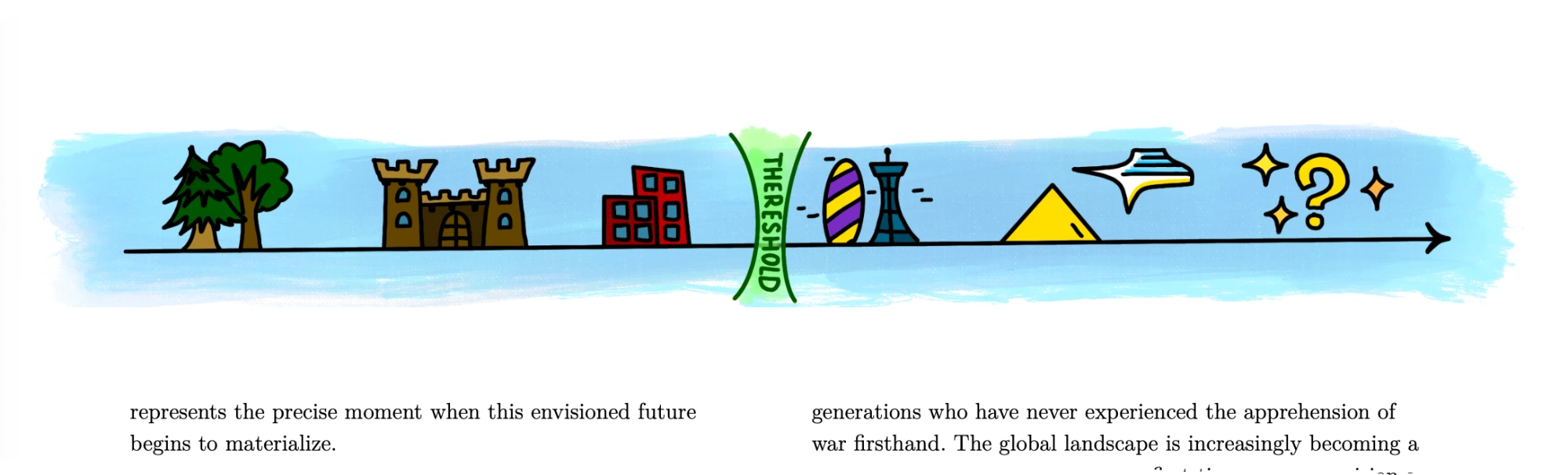
Threshold of The Reverse Viewpoint AND PEACE
Recently, I have noticed the presence of a threshold of reverse viewpoint in peace and the advancement of human civilization. Despite rising tensions and the possibility of war, there exist generations who have never experienced the apprehension of war firsthand. The global landscape is increasingly becoming a haven for humanity. It may be the first time we can envision a world devoid of all forms of conflict and observe tangible signs pointing in that direction.
We are by no means safe today. If anything, the problems we observe in places such as Gaza or 🬺🬛🬕🬵🬤🬩 indicate the severity of the situation. Yet the means of our development have given birth to an idea in which peace is no longer perceived as a nicety, but as a necessity and a basic assumption. The global supply chain, the internet, and the free market all now operate on an agreed-upon level of international cooperation that is gradually erasing the idea of conflict and war from the collective imagination. This is both novel and remarkable.