Ever since 29⟡144, I was trying to design a curriculum for then School 42 alternative FANAP wished to have, but they were all incredibly boring. If anything 1285 had to be about excitement from the get go, and boring had no place in our world. Thinking and thinking about the design, I was remembering the insight I had years ago that Visual Studio Code and the TypeScript project are hard for newcomers (around five or six years after they were introduced) but not for me. I had the very easy to understand and basic version of them, it was easy to master and understand. Over the years more and more features had appeared, and each month or season I could learn a few little new things, that had solved my problems. I had months to wrestle with alternative solutions and so when these new features came they were life savers. On the other end of the world there were people who had just encountered the accumulation of all those features and it had freaked them out. So I thought, why not do this with education?
This essay is written in 30⟡109 for a missing idea that I assumed was explained but never was.
Ever since 29⟡144, I was trying to design a curriculum for then School 42 alternative FANAP wished to have, but they were all incredibly boring. If anything 1285 had to be about excitement from the get go, and boring had no place in our world.
Thinking and thinking about the design, I was remembering the insight I had years ago that Visual Studio Code and the TypeScript project are hard for newcomers (around five or six years after they were introduced) but not for me. I had the very easy to understand and basic version of them, it was easy to master and understand. Over the years more and more features had appeared, and each month or season I could learn a few little new things, that had solved my problems. I had months to wrestle with alternative solutions and so when these new features came they were life savers.
On the other end of the world there were people who had just encountered the accumulation of all those features and it had freaked them out, it was hard for them, the ZPD was just too big.
Henceforth, I had thought to myself: This is the best way to learn. The education in mathematics has always been: take this block, build upon it a bigger block, use them to build bigger and bigger blocks, have your blocks grow. You learn to count, then you learn sums, then use use the sum to build the multiplication, the multiplication to build exponential powers, … You also learn physics by learning the history of it, You learn about E. Rutherford before you learn about A. Einstein, you learn about Einstein before you learn about E. Written. And I thought: What if we do the same with Computing?
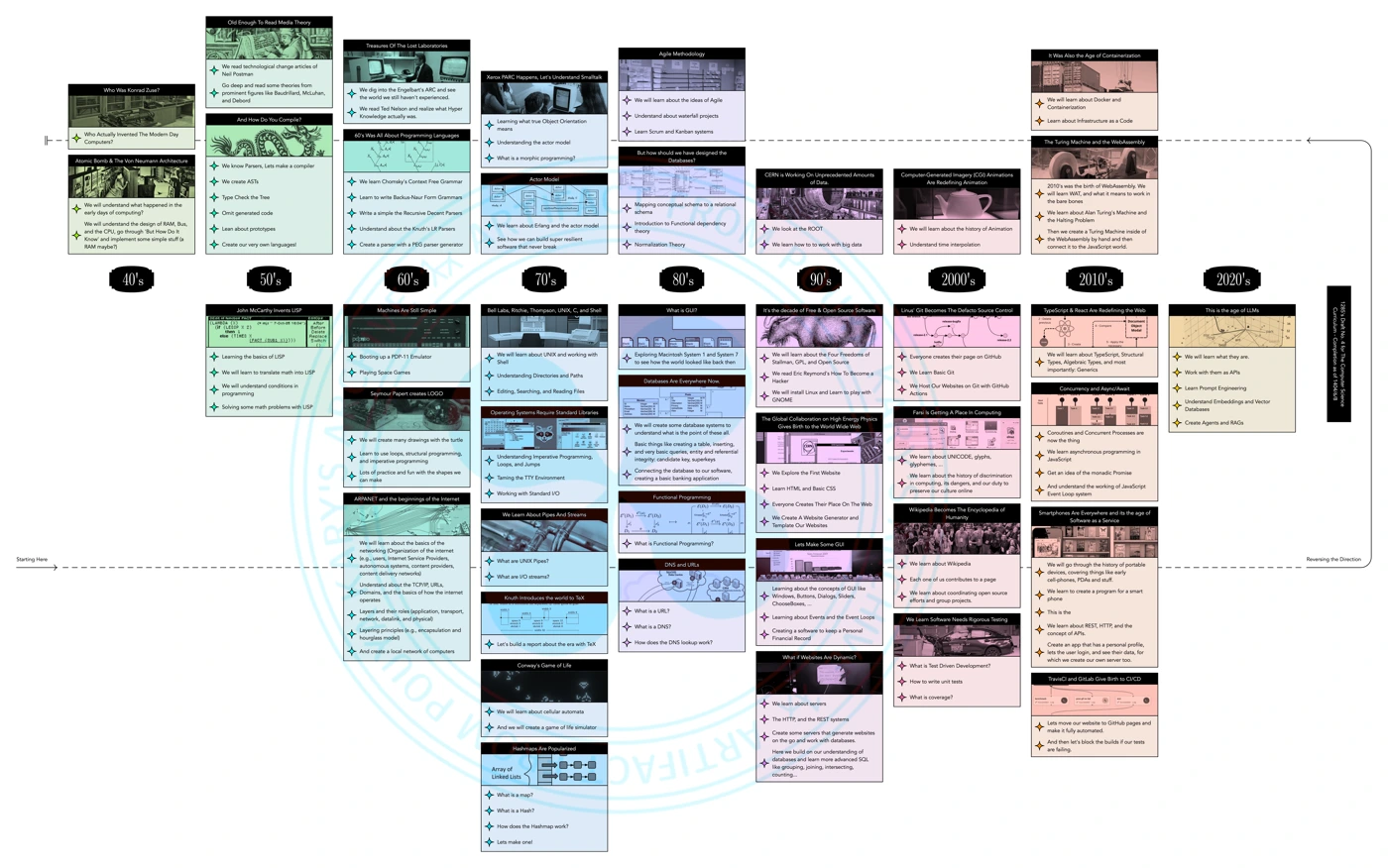
Computation is nice in that you can simulate all previous hardware. I learned C and C++ on the ancient TurboC++ software in our highschool, the simplicity it provided made my life a lot easier and straightforward. And we could do that for the whole computing. Our artists would have gone to different “decades” and use the most basic computing elements, learn them, struggle with their struggles, and slowly build upon their tools more tools. They could have what I had for some tools, for everything, and the interesting idea then was: Once they were finished, the nature would have continued in the exact same way, only slower.
This however had a problem: Some of the hardest things in computing were created early, and then it became more and more easier to program, if you started from those things exactly, you would have crushed everyone attending your curriculum.
Another problem was the gems forgotten by history that would have required different paths. (Say all the works of Maestro Engelbart and Maestro Kay ). For that I thought okay: The curriculum could go on and on and reach the modern day. Once it reached the end, the direction would have reversed and people would go back in time, learning the hard things and what they could not have learned, things that gave them alternative views, and the forgotten gems of history.
Presenting this to Ashkan , and Mohammad had them very very excited. I thought well at least I have done my job here. We then showed this to Shahab Javanmardi . He really loved it. Saying and I quote that “I used to teach physics, and I really loved the narrative approach. I wanted to teach things this way myself”. So he was too instantly onboarded.
Ashkan then told Shahab Javanmardi about my thoughts on the interior design of the 1285 (29⟡215), Shahab Javanmardi went even one step more and said: Kids these days need a way cooler thing than a school, we should make a Harry Potter castle for them.