There are good reasons why the education that we have actually sucks, and cannot be trusted, and must be in our trash cans. But then, when thinking about the alternatives we can have for the current industrial education, we may conclude quite simply that there is hardly a great rethinking of what education must be.
From the standpoint of someone who has been involved with technology and its industry for quite some time now, I have seen how the idea of moving from tech to market has always failed. It was popularized by Jobs that you have to see what the customer needs and work backwards from that. Make the technology to actually implement the needs of the customer—for which he is quite right.
Now, quite honestly, I resent the ideas of the capitalist world. My hope is to have a world of less of whatever we are in right now. Yet this understanding can be applied to the rethinking of education as well.
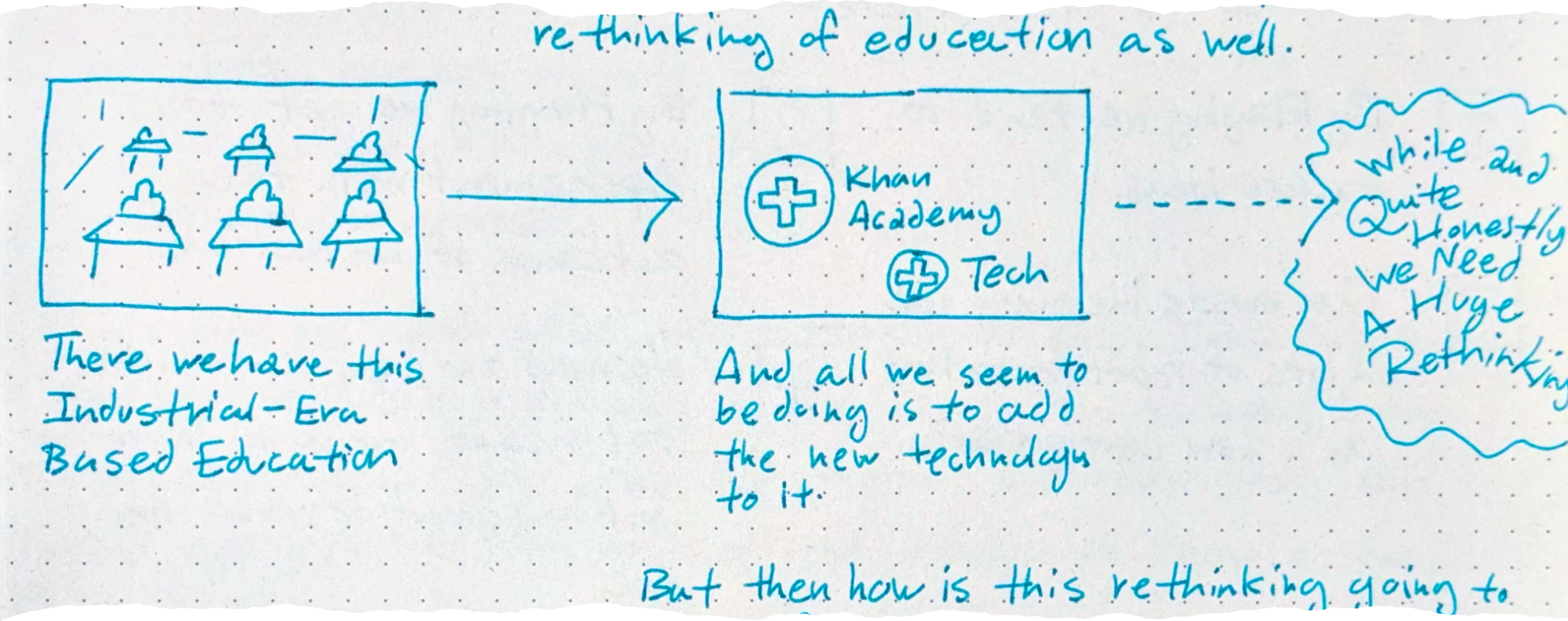
But then how is this rethinking going to happen to us? What will it be, and how are we going to approach it? Here is the part where we have to think for a little bit.
Studies apart, what do we intrinsically know about learning that is true? The very first thing that comes to my mind is that “play” is actually everything. We learn by playing, and this is so fundamental about us. If we actually start to try to see and understand learning, we get to a few ideas which I will jot down here:
- By playing, we tend to explore ideas.
- By playing, we get to experiment with the outcomes of our actions.
- Our muscle memory needs lots of repetition to land on a new configuration.
- We need our experimentation to be safe for us to learn how great or how bad things are.
Now, this is something so very interesting to actually think about: the reasons we play. We play because it allows us to:
- Experiment and iterate over the experimentation
- Do it in a simulated world where our actions have no serious consequences
- Be creative and explore ideas that do not require feasibility, market demand, price—or, in fact, any form of optimization. Ideas here can be goofy, or very stupid. Either way, it is the right approach.
- And never forget the fact that this is all just for the fun of it.
And well, with all of this jotting down said, I am beginning to realize just how and why we even play. This is everything one needs to not just learn, but to grow. And then take this and apply it to the rest of the things we know or have.
We have been smart enough to have realized that machine learning models must learn in the exact same way that children learn. AlphaGo learned Go by playing lots of it. We have companies trying to teach machines to play things like Minecraft. And that has been a very interesting thing to do—but then, has anyone tried to do the same with learning?
This can be answered in parts. We have the idea of games, but they essentially have no way to advance someone in anything. What will come of playing war games in video game consoles? I don’t believe much. It is pure entertainment, which is quite irrelevant to what we know as learning. And then, of course, there is the matter of gamification.
Gamification—as far as I can define it after all of these years of being used to it—is to use game design techniques to “addict” people, to make them need a product and service. Not only is it a fairly unethical approach; it is easy to spot that it, too, does not adhere to the idea of play.
If we believe animals and machine learning models are learning through play, then perhaps much of our work in designing all sorts of educational design that are not play—we have been committing crimes. And thus I would urge anyone to move into the thinking of what might be a good design for 1285 that is even more play-centric.