My idea of Unified Notation is something very hard to even imagine. The heart of this idea is to have a Dynamic Medium with Paper-like capabilities; for which I mostly mean the included freedom. There is a huge gap between a “Tool” and its “Creation”. The paper gives you a canvas and you may bring any tool of your liking so that you can modify this paper. When it comes to a computer; things become even more simple: You have a matrix of colors and however you change the Matrix is a way. Some people simply modify it; some go the long way to create Mathematical Paths and render vectorized things; some go to the GPU; some load pictures. Yet, at the end it will be manipulating a matrix. Now let us move further and examine this whole differently. And so the problem remains to be the one I have always been grappling with; the problem that.
In Dynamic and Immutable media, the look might perhaps be the same; but between them, there lies an ocean of difference.
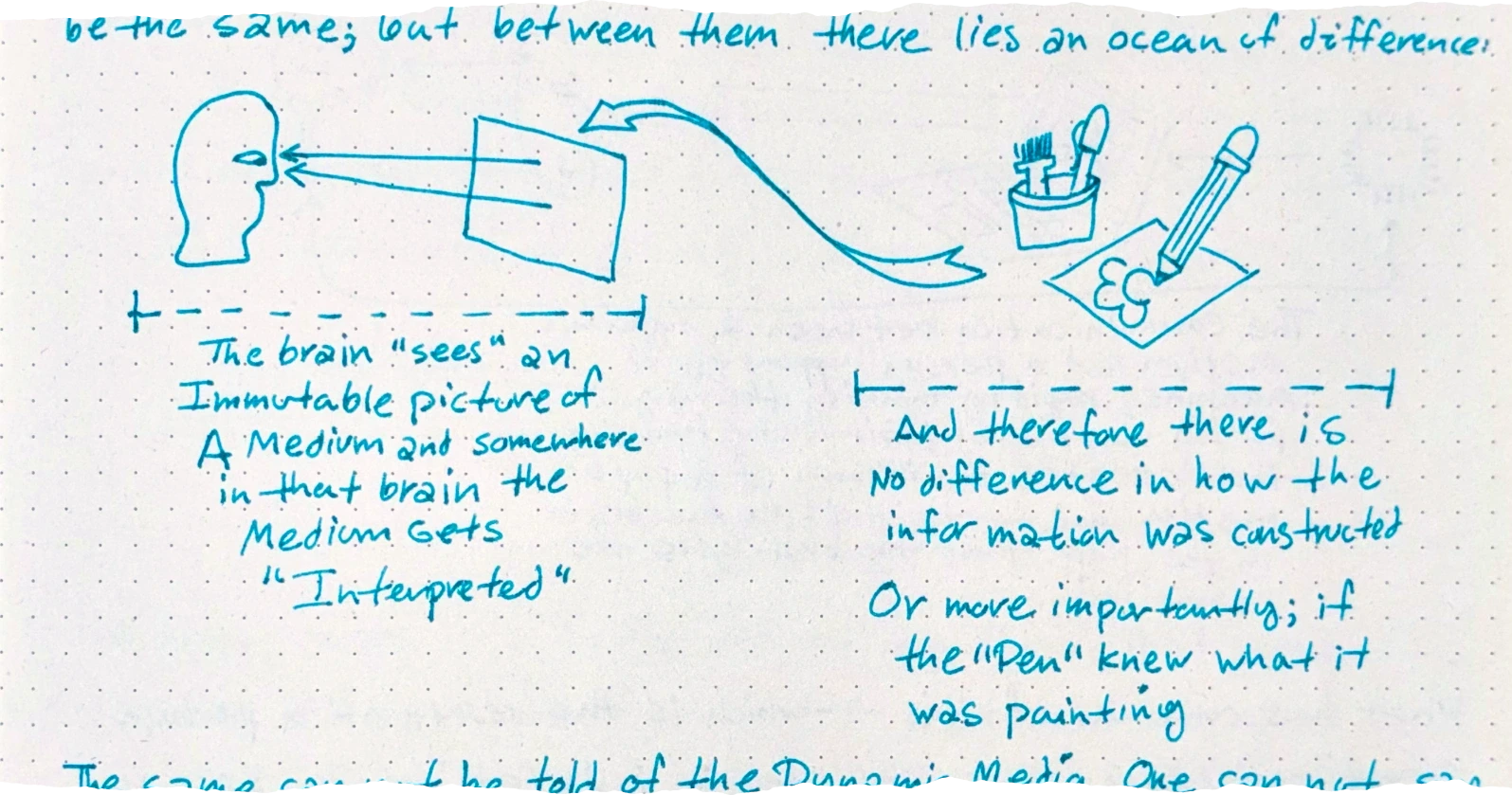
The same can not be told of the Dynamic Media. One can not say that there is no need for a calculator to actually know what it is doing. Quiet the contrary, the calculator has to know exactly what it is doing, otherwise, it is not calculating. One can say that dynamic media are essentially—as they always have been—deceptions. Machines that emulate reality. The way Maestro Victor calls it Simulation. These media have always naturally been islands of rare existence. As:
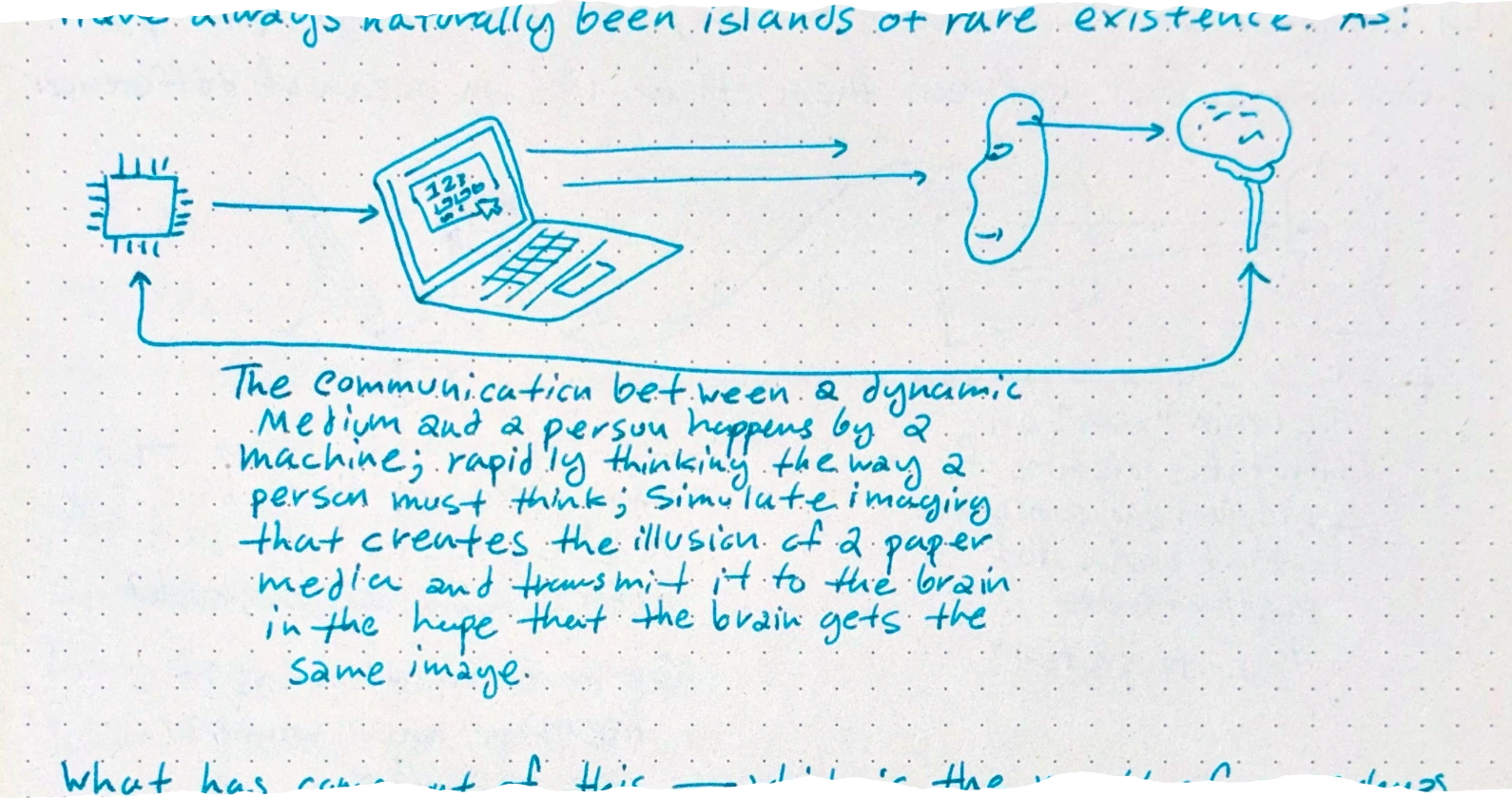
What has come out of this—which is the result of a perhaps competing industry;—can be seen as isolated images. Because while they look the same to a brain; underlying are fairly different, incompatible machines. It can be said that it has not been the vision. People at XEROX PARC had such amazing things in SmallTalk that, if realized; this whole idea might have been very different in the “production” mode. A mode in which one could have shared the logic of creating all of these simulating machines. But still; to have a full notation system it could not have been enough. Because while it could share the button logic; it could not have connected Musical Notation to Math. This is perhaps the biggest advantage of having a mind that interprets.
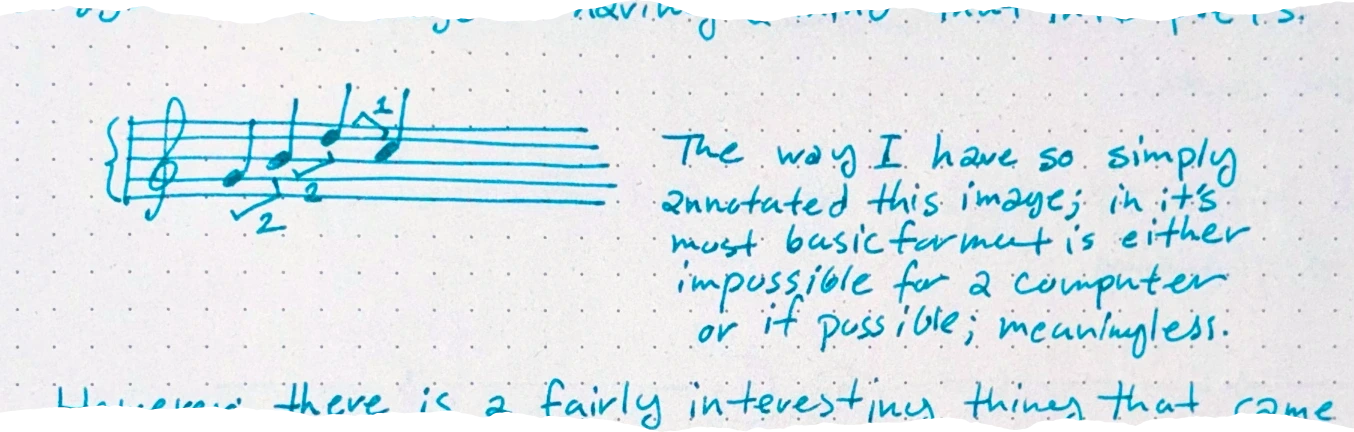
However, there is a fairly interesting thing that came to my mind today. What if we had a system that allowed arbitrary data and annotations to be made and have an engine that could select an interpreter by type. Say:
MATH AST —> Symbolic Expansioned Math AST
Musical Notation AST —> Rendered Sound
Musical Notation AST —> Mathematically Annotated Musical AST
…
And the system could query engines and compile a combination of them? This is me improvising on the idea and it is perhaps not even meaningful; but then what if languages could be partial and a meta notation was a system configuring a “Field Language” and “Interpreter,” based on the data?
I have to sleep on this and think what I’m thinking.
Talking to GPT; it has been clear that first: I do not define “Exactly What I mean by things” and that it is hard to even grasp personally what I mean by what I mean.
I can not think of very many other disciplines [
Our human brains are not very good at dealing with this. We do not have English terminology that can account for systems that span this range. Is something that takes 500 cycles “fast?” 50,000? 5 million? 50 million? To a human, all but perhaps that last one are equally “instant”. Then again, try to do them a billion times each and the differences become quite marked.
“Fast” and “slow” are often not very useful words in software engineering because of this broad range of orders of magnitude. Imagine trying to draw the line between “fast” and “slow” in some sort of general sense across 19 orders of magnitude, in a world that generally experiences performance in a very linear manner. You can’t.