Pouya Kary's Archive
2026–01–13
1404/10/23
ANNO TRICESIMO DIE QUINTO VITAE POUYAE

Archive needs an umbrella project system to umbrella over other projects.

What if we treat the current media as dead media and push it to the glory of a dead media? (Brian Eno stuff) & get out of the Spectacle Guy Debord 🞶 style?

I find Paulo Freire 🞶's ideas quite agreeable. Yet Parsatoo did warn me that such a view is dangerous and I must approach it with care. I agree with that as well. What I find fresh is that the book is not about deliberate political understanding of education, but actually a politics grown around the problems of it. The problems he is pointing are not political but "media ecological". Every problem that has been in education is a direct result of our media inefficiency.

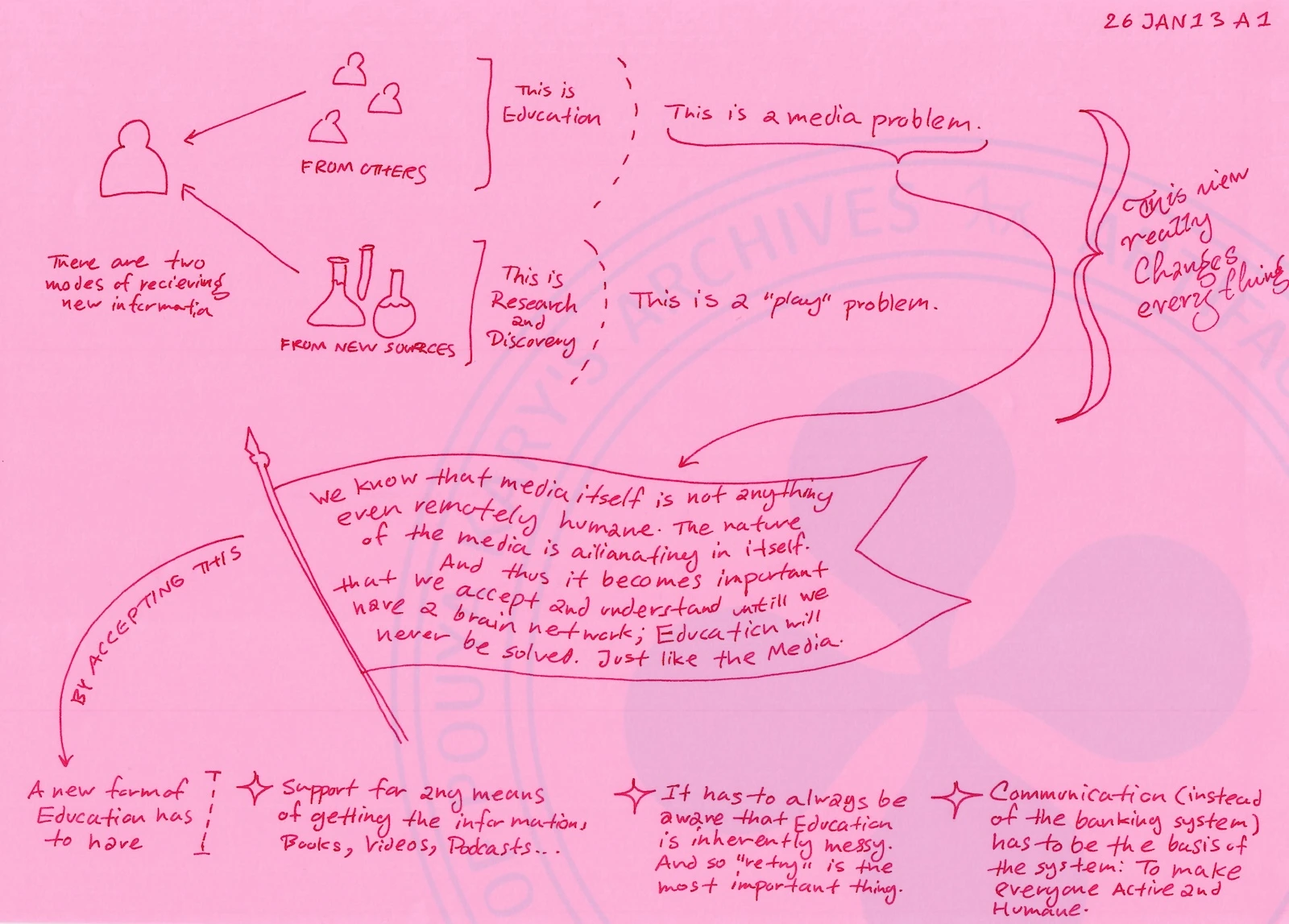
This is the big breakthrough of the day: As long as something is to travel between minds, there shall be alienation and we must not expect education to be fixed. The same exact problem we see in the mediums themselves.

Long ago, reflecting on what Bret Victor 🞶 is doing, I concluded that at least within the realm of two dimensional media there is nothing much left to do. And the big conclusion was how by eliminating all wrong design decisions we get to the bottom of the problem which is the alphabet and the language itself. To fix media you have to begin there. That is unresolvable unless we go to the "To Kill Math We Must Wire The Brain".

Tanya 🞶 has been worried sick of what has been happening in Iran. The disconnect made her cry so much on the phone with my Mom 🞶. Power is sickening.

1. Overall Structure and Tone
The image is a red-toned photograph of a handwritten conceptual diagram. It appears to be a philosophical reflection on education, media, and knowledge acquisition. The writing is informal and diagrammatic, with arrows, brackets, and small sketches (people icons and laboratory flasks).
The page is organized into three main conceptual areas:
Two modes of receiving new information

A distinction between education/media and research/play

A central philosophical claim about media’s nature and its implications for education

Practical consequences for designing a new form of education

The overall message:
A new understanding of media fundamentally changes how we must think about education.
2. Top Left: Two Modes of Receiving New Information
Text says:
“There are two modes of receiving new information”
Two visual pathways are shown:
A. From Others
Small drawn icons of people.

Labeled “FROM OTHERS”

Bracketed with the phrase: “This is Education”

This implies:
Information transmitted socially.

Knowledge passed from person to person.

Structured, institutional, communicative learning.

This is defined as education.
B. From New Sources
Small drawings of lab flasks.

Labeled “FROM NEW SOURCES”

Bracketed with the phrase: “This is Research and Discovery”

This implies:
Knowledge obtained directly from the world.

Experimentation, exploration, scientific inquiry.

Original discovery rather than transmission.

This is defined as research and discovery.
3. Middle: Media vs Play
To the right of those brackets are two parallel reinterpretations:
“This is a media problem.” (linked to Education)

“This is a ‘play’ problem.” (linked to Research and Discovery)

Interpretation:
Education is fundamentally shaped by media — the channels through which information is transmitted.

Research/discovery is fundamentally about play — experimentation, interaction, exploration.

Thus:
ModeTraditional LabelReinterpreted AsFrom OthersEducationMedia problemFrom New SourcesResearch/DiscoveryPlay problemThen written to the far right:
“This view really changes everything”
So the author claims this reframing is transformative.
4. Central Banner: The Core Philosophical Claim
In the middle is a large banner-shaped text block. It reads (paraphrased clearly):
We know that media itself is not anything even remotely humane.
The nature of the media is alienating in itself.
And thus it becomes important that we accept and understand until we have a brain network.
Education will never be solved. Just like the media.
This is the most important philosophical section.
Key Ideas:
Media is not inherently humane
Media is structural, technological, abstract.

It is not naturally human-centered.

Media is alienating
It creates distance between people.

It transforms communication into mediated form.

It separates humans from direct interaction.

Education cannot be “solved”
Because education depends on media.

And media is inherently alienating.

Therefore education inherits the same structural instability.

The phrase “until we have a brain network” suggests:
Only direct mind-to-mind connection (no mediation) would remove alienation.

As long as communication requires media, alienation persists.

Thus:
Education and media are structurally unresolved problems.

There Are Two Modes of Receiving New Information (1285 🞶)

Day's Context
Open Books