To be remembered: I adore the typeface design of “Ludovico degli Arrighi”.
I have grown mean and heartless over the years. I find it hard to fathom. Why have I done myself so wrong?
One can be kind and tell all the beautiful things to others. What is it that stops me from giving others such a free gift? To people who have done me no harm? no wrong? those who at all times have been kind to me? why have I transformed to this monster?
I was like this when I was younger as well. I used to get gifts and never give one. This must not be how one should be. And the strangest part is that while I have the shame of this everyday, I never change. What is wrong with me?
For a long time now, I have been noticing a difference between people who are the first generation and those who are the second generation in using things. There is a big, big difference: those in the first generation usually have constraints in how they use their own creations; they almost always remain loyal to the world before their making, and they have a philosophical understanding of what they have made.
This is not at all the case with the next generations of people, who are sometimes even born and naturally acquainted with the creations. To me, this is so bizarre because while the first group might have had the philosophy, they were always restrained in their creations, and this is not the case with the next generations.
Take people at Xerox PARC, for example. These people made Smalltalk; to them, each element was sacred and important, and yet they remained true to the system and could not have compromised on any of its elements. Xerox Star eventually failed.
While that is the truth, the people at Apple copied all the elements of it visually but thought of nothing it had internally. This simply made all the nice things of Star fade away. No more live, open system where you could modify the system and get some immediate feedback. The system was designed—very intentionally—to allow the person using it to understand the system and be able to extend it. Yet, the copies made by Apple, Microsoft, GNOME, KDE… they all locked the liveness of the system and made cheap copies. (Or perhaps copies that made some programs are all controlled by them exclusively.)
Even if you take someone like Steve Jobs, who at one point had created one of these less meaningful copies—the “Mac”—you see he had little to no regard for companies like Facebook, who had started to track users and sold advertisements based on their surveillance. And if you take Zuckerberg, he was stunned by how companies like Snapchat had copied their work without any consent.
So basically, this is all a JPEG saving problem. Each time it is shared, a portion of the information and the quality is lost.

But then, what made the problem of generational copies more interesting is rooted in the design of the abstract language, artifacts, and the context loading of passing graphs to each other. Let’s take a look at this example:
Maestro Victor tells the story of how pop-up menus were first invented to give children “a window to what is possible to do with the object they are interacting with, so that they know what functions are available to them for extending the system.” And for that reason, the context menu did not have labels, but pure function names. So if you look more closely at what has been going on, you start to see this:
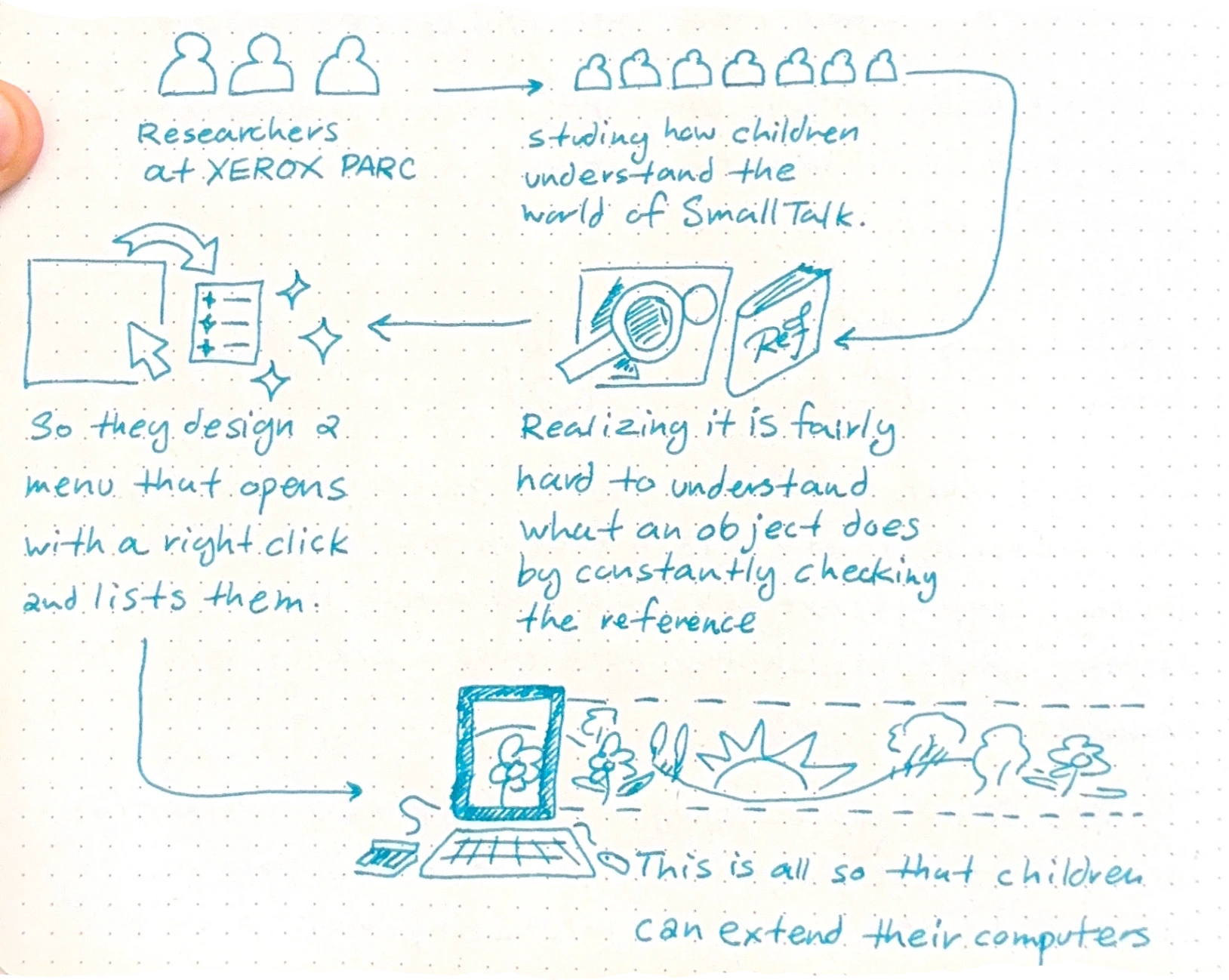
And therefore all of those brilliant ideas are lost, simply because the implementation has become the reference.
People who made crypto money—initially—told the world that the idea was to weaken centralized banking and hopefully to dismantle it completely. It was designed to be something that removed the limits of money for everybody. But what happened to it? Well, some might say that its nature made criminals adopt it and use it for all sorts of bad things. But it is not this, not this specifically. The problem with Bitcoin was that it simply was open source. This is very much Maestro McLuhan ’s “The medium is the message” here, as the open-source-ness of the coin and the fact that its maker(s) are among the richest people on Earth now makes others want to create their own cryptocurrencies, and therefore many are born. Here, the newcomers to the system no longer have any intention of decentralized banking and the freedom that can come with it; it becomes an act of choosing between what is the best, and once something is in that state, the trading happens, and so freedom-seeking becomes wealth accumulation.
And so this is basically it. Maestro McLuhan ’s “the medium is the message” and the hidden message are basically the loss of context. I have been reading Scott McCloud , and he rightly mentions that the gap between the panels of a comic is the most important part. It is where you are forced to imagine things. And that is true here as well. The message is basically the imagination of the lost context, in a world where implementations are references.
Now this brings me to my main and last point: Each person who is making something has a context in their mind that gives birth to their creation. And for them, it is a limited device to help with something in their mind.
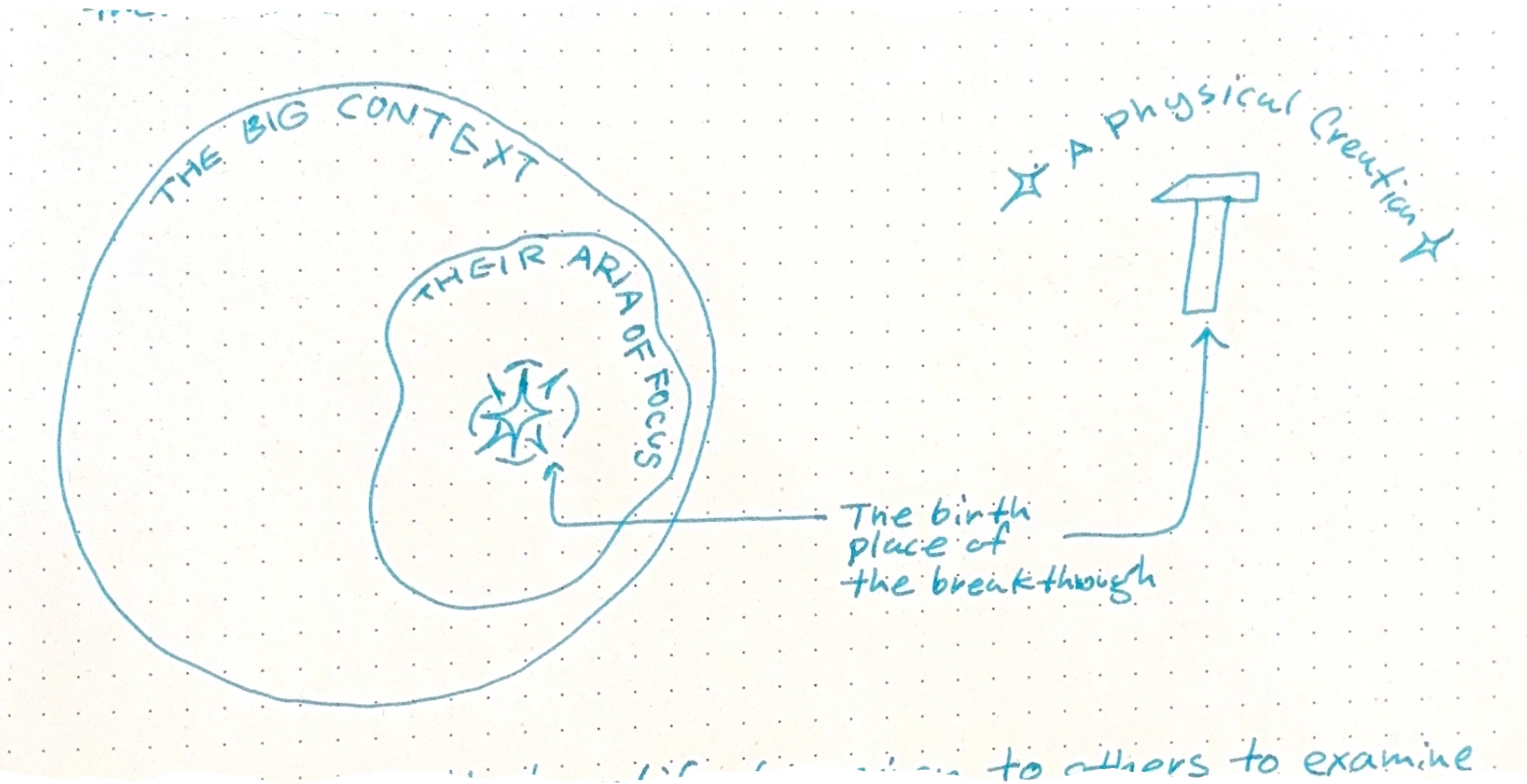
And yet, when that artifact is given to others to examine, the whole context is lost. So no longer does the artifact serve the context; but it becomes what it is in its essence. Basically freed from the context, it is now able to transform into an idea. And we explore ideas in all ways.