For the record, they are bombing bridges, train stations, oil refinement stations, and their president has said “a whole civilization will be wiped out of history tonight”. Not only people don’t seem to see this as war crime, we are still the world terrorists.
When I was young; I always got drawn to the question of the boundary of a human in the sci-fi movies. And the interesting part was how no one seemed to understand my problems.
Imagine one of these teleportation movies or series like Star Trek; in them; people + their tools and clothes are selected by a machine and teleported.
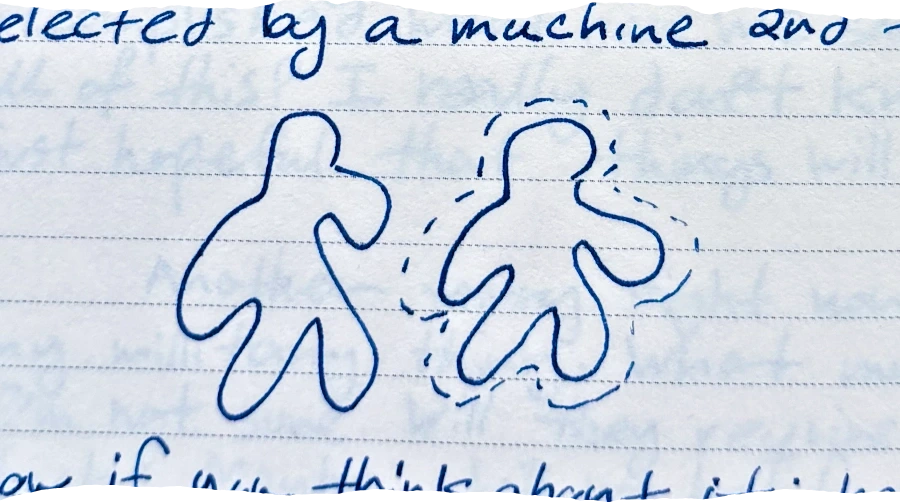
Now if you think about it; how does the system understand the clothes are something the human needs in its Teleportation? And if so; how does it even know what that human is? You may, like all people I know; say that it is obvious; but then; a human is a collection of cells; these cells have connected atoms and the atom is like the solar system:
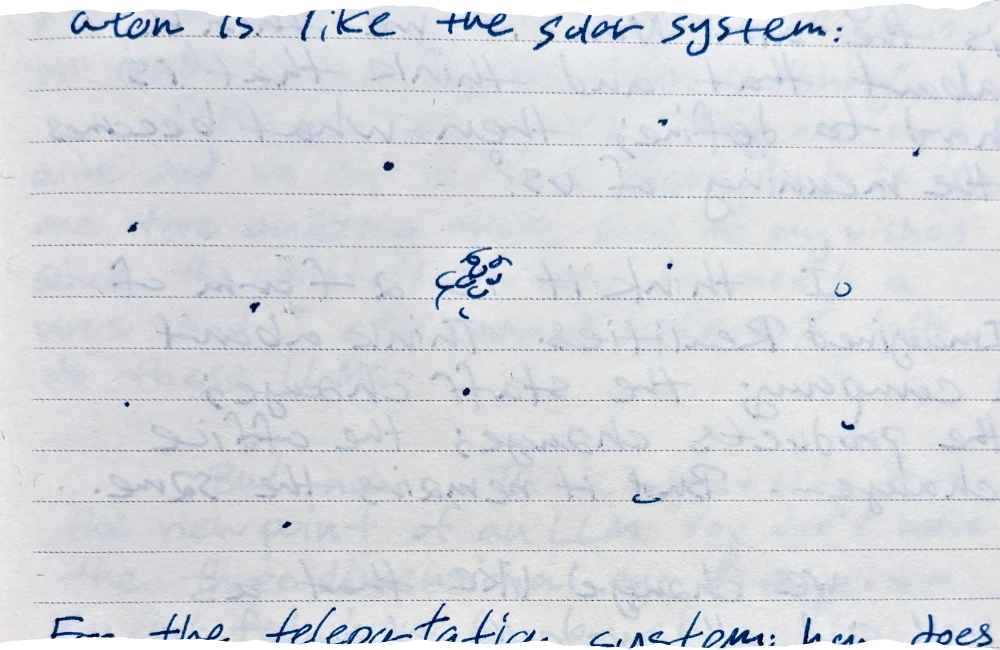
For the teleportation system: how does it know that the end of the atom is where? And if it does; think about the cells that are let go. We have cells that are hardly connected and so how do we know? It’s hard to say.
In some movies about the time travel and stuff the clothing of the person is moved with them through the time which is funny. But then if you think that is based on the latest image provided, here is the continued transcription following your instructions:
funny; how the rest of it is not? how does the system understand what electrons and protons and… belong to you; and what other is the air? Now if we think about that and think that is hard to define; then what becomes the meaning of us?
I think it is a form of Imagined Realities. Think about a company; the staff changes; the products change; the office change. But it remains the same.
we change like that as well and all our cells change as well too. How come we are not seen as imagined realities?
I’m still confused on how a teleportation system is going to detect the cells of a person?
“Jobs” represent a relatively recent pattern of work. From the fifteenth century to the twentieth century, there is a steady progress of fragmentation of the stages of work that constitute “mechanization” and “specialism.” These procedures cannot serve for survival or sanity in this new time.
Under conditions of electric circuitry, all the fragmented job patterns tend to blend once more into involving and demanding roles or forms of work that more and more resemble teaching, learning, and “human” service, in the older sense of dedicated loyalty.
There is a world of difference between the modern home environment of integrated electric information and the classroom. Today’s television child is attuned to up-to-the-minute “adult” news-inflation, rioting, war, taxes, crime, bathing beauties-and is bewildered when he enters the nineteenth-century environment that still characterizes the educational establishment where information is scarce but ordered and structured by fragmented, classified patterns, subjects, and schedules. It is naturally an environment much like any factory set-up with its inventories and assembly lines.
[…] Today’s child is growing up absurd, because he lives in two worlds, and neither of them inclines him to grow up. Growing up-that is our new work, and it is total. Mere instruction will not suffice.
We have now become aware of the possibility of arranging the entire human environment as a work of art, as a teaching machine designed to maximize perception and to make everyday learning a process of discovery. Application of this knowledge would be the equivalent of a thermostat controlling room temperature. It would seem only reasonable to extend such controls to all the sensory thresholds of our being. We have no reason to be grate-tul to those who juggle these thresholds in the name of haphazard innovation.
An astronomer looking through a 200-inch telescope exclaimed that it was going to rain. His assistant asked, “How can you tell?” “Because my corns hurt.”
Environments are not passive wrappings, but are, rather, active processes which are invisible. The groundrules, pervasive structure, and over-all patterns of environments elude easy perception. Anti-environments, or countersituations made by artists, provide means of direct attention and enable us to see and understand more clearly. The interplay between the old and the new environments creates many problems and confusions… The main obstacle to a clear understanding of the effects of the new media is our deeply embedded habit of regarding all phenomena from a fixed point of view. We speak, for instance, of “gaining perspective.” This psychological process derives unconsciously from print technology.
Print technology created the public. Electric technology created the mass. The public consists of separate individuals walking around with separate, fixed points of view. The new technology demands that we abandon the luxury of this posture, this fragmentary outlook.
The method of our time is to use not a single but multiple models for exploration-the technique of the suspended judgment is the discovery of the twentieth century as the technique of invention was the discovery of the nineteenth.