When I was young I had this wonderful problem in which I used to get all human expressions too literally, trust them; never question them; and simply question the world when it was not according to that idea. I surmise that it is tightly connected to the idea that I used to grow up in a scientific family and environment and my environment was LEGO: rules dictated the world and I had internalized everything about the brick world to a point in which I still draw people like minifigures and get attracted to designed objects with a near LEGO design philosophy.
I might have given previous examples to this problem when I had written that in a Sharif University program; this person had a talk on open source and free software ( I have no idea why I used open source first) and he was quoting @Stallman in how free software was required so that you could edit the software that you use. And so I began to think that maybe it is me that is an idiot if I cannot edit every software that I touch. And so to fix me being an idiot; I had to author all my software myself, and create all sorts of developer tools, and all sorts of languages to help me do what I otherwise could not have. Basically I had to be a little Maestro Engelbart and help myself boost and augment my IQ to be able to author all kinds of software just not to be an idiot to this person’s saying “Free Software means being able to author and edit all your software” without even thinking perhaps a little expertise in the domain is required or that this may happen few times during the whole careers of people.
There is another factor also; that I have little calibration with others and little understanding of what is normal and fair. And on the other hand I have been a failure whole my life. I have been a horrible student at school; a two-times university drop out; and my professional life is bounded with failures. My independent work “works”; they are there and they are working; yet; my work—after all of these years—has not even started.
You have no idea how hard it is to withstand this amount of pressure. When I speak about the most simple of my memories; others go nuts. I have gone way ahead of myself. Sorry.
Another of my innocent and ignorant ideas about the world was about replicability and standards. I guess that happens if you love LEGO; and IKEA: standard things that are mass produced. And I had the same vision applied to the rest of the world. I used to think about the idea of the “Genre” as soon as I started gathering music around 11 or so. My father was a huge music collector, and he had terabytes of music archived. I was raised with so much good music, but I had none myself. At around 10 or 11, my father gave me one of his — back then cutting edge — mp3 players; and so now the problem was what to put in it. I had one or two Beethovens and Chopins that I loved; but not much else.
Given that I expected to have a world of replicability; I used to wish to find more songs/pieces like some specific ones but then I could not find them. Say “Shoot the Moon” by “Norah Jones”. I could not find any song even in her repertoire that was anything like that one. It was strange for me. How is that possible? When talking about genres I thought “If we have X; in genre Y; there must be other Zs just like X” because that meant a genre. And I was so wrong. Not only there was nothing like Shoot the Moon; there is no one like Norah Jones.
The question simply extends to other things; for example I used to love Apple at the age of Steve Jobs , Jony Ive , Scott Forstall , and Cook. They were an amazing powerhouse of design, implementation; vision; and integrity. When Steve Jobs died I was thinking how can this be? What Apple will look like now? Surely there are others like him and Apple will be Apple. But it was not and Apple never became Apple; Just like Jony Ive never did anything he would do in the age of Steve Jobs . If this was true — which it was — then how could we have sustained the world that promised stability; sustainability; and replicability?
My idea of the world was like a big sitcom in the childhood; that world is like this and can be maintained like this; and each episode will feel like the previous. but then; it wasn’t like that at all. The world is not such a place. And I was shocked to learn that all things are once in the history.
I had expected the world to act like a ship of Theseus; each replacement of the parts to be untraceable. For ships to be identical. But it was not as such. We had an ever changing world. And I guess this pursuit to match the world with the idea of genre; and my inability to accept that if I see something in a photo; I will never be able to create an exact replica of it; that all people are truly unique, that all things are unique was when I began to speculate each person has a “ Mind Kernel ”, something in their head that generates their creations.
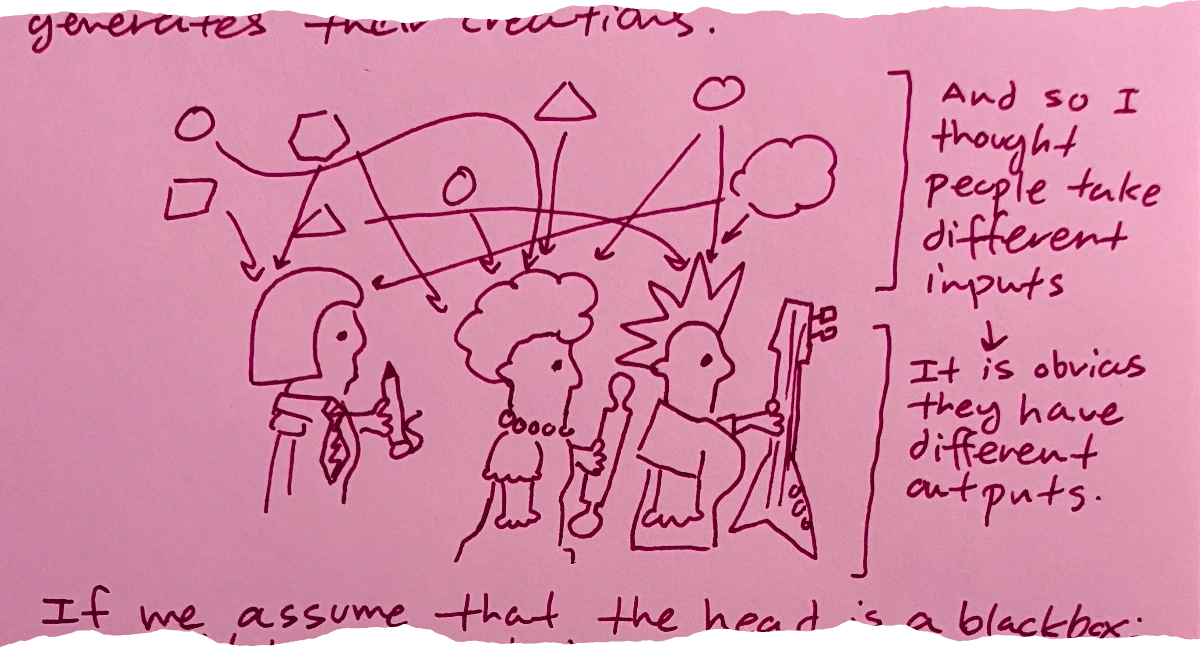
If we assume that the head is a black-box; then it becomes obvious that even if there be nothing random and nothing different in the brains of people. If all the brains be identical and deterministic; then given different lives that we have; all the inputs are different and so must be all the outputs. It is quite very simple.
And so I understood my pursuit of finding identical music, lamps, homes,… are impossible. But then; it became the foundation for the Mind Graph . These all took me two decades to un-spaghetti and understand; but now that I look back can be seen way simpler.
I was trying to understand creations and were reverse-engineering my way to bypass the problem of irreplacibility.
I guess pursuing this also stems from my trauma of death. Somewhere around the time I had lost Baba Ali , my grandpa; I began to get detached from life, and adopted this philosophical profile I use these days. Before that incident I had failed five times in the first term of my English class. I used to get into the very first course, fail, take it again for 4 months, fail, take it again… Until the institution told my parents it is kind of them to send me there but they are wasting their money. After that given all the humiliation I tried to learn English on my own and prove I am capable. Doing so I forced myself to think in English and that became a new part of me. Today I mostly think in English as if I am a commentator of my own life; or a distant observer. And I began wanting to have things that I could replace if they got broken. IKEA became a new love in my life. I used to buy things that were random. These days everything I have I know the company model; all the shops that sell them; and a huge reserve of backups if I can afford [ Also getting ahead of myself] and so the problem of replacing became on my own; the first rule of Pouya:
If others don’t make something for you; own the production line and make it for yourself.
When reverse-engineering things you start noticing something: Things; like LEGO are made of bricks. A pop song is mostly made of a guitar or two; some piano; drums; some synths; some backing strings; some known effects like a high pass or compression or something; these are known tools. And so:
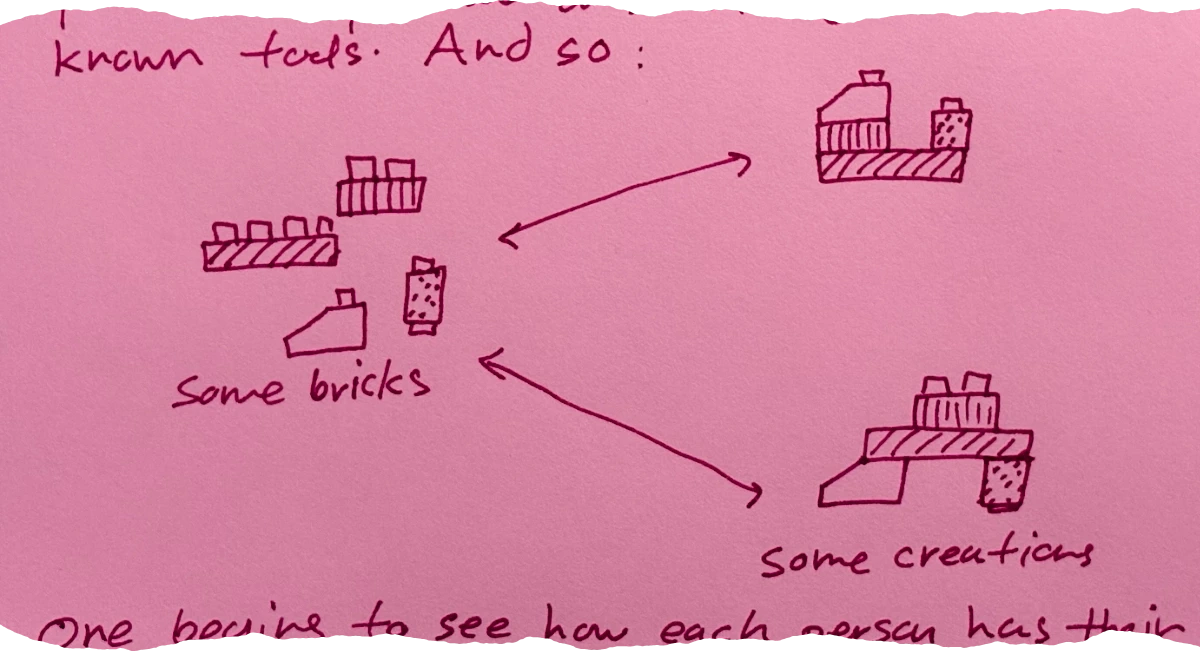
One begins to see how each person has their own tools and their combinations makes their unique creations. Why each person creates things that are like each other but not at all like the creations of others:
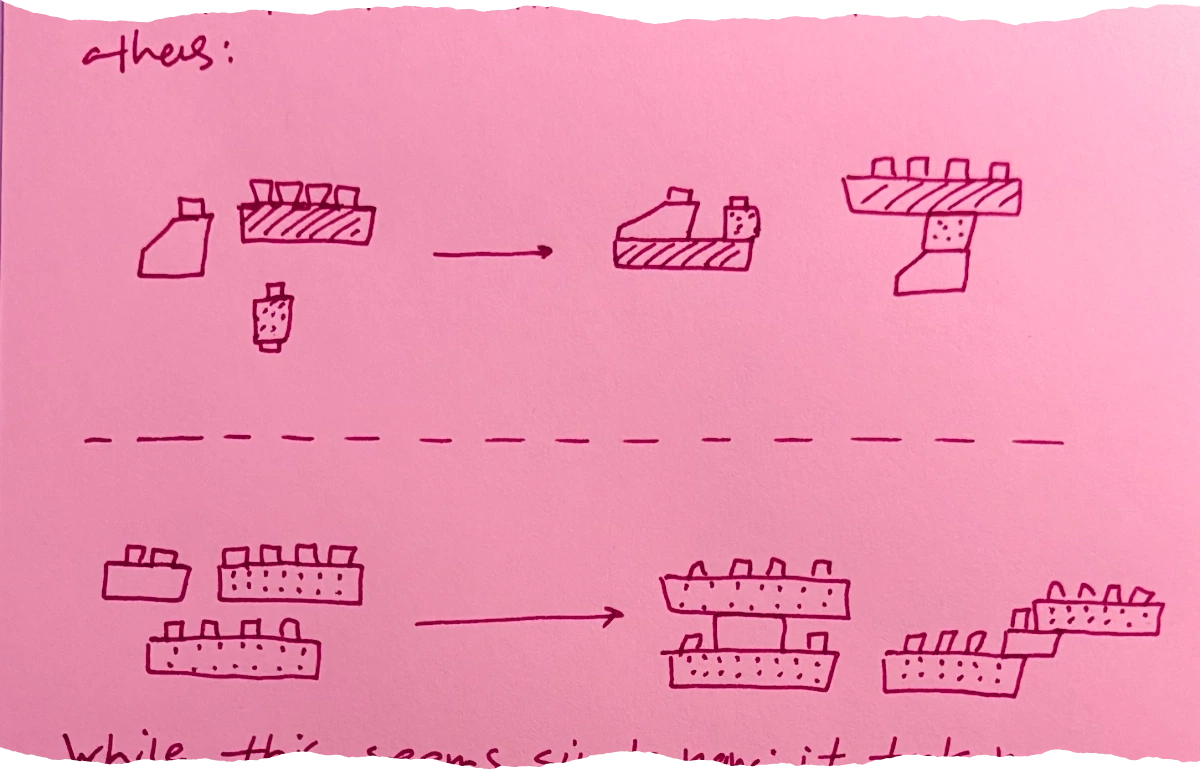
While this seems simple now; it took me years to study the works of musicians; composers; painters; architects; designers; writers; philosophers; inventors; researchers; and… to see that over and over the same pattern is there:
Creators have similar creations; and creators all have tools and techniques; and their creations cannot be more than the combinations of these.
And so it clicked someday that oh; it is all connected and it gave birth to the Toolbox Theory .
I have gone way ahead of myself. Sorry.
Another of my innocent and ignorant ideas about the world was about replicability and standards. I guess that happens if you love LEGO; and IKEA: standard things that are mass produced. And I had the same vision applied to the rest of the world. I used to think about the idea of the “Genre” as soon as I started gathering music around 11 or so. My father was a huge music collector, and he had terabytes of music archived. I was raised with so much good music, but I had none myself. At around 10 or 11, my father gave me one of his — back then cutting edge — mp3 players; and so now the problem was what to put in it. I had one or two Beethovens and Chopins that I loved; but not much else.
Given that I expected to have a world of replicability; I used to wish to find more songs/pieces like some specific ones but then I could not find them. Say “Shoot the Moon” by “Norah Jones”. I could not find any song even in her repertoire that was anything like that one. It was strange for me. How is that possible? When talking about genres I thought “If we have X; in genre Y; there must be other Zs just like X” because that meant a genre. And I was so wrong. Not only there was nothing like Shoot the Moon; there is no one like Norah Jones.
But this is all if you only think the Toolbox is limited to a few things. After some time walking through my adulthood and having conversations with others I understood how their lives have shaped them. There are these tiny elements you see here and there; my Mom loves bronze and brass; she is in love with cowbells and old locks; both of which have their best versions in brass. These are not the main themes of her life; she talks about them each five years or so. But I know she loves them and puts them in things she makes and gets so excited when she sees them.
My Dad loves clean and precise cuts of metal sheets. While I love Kaweco and TWSBI fountain pens for their beautiful plastics; warm feelings; LEGO like natures; my father loves Parker and LAMY for their Bauhaus design styles and the feeling of metal. He loves minimal steel and glass designed things. When he buys something this hidden bias that he has never talked about is quite visible.
The mental toolboxes of people are way bigger and complex than what you see in the professional techniques and tools. That is why there are no two Norah Joneses.