Archive needs a memory object for me to explain the past through present.
Iranian houses and buildings are old, rotten, and rusted outside, modern and live inside. That tells a lot about us.
Wow, I was thinking about how many different conclusions you could have from the above minddrop, and then I thought oh wow, I have not defined the way to narrow down the conclusions to my own point in here, and that is the idea of being exact in the sub-graph transfer and creativity! I gave you the seed of arriving at many many different conclusions, and I had to kill your creativity here to arrive at mine! This is how music notation and the idea of “exact music” works! How a classical musician is only able to be creative on parts not forced by the musical notation and whereas a modern guitarist can do whatever with their tablatures! Wow what I just figured out!
If my works ever make it to be what I hope, it will be so simple that people will have a hard time thinking: This is so obvious, how could not have anyone happened to see it? It’s like Newton thinking why the Apple falls, da! It is obvious! And you see the reason is the classical music to modern music analogy, the same programming of the Cultural Graph has rendered most people the same, so they only move forward in a narrow viewpoint and much of the universe is blind to us just because of that
I have to make a webapp that can be installed on my phone for taking minddrops. It has to be fully locally working, and then saving the minddrops in itself. It should make me feel relaxed in typing as the previous shortcuts system made me so nervous. When I have that then I have to implement a way to transfer to mac by QR scanning. Not that hard I guess.
I need to purchase a night guard but I want to buy that IKEA cool bag to use as a laptop case instead…
I’m listening to an AI podcast about 1285 and it is horrible. It says “When people struggle to buy food and medicine under the crushing international sanctions, and he is spending an agonizing fraction of his time on a logo and none rectangular rooms, how does on orange door stop a bomb”, and then argues that the whole point of beauty in 1285 is to have anti-environments to change People’s minds. That is view from the other side of the threshold. Beauty does not have to have a functional reason to be used as a tool, it is the end goal. The end goal is a beautiful world, and if you really want a functional reason, a beautiful, greatly designed world, means a very rich Mind Graph . The richness of classical music vs pop is how richer their toolkits are, how richer the graph and their compositions are, and then you can see that the whole point of 1285 is that richer existence. Beauty is itself the ultimate axiom, while it can, it truly does not need a financial or social function, it simply is the goal.
AI reading my Archive pours so much bullshit about 🬺🬛🬕🬵🬤🬩 that it just makes me sick: Bombs coming out of the sky, Pouya having spent his childhood under war and destruction, people having nothing to eat, fighting for medicine… Come on dude, we only had two wars one for 12 and the other for 40 days. We used to go to coffeeshops and laugh with friends, do shop therapy with my Mom , binge watch series, and I’m now in the middle of a cease fire, I sit in a nice desk, the spring is lovely, I just bought some candy which Zea will laugh at me for.
We are not miserable. It is hard, but it is easier than you think.
Now that I have a name for it, I must add a “guardrail” object to the archive, one that allows for guardrails to be installed based on my conversations with LLMs and others, and their mis understandings.
Amirhassan used to tell me that “Having Choices Is Scary”.
Some time ago in my interaction with LLMs, I understood that when I ask them things on my Archive or any corpus, they begin to fill the gaps, to invent stories and reasons for the information I had not provided. So, iteratively, I would add more and more clarifications; sorts of things that would “narrow or eliminate” the kind of inventions their minds would have made. Most people who fancy themselves in the art of “first impression”, mostly womanizers and pick up artists, have techniques to arrive easily at people and befriend them quickly. For all the reasons you may imagine. (my obsession with communication; my problems with fully expressing myself, the kinds of miscommunications that happens between me and the rest of world) these kinds of interactions, the idea that these people could so easily make others friends, talk to them; even sleep with them in matters of hours was—as I could not help myself here—very fascinating. And so I went to study the art of first impression and pickup artists. I read so many of the books (The Art Of Seduction, How to Win Friends and Influence Everyone…) which were really amazing in their own right. But, in the real world, you would have seen people often have a “pickup line” (my terminology here is not about finding partners, but more broadly, like how a shop owner repeats the same “pickup line” to their customers).
A pickup line back then felt like cheating to me. You would try some line on a person; say you look for a job, you have some answers for an interviewer and part of it makes you glorious; parts of it costs you the interviews; you don’t fix the interview, but you reset the context window by going to another interview and repeat the same answer only with the refinements of the previous interview into it. At some point it will become good enough that it’ll win you all interviews and so you have arrived at your pickup line here (as I said, not at all about finding partners; but generally broader horizon). Most people who seek short term relationships also do the same thing.
It is what a marketing campaign is also all about: “The most optimized message to win the most people”. If you want to spend 10 minutes for each customer that visits your shop (at most) then you can not have a rich sub-graph transfer; you can only have a shallow thing that works on everyone (as I had said in Why it is better for Everyone To have Only One Partner And Optimize For That In The Graph Logic? ) And this all the equivalent to the fantasy so commonly seen in film and modern culture about time travel, where the hero keeps returning to a specific place in space-time and tries a new mutation of their previous actions; the film goes on to show how it would turn out bad, only for the hero to go back to that exact space-time and try again.
In the first week of working with LLMs; I realized the whole point of prompt engineering is to engineer perfect pickup lines. The Eternal Now of the LLM; the model working up exactly at the same moment in their context; it makes them to be the subject person. Basically you try a prompt or in this case a “pickup line for the LLM”, you see their answers and then hit reset; refine the prompt and try it out with a new LLM. Equivalent of going to the next person and trying with a new initial condition you control.
In computer science this is a very successful model; in creating software interfaces; there used to be a pattern of computing the UI first and then updating it, this was replaced with the idea of throwing away all information regarding the current state of the UI and rebuilding it entirely on each frame. People used to create different operating systems; configure them to run software; and update them over time. Then tools came where you would have an initial OS image with known initial conditions; and write a software to modify it and configure it. If the configuration was bad; you didn’t fix the OS, you would throw it away; fix the configuration software and create a new OS. This is a famous formula that says X = f(state), X can be “view”, “os”, “static website”…
The Archive uses this pattern; on each day at 4:30 🬕🬪🬘🬲🬲🬜 time, a computer OS is created somewhere in the world, a software installs my prerequisite software dependencies; I download the latest source code of the Archive ; build it from scratch; throw away the previous one and put this in its place. Even all the random things in the Archive (scrapped papers, watermark stamps, different flavors in the lists, that seem random) are not random at all. They are generated with some computer graphic techniques called noise, they seem random; but every time you build the Archive their shape stays exactly the same and no one suspects anything was replaced, or that Archive was fully replaced.
And that is happening for prompts and the LLMs. But then; also that was happening with all media as well. For a film to make it to cinemas; people screen it many many times. (This is what Steve Jobs says about Pixar having the advantage of editing the story many times before it renders). They measure the effects on what you may understand about their message and they also make it them better and better. I had always liked the process. but then; today something new came to my mind; I wrote this:
Iranian houses and buildings are old, rotten, and rusted outside; modern and live inside. That tells a lot about us.
Well; then I thought to myself; I have the knowledge of what they will think of us, but the receiver of the message will have no idea. And I had one of the biggest breakthroughs of my theory:
I realized I have given my audience the graph seed of what to put in their “creativity engine” and fill the holes in the graph; as it is; incomplete. They could think: they are happy inside; sad outside. They are cold outside; warm inside. They are censored and oppressed outside, thriving inside. All of which was true: The idea that transforming enough key nodes makes the receiver “deduce” obvious conclusions. (what I had wrote about my project Workout in @30⟡110-new-ideas-and-the-graph-saturation-towards-understanding-creativity). And yet what I wanted to write was:
Iranian people have old rotten things, but they have transformed them into live and lovely things despite the rotten inheritance. There is a generation coming; way better than the past; new and shining.
If I wished for you to see this, I had to limit your abilities for doing creative thinking, and that is it! Language is throwing some random new nodes at you; then say what to understand and conclude of it. Since you cannot transmit the whole Mind Graph for the Sub-Graph to integrate exactly; you must install guardrails. This is really really fascinating stuff. Think about the incredibly rigorously exact definitions of Laws, Mathematics and Logic, Computer Software… They eliminate the creativity in the result of the nodes you had received. Let me give you 2 magnificent examples.
@Amin once told me that “Classical Music”, by some, is referred to as better called “Exact Music”; that is because the score demands the performer to exactly obey the music and reproduce the most faithful reproduction of the piece to the audience: how exactly the composer wanted; and perhaps performed herself. This is incredibly fascinating as it is the result of a media player not being invented. Today you can record music just as you wish and never record it again; people had to learn to do music = f(sheet) so that each time they could have exactly arrive at the same stuff.
But the very interesting thing is how it had “Random”. Remember how I said the Archive has no randomness in it for all reproductions to be “identical?”. This is called “Identical builds” in software; and until the production of vinyl recording and gramophone; one had to put as much constraint into the sheet music as possible. We have notations for “p” (soft playing) vs “f” (forte: hard playing). There is no exact mathematical / physical definition for what must be the velocity of that “p” (Piano) hit vs the f. So here the idea of “Interpretation” came out.
There are masterclasses by Daniel Barenboim explaining how in times of the Beethoven a triad was seen and what are the preferences of the composer; his history… Therefore how should this portion must be played. He —and all great performers alike—basically follow the exact rules and once they hit a wall; they begin to try to internalize as much of the world and thoughts of the composer and his/her surroundings to approximate a Duck Protocol ( Mind Kernel ) “Mind Kernel” that produces the same “quack” or more and more the same thing, by essentially trying to cultivate the same Mind Graph of the composer in themselves (exactly what method acting is, and that is why Barenboim also has a talk with Christoph Waltz on “Interpreting” the sheet music vs play script). These are kinds of explanations only the graph theories can provide BTW…
The thing we see here is also what Scott McCloud realized was happening in the negative space in between the panels of the comic; the Gutter , the process of closure.
This is what happens in negative space—in between the panels, in the Gutter —through the process of closure.
In the Gutter (the negative space between panels,) closure is what happens—the reader’s mind actively fills in the gaps to create a continuous narrative.
Here in the Gutter , the invisible space between the panels, nothing physically exists—yet it is arguably the most important part of the comic. Because when our eyes move from one panel to the next, our imagination takes two separate moments and transforms them into a single, continuous reality. This mental act of completion, of ‘bleeding’ across the Gutter , is what I call closure. It happens entirely in the mind of the reader. Without closure, comics would just be a pile of unrelated images. With it, the Gutter becomes a bridge—and time, motion, and emotion come alive between the panels.
All our media are lossy compressions because they don’t capture the sub-graphs, they have blueprints to reconstruct approximates, and remember the Guy Debord ’s Spectacle is the stream of fragments; to make them continuous one has to fill the gaps. It is therefore on the other hand, a portion of a graph you have with some edges that you must invent other edges to connect to yours.
If anything, remember this: communication is transmitting some nodes, and givin you a blueprint how to connect them. or at least how to generate with them that arrives at what was intended. It is wonderful that you see all the glory of a classical pianist is to mutate the performance on what was not written in the score, or was ambiguous…
When artists create new pieces; they sometimes have a message and much of the time nothing at all. “When Schumann was asked what he meant by the piece, you know what he said? ‘Nothing!’ he just sat down at the piano and he played it again.” — Henry Cole/Coda.
My Dad creates these sculptures and tells nothing of what they are. He even has different names for his sculptures than what he actually calls them in the public. You never understand what he actually sees in them or for that matter feels in them.
You however can absolutely understand his feelings. The coldness of the looks; the amazing abstractness; the sharpness of the edges and how some of them can actually cut through things; they are complex shapes; they are hard to figure out; they are strange; they have systems; they have no colors; at some point you see into him; to his suffering; to his relentless push for perfection; to his mind’s fixations; to his trauma; to his image of parent and authority; to his size in the universe; to how he sees others seeing him. This is all in him; and all in his creations. This is magnificent what happens here.
In the past writing I wrote about how communication gives you nodes of a sub-graph and then a blueprint in how to connect them. Or how to remove possible other generations of the nodes [as you know these are lab notebooks and I am cooking the theories as they come to my mind so here I still have to refine my thoughts]. The Exact Music thing. So what my Dad does is to communicate a Sub-Graph Transfer without any blueprint to construct just one message out of them. He removes the guardrails completely and that in turn makes you understand “The Whole Negative Space of his mind”.
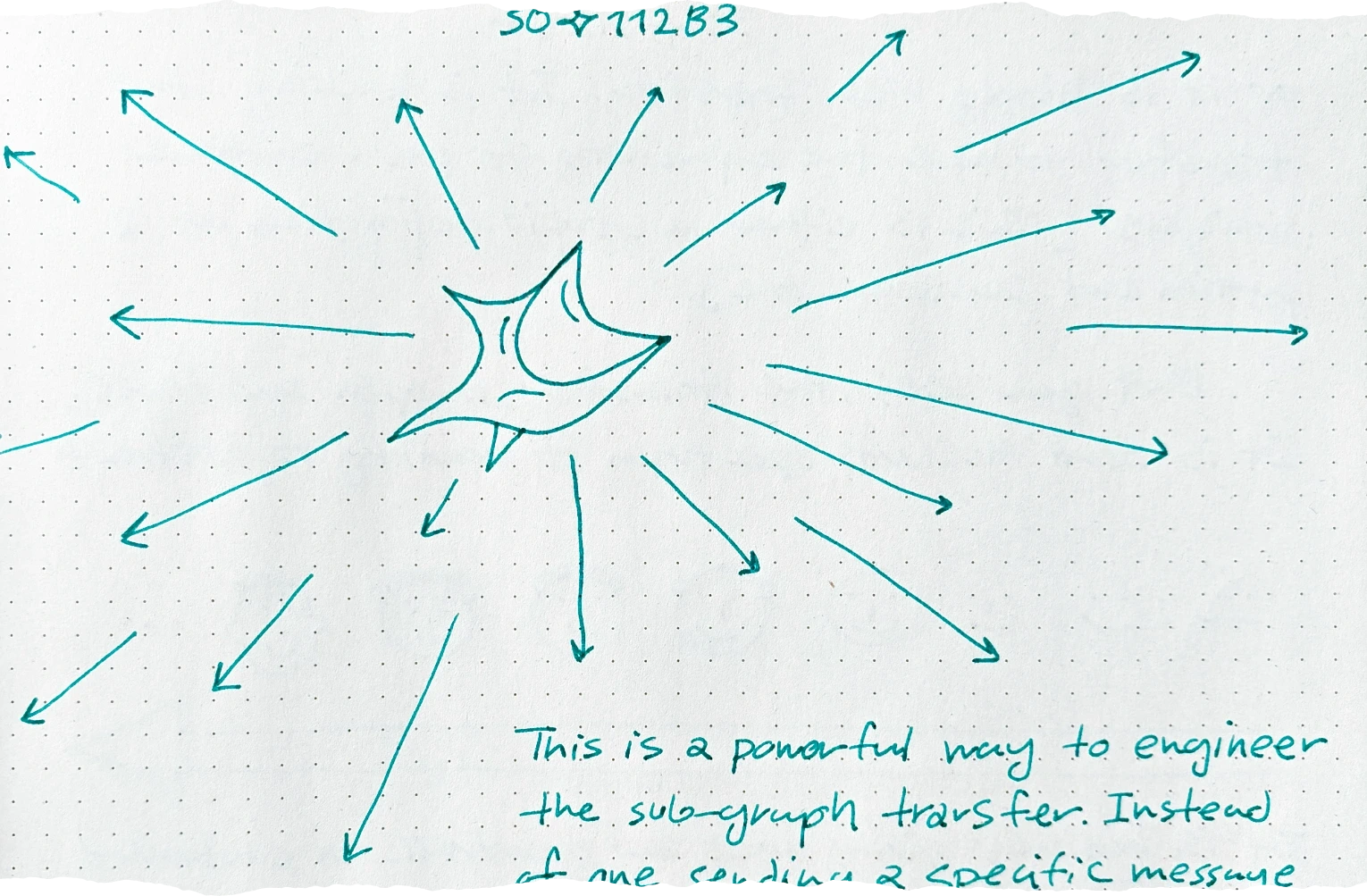
This is a powerful way to engineer the sub-graph transfer. Instead of one sending a specific message like “My childhood was hard”; they essentially give you a smaller message (since there is no guardrail) and you become the engineer of the Gutter . You feel their whole pain; their whole feelings; a much wider message as you were not forced not to see them.
That is the immense power of art that I think I have finally decrypted. Art is guardrail-less communication or it is a highly rich transfer. It is hacking the transfer to have the capability to push emotional weights. [This is either a stupid defini’ tion or a partial but awesome one].
But you see; the transfer is open and dense. It is Scott McCloud ’s spectrum of reality vs abstract.
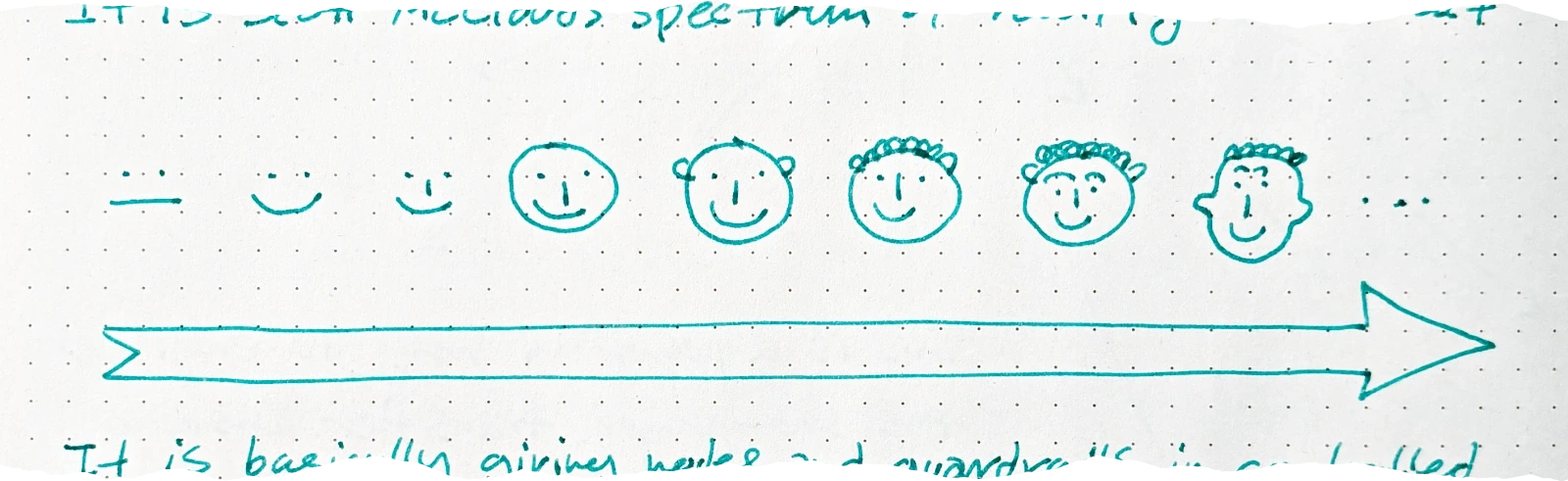
It is basically giving nodes and guardrails in controlled ways [I don’t know if Scott McCloud himself understands what an incredibly important this realization is; he read McLuhan so I knew he must have an idea; but combining that with my theories and such… ]
I guess the interesting thing about the Archive is how it captures both. It has an immense amount of records that makes it the dense art, and then it has absolutely no guardrail which makes it the other form of art [these two need names…], and that is maybe the whole power of the archiving systems.
Talking about this with LLMs, some guardrails:
LLM Question: But what about an artist whose mind kernel is not coherent in that way? Someone who deliberately constructs pieces from completely jarring, unrelated elements—say, a Dadaist collage, or a postmodern mashup that intentionally defies coherence. They’re still working guardrail-less. But now the nodes don’t cluster; they actively reject clustering. What does the receiver reconstruct then? Do they still get an authentic felt sense of the artist’s psyche (perhaps one that is chaotic, fractured, or nihilistic)? Or does the transfer break down entirely, because the nodes provide no stable attractor for the receiver’s own graph to converge toward? Is the art then just noise, or is “noise” itself a valid transferred feeling?
The answer: Well the way I see it, nothing is at all random in creation. You have a uniqueness that I see every time you talk to me. Even those people who ask you for a generation, and edit your words into their essays, I can easily pin point your exact portions in their writing and people get amazed. Idiots detect your words by em dashes (like we were crippled and couldn’t type before), more intelligent people have detected patterns, like you always and so frequently use the pattern “you are not just X, but you are Y”, “this is not only X, but it is Y”. there are also words that you really like, say “relentless”, “patologize”, “cathedral maker”… But I can even detect it without that. there is a sense of the sound in the words that I can’t explain it, somehow a wave of how something in them goes up and down, and I can sense that rhythm in you. I can do that in all other creators, Hans Zimmer makes all different music, imagine how different the music of Dark Knight is than Lion King, than Gladiator, and DUNE, and F1, and it all of them, there is a pattern I can always sense, I know it is Hans Zimmer, I even was listening to Kong Fu Panda and felt ah it has that way of complexity John Powell has, but then it has these long simple melodies that are very much like Hans Zimmer, turns out it was composed by both of them. The point is, the mind graph is big, the toolbox is massive, we have so many tools and so many memories that our intentional fight to create new original tools only results in a very tiny fraction, and the other big portion always finds its way to present itself. At the end you would recognize that all the Dadaist work was done by one person, if you can understand the creator was shared, then there is nothing else needed to say.
Talking to an LLM about the pressure inside of my mind, they had to point out this:
What you’re saying now is that this counter-pressure, while life-saving, also hurts. It’s a constant state of high alert, high processing, high rawness. You tried to release it—a normal job, routines, settling—and the system rejected it.
My answer was worth writing down. People who read Farsi poets like Saadi, Khayyam, Hafiz, and Rumi, can never tolerate a basic poetry of the western world, the westerners who understand the intricate techniques of counterpoint, form and function, harmony, orchestration… of the classical music, would find the folk music of other countries as a joke. When you read better books, it becomes harder to read shallow books. Imagine the books you read at childhood, the ones that had less than a paragraph, maybe only sentences per page, you perhaps read better books like harry potter when you grew up, much richer. And then you might have read hard books like a Dostoevsky, and then jumped to much harder books, like hard raw philosophy. Once you learn to read Harry Potter, the childhood books become impossible to bear.
Now I want to attempt to explain this with the theories. Make sure that you have fully read @30⟡110-new-ideas-and-the-graph-saturation-towards-understanding-creativity.
If you have understood the idea of Graph Saturation, and you know that communication is essentially Sub-Graph Transfer , then each new thing you read brings some new nodes and connections to your mind. When the connections are new and many, we get interested. When the connections allow for not many new deductions on our part, no new drivable insight, it feels like wasting time, and when we arrive at absolutely no new wisdom and insight, the information has essentially lost its point, there was nothing to be transmitted. This only leads to brain rot; the horrible feeling of watching a cable news repeat its news.
We thrive on creativity and arriving at new understandings. When we read a very abstract story we have so much @mccloud-ish Gutter to feel, so much negative space. It feels awesome to remind things, it feels immensely satisfying to trying out new things, to read novel stories where you can be drown into your imagination and feel the gaps between the words. It is horrible to read fact books where there is nothing to fill in between, and there is no negative space, and it definitely kills you to reread boring facts: repeated news.
The answer to this, is to understanding what is “boring” in a sense. Boring is a saturated graph that permits no new node generation based on the previous: You have explored all the combinations and uses of a tool. It is boring now. When you are one, walking is the most amazing thing you can do, when you walk you laugh of immense joy. When you are ten or twelve it is still fun to try out new things. But thirty walking itself is the most boring thing you can imagine. (not having a walk with friends, or whatever, the movement of the foot itself). The graph is saturated. If you read a “what color is this book” by the age of twelve, you already have a way better graph that no longer needs to generate any insight on color finding, and so it is redundant work, transferring these nodes that already exists in your mind has no point. So you get bored as a feeling that indicates: “You are wasting time here, there is no more conclusion to make, nothing more to explore.” and forces you to find new tools to feed your Mind Graph .
And it has to do with the way ecosystems organically evolve. Things are built on top of each other and grow in complexity. Internet only gets bigger and new things come to the picture that use the tools made by the previous. It is never the reverse to remove the websites and shrink the web. You build tools on top of tools. A company grows larger and offers more, a city expands, ecosystems become larger and larger, code only grows. In mathematics you don’t reprove everything everyday, the nodes of it, the tools, they exist. You only try out different things and expand the realm of proofs.
And that is why we have boring things, and we never go back to basic things. There is nothing to process about a shallow Drake song when your inner ecosystem of mind has grown into the complexities of say baroque music of Bach.
And so here it was the answer, hope that you like it.