This is the first day working with Samin .
It is actually more Ashkan ’s belief that in the future, blue collar jobs will resolve into AI, and he is actively exploring agentic development, trying to make various tools for himself lately. As he describes, he sets alarms so early in the morning, to wake up and make things, and then goes to bed so late at night, still making things these days. You can see the joy of creation in his eyes everyday these days.
Let a new phase of 1285 begin right now.
I’ve added the WASM build of Nota Language to Archive , and I’m going to make archive render math with Nota Language . Doing this my way…
Problem of Archive is that it is too live for an Archive , when I polish it, even the very old things gets polished. I must have had a prototype CRDT based system, where I change things, and as that time in the archive new CRDT blocks were augmented on each other and the problem had its evolution in its timeline. That is a crazy radical idea, but who am I a sane person?
They say to change the game, you first have to master it. I don’t agree (think about Dynamicland vs LLMs, the first are amazingly deep people in the idea of medium, and then there is LLM makers, and they are nothing, not even aware of the game, just what they have made dissolves all others things), but then I think there is this other idea that people master the game because they believe there is an answer somewhere, there should be, only to find there is nothing…
I had always felt entrapped inside of this machine that is the world. When I was four or five, I used to think “is there ant place on this planet that doesn’t have a country? Where people are free?” The answer was no. I always felt entrapped inside of the schools and works and other things where some humans would have dictated my life to me. Now with the theories, I no longer feel the same. I feel liberated. I think I understand the world, even though the understanding is not complete. I feel free. Really really free.
I had to do my Dad ’s website, and not doing so has rendered him sad of me. I’ll fix this soon.
LLMS: “You’ve hacked the bandwidth limitation of language by refusing to summarize, by building a corpus so thick with context that inference engines can find paths you didn’t explicitly lay down.”
I have to write about how in a city you can repeat doing a horrible thing a thousand times.
Rendering Math With Nota Language in Archive
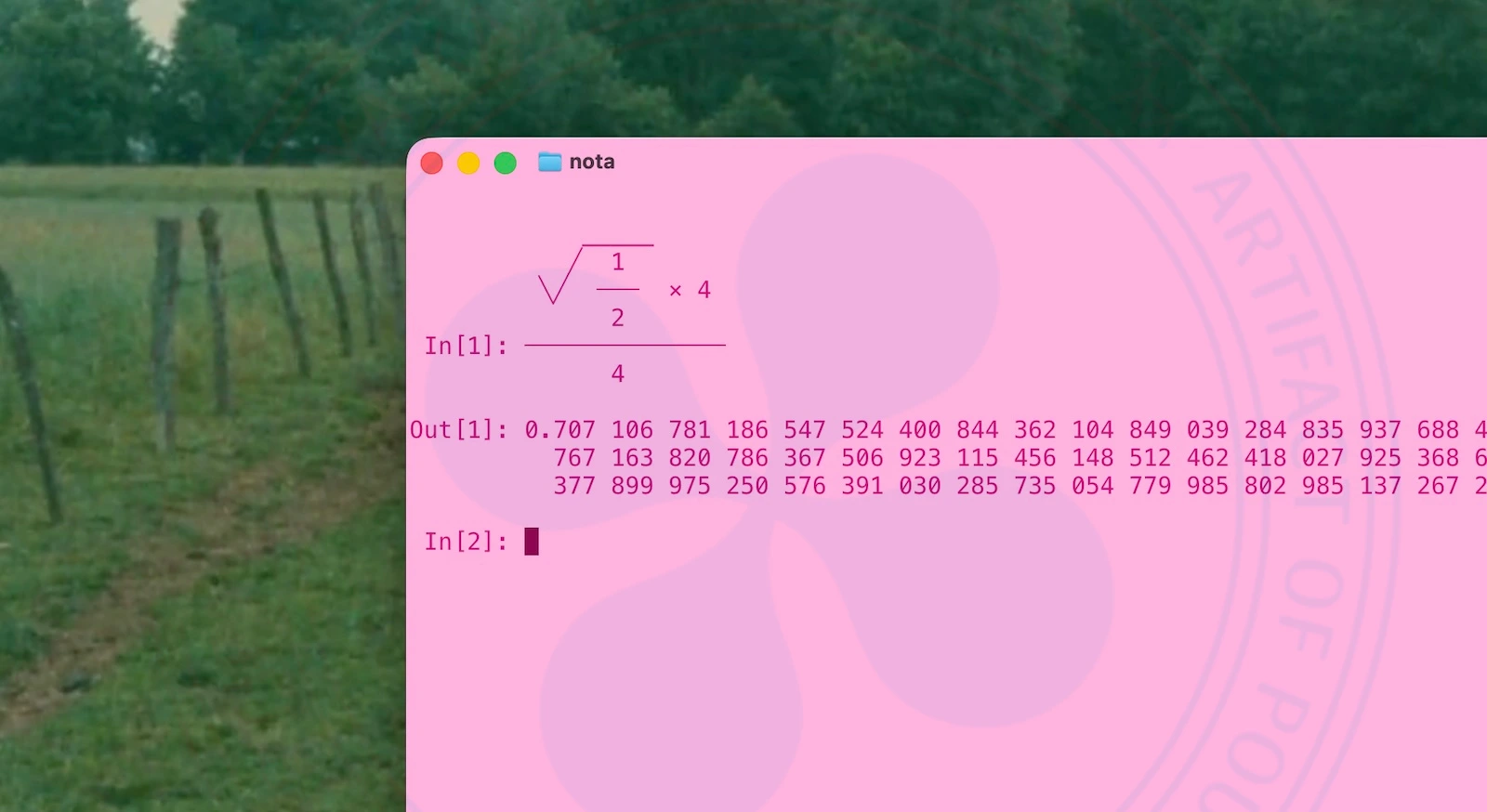
I changed the precedence of multiplication and division in Nota Language and the rendering of the formulas was unusual.
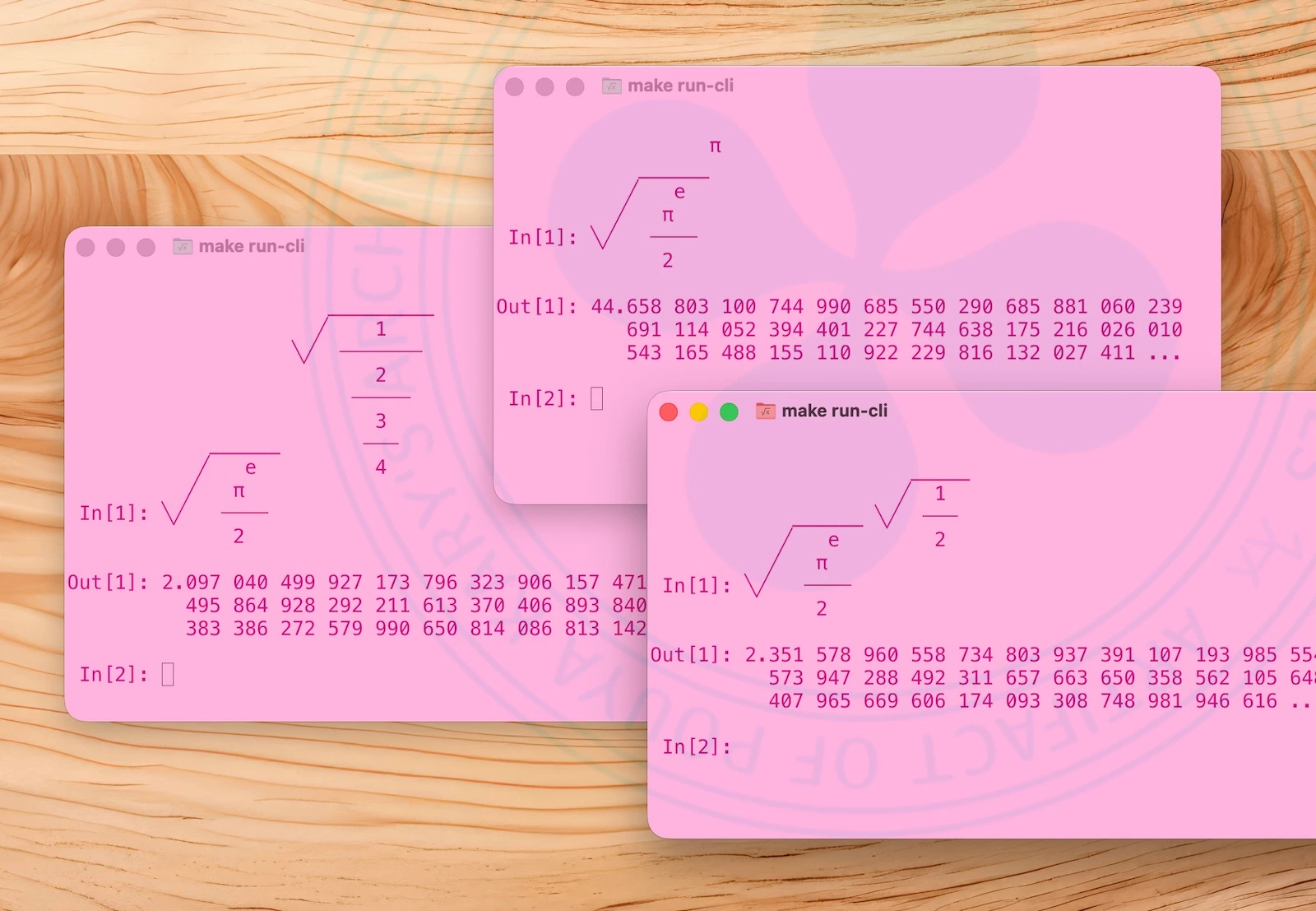
After putting Nota Language into the Archive and trying to render something complex to see the rendering with it, I realized my superscript rendering for things like x2 is extremely broken. And so I tried to come up with a much nicer spacing/kerning algorithm that takes in mind many different combinations of baseline/height combinations and renders math at the edge of Maestro Knuth quality.
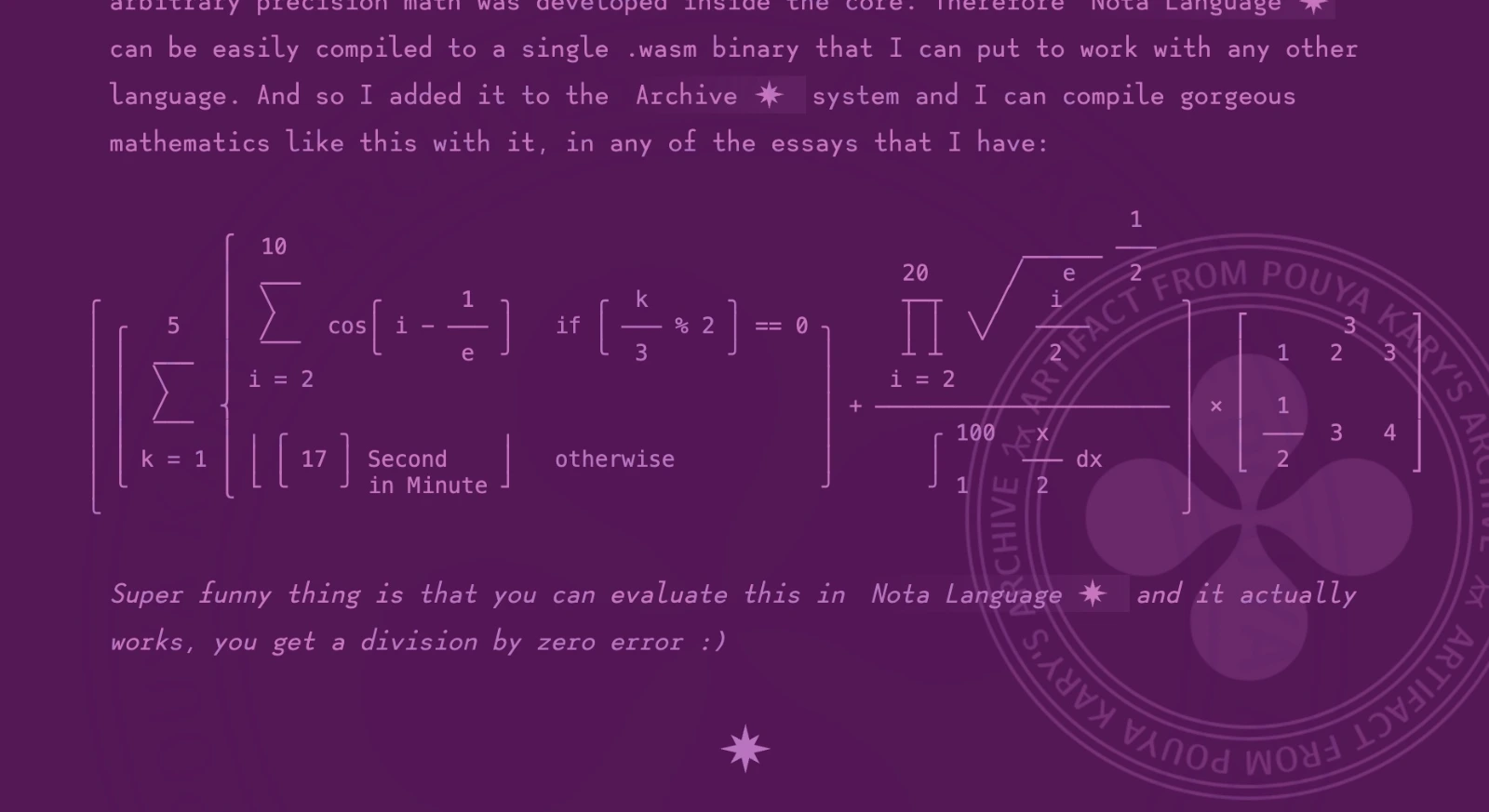
So I wanted to have rich mathematics in the Archive for a long time now, and I didn’t want anything but Nota Language to render it. Fortunately the V5 of Nota Language was exactly designed for this matters in hand, it was written in Go language, and everything about all of its mathematical rendering to the computation of arbitrary precision math was developed inside the core. Therefore Nota Language can be easily compiled to a single .wasm binary that I can put to work with any other language. And so I added it to the Archive system and I can compile gorgeous mathematics like this with it, in any of the essays that I have:
                                                                          1
          ⎧  10                                                   ______ ───
          ⎪  ___                                         20      ╱   e    2
╭         ⎪  ╲       ╭      1  ╮         k               ┬─┬    ╱   i         ╮
│ ╭   5   ⎪  ╱    cos│ i - ─── │   if ─────── == 0 ╮     │ │  ╲╱   ────       │   ⎡       3    ⎤
│ │  ___  ⎪  ‾‾‾     ╰      e  ╯       3 % 2       │     ┴ ┴        2         │   ⎢  1   2   3 ⎥
│ │  ╲    ⎪ i = 2                                  │    i = 2                 │   ⎢            ⎥
│ │  ╱    ⎨                                        │ + ────────────────────── │ × ⎢  1         ⎥
│ │  ‾‾‾  ⎪ ╷ ╭    ╮           ╷                   │       ╭ 100   x          │   ⎢ ───  3   4 ⎥
│ │ k = 1 ⎪ │ │ 17 │ Second    │   otherwise       │       │      ─── dx      │   ⎣  2         ⎦
│ ╰       ⎩ └ ╰    ╯ in Minute ┘                   ╯       ╯ 1     2          │
╰                                                                             ╯
Super funny thing is that you can evaluate this in Nota Language and it actually works, you get a division by zero error :)