When I was a kid, all my best friends were always children of divorce, and stupid me was always having this question “why”?.
I just woke up from having fallen asleep, went to my parents, as always my mom was talking so loud that I got headaches. And I always get this thinking why they kept telling me to talk with a low voice when they themselves are talking like this.
Then things between them got tension, and I went to my room hearing them fighting. I started blaming myself for having a bad energy in my looks, to having exported something bad. And then I remembered my friends who are children of the divorce. Why should I have remembered that?
Why should I be so angry all the time. I have put my anger towards working and changing things, and that is totally unnecessary. I always felt why am I so angry all the time? I guess these connections that I’m remembering are the answers.
What a strange world.
There is this thread of thought that is hanging in my mind for a whole extended time over the past decades, and that is the whole point of greatness vs mediocrity. We care deeply about the perfection in our world. [I have been deeply interrupted right now.]
What is a good fountain pen? It is one that has a great nib; good feed; nice weight; beautiful design; ink capacity that lasts a good while. The better ones have things like air-tight caps that guarantee they will last, but if you think about them; all of them have the same structure. A Dollar 717i is a perfect pen. It has a plastic feed; that makes it cheap; hard to break; and great with bad ink. It has only a medium nib; it leaks ink badly; it has a great piston filler mechanism for the body. It is great for the use of putting great writing into the hands of everyone. But then you also have things like a great Kaweco or LAMY pen. They have solved the problem of leaking; they have much better caps; they have nicer looks; more consistent inks. The structure is almost identical. But the execution is way different in the details.
If you take things like the nib for example. You can start with the Dollar 717i; it works; but then you have Platinum or Pilot’s Preppy and Kakuno; they are way better; they have more precision; they are not something like a LAMY or a Kaweco. These are much nicer; the ink flow is a lot more consistent. And then you have TWSBI and Esterbrook; the ink is a lot more wet yet very concise. You can go way up to premium Pilot / Platinum nibs; to things like Pelikan Souveran or a Montblanc 146/149. Again; the structures are the same; but the details vary. Not if you look closely you see an amazing pattern. One that is way more interesting than one previously expects it to be.
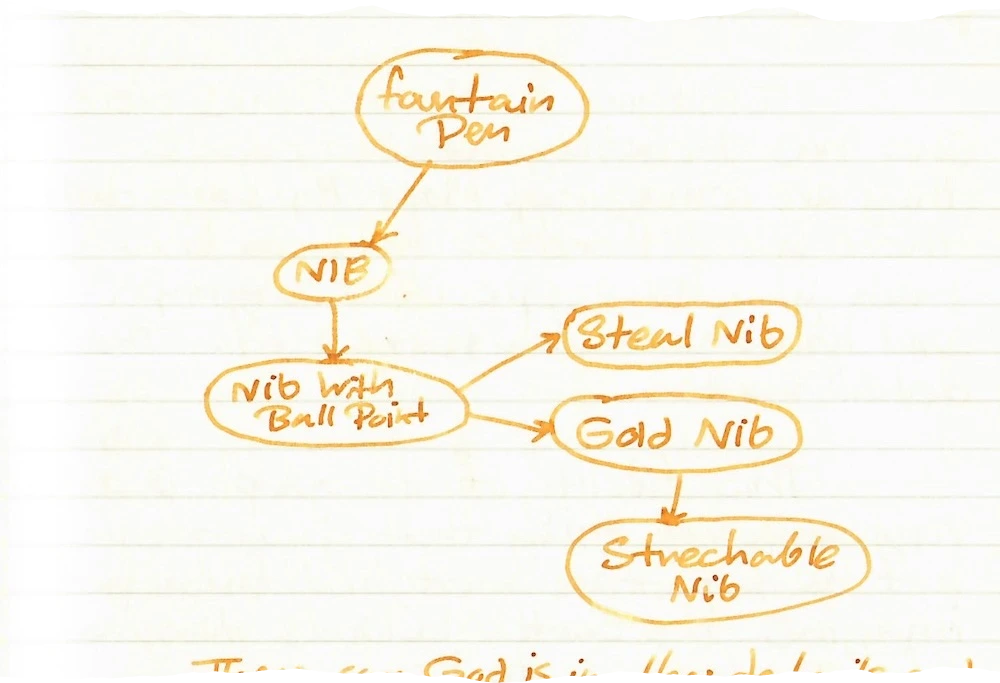
We have a world in which there are one main structural nodes in our graphs; and they have leaves (leafs?). That is a very big and important thing. If the shell, the nib, and hubs are present in the graphs here and there? Why should it not be present in ideas and systems? I think the way ideas are built reflect exactly how the organic networks are built.
Take the difference between any two things. Why is the Android operating system a garbage of a software and the iOS is not? Does iOS have more capability? In many areas yes. But in the general sense; the quality of those things differ; the quality of technical designs differ; the quality of the art differs. That is the same difference between a Porsche and an ████ Khodro “Samand”. They both have wheels; engine; and stuff; it is how much detail goes and not goes in their making. Imagine a Norah Jones piece. She has incredibly detailed chords; they are amazing. Most Pop songs can’t. There are differences between how much you have specified a graph and how much you have not. The detail matters. This fidelity of the graph is a very amazing thing that you may not have fully matched yet. Imagine the Scott McCloud ’s diagram of Photograph to Icon;
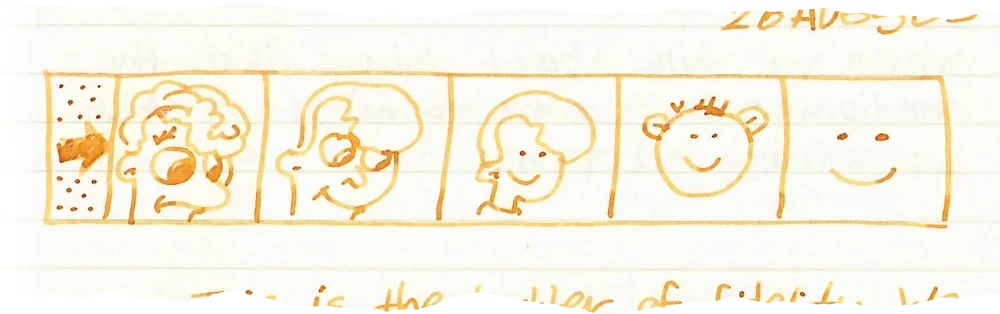
This is the ladder of fidelity. We can understand, by looking at it, how the graphs are made. There are amazing things one can do with them. When you think about it; the understanding of hubs in graphs also explains the Great Maestro McLuhan and his saying that: “The Medium is the Message”. Medium is simply the higher node in the tree. Fountain Pen is the medium for filling mechanisms. Piston fillers, converters, spring loaded, button fillers, vacuum fillers… are its message. International Convertors, international convertor cleaners, and a whole class of things are the direct results of the tree; they are each mediums and messages.
When we talk about things like the mediums; they are constraints in which something happens:
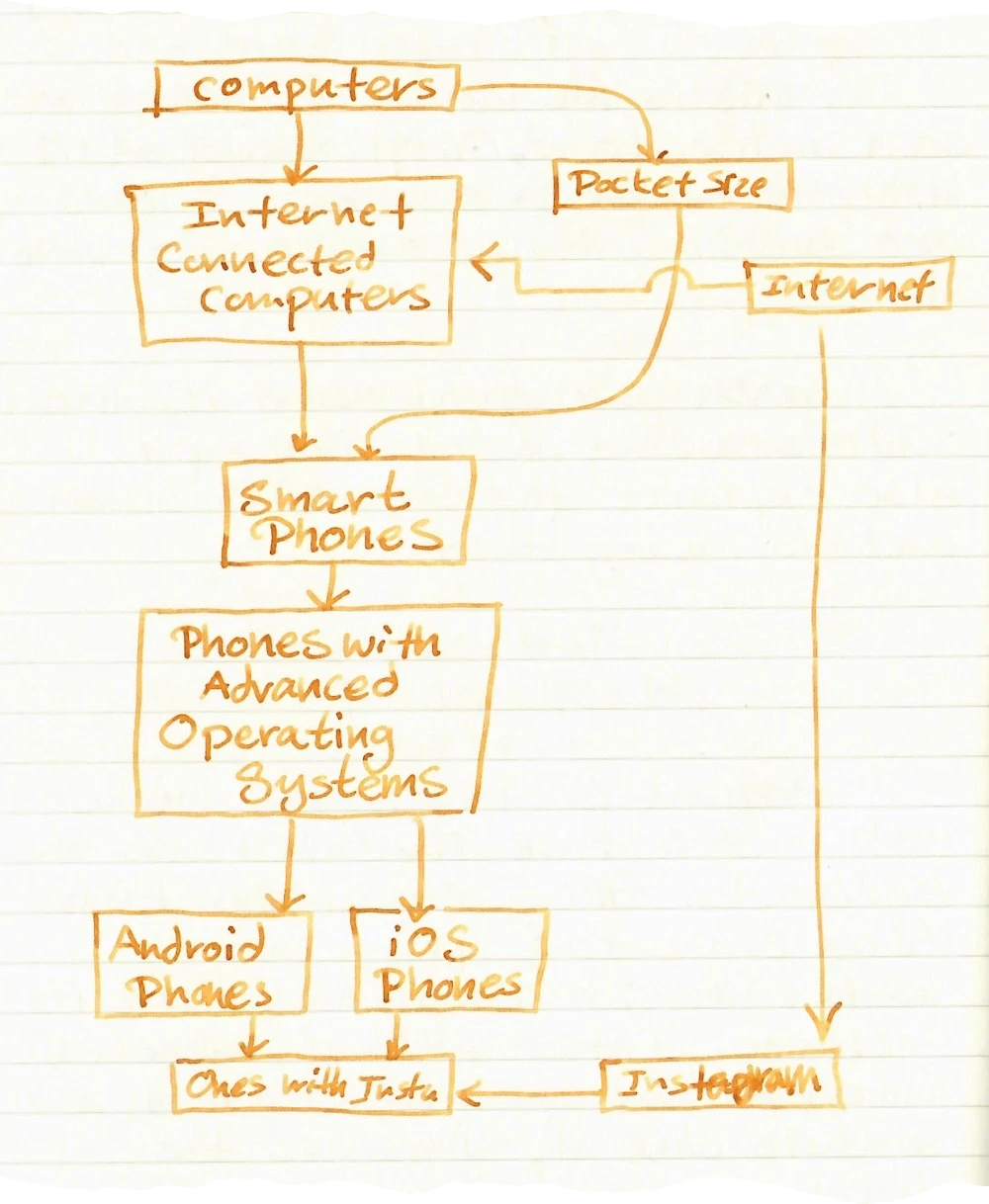
And so; as it becomes more and more obvious; the hierarchies of the system indicate the constraints of their message.
When I was a child; I used to think about the ways in which LEGO has sub-systems. You have LEGO System and then you have LEGO Technique. In the LEGO technique we have things that operate with in the LEGO Systems. These mediums are all portions of trees. In making my Arendelle Language ; I was too noob to know how to parse and run a language. And so; for that; What I did was a very stupid way to implement math. Arendelle Language Language used to read character by character and run the code. What it did not have was math. The Lexer; parser; and AST; and runtime where all one pass in the same functions; it would read the chars; parse and evaluate them at the very same time. Now; the stupid part; was it if you ran the code in a loop for 20 times; it would parse and read it 20 times as well. I’m getting ahead of myself here.
To handle math in Arendelle Language ; I had to know the bounds of the math. That was easy (I counted parenthesis open and close) so I could do this: [@a + #x * sqrt(1/2), PRP] and I could know the math is: @a + #x * sqrt(1/2) As you can see; Arendelle Language variables; spaces; and stuff; had marks; so I would then replace them with their values from the tables:
| Name | Value |
|---|---|
@a | 12 |
#x | 2 |
#y | 3 |
              _____
     ╭       ╱  1   ╮
12 + │ 2 × ╲╱  ───  │
     ╰          2   ╯
Once I had this; I would pass the equation into a math evaluator and compute it. The most brilliant and stupidest thing I could have done. This for me was a sub-language I had called MEL (Mathematical Embedded Language). Given something this cool; I also had realized Medium within medium. But again I’m getting ahead of myself.
In doing all of this; there have been things that I find to be amazing. In the fermata between yesterday and today; the yellow pages of this essay and the blue ones; I had met Ashkan . He was curious and so I was trying to explain to him the Gutter and the Guardrails to him; I was trying to explain why math is “Exact and explicit” communication; There I noticed something amazing about Math, Logic, programming… They have their whole graph not only explicitly defined; but everyone knows them. When thinking about programming languages being clean languages — the opposite of natural languages where you can never define its rules explicitly; Ruby is easy to define because everyone in the world has an exact copy of the Ruby engine.
Things like JavaScript not so much because of so many engines that each vary a good bit. That is an important distinction. We don’t have any Gutter in the learning of math because we define plus; we make multiplication from addition; we make exponents from multiplication; and so on. And this is beautiful. We love systems because we all know their rules equally. I think real bonds intellectually happen when people have near approximations of what they are doing; a shared graph; and systems give us that. And as I had explained days ago; systems are explicit materializations of the graphs. [These parts are getting very strange I know]. So there all beg the question of what is the use of all this? Well! I may have a good one: We know that our knowledge is spread as a graph and we define very rigid disciplines for them; but well; if we drop the whole idea of areas of knowledge we can make the system navigable through shortest paths and degrees of separation. That would be an amazing thing.
Yesterday I also thought about the idea of “Purity” and Maestro Moeller ’s mention of Germans having a thing for purity. This is something wonderful as well that has captured my attention for a while good while. Why do we love purity so much? I guess there is no right answer as of now; but I can speculate personally: To my current understanding; the idea of purity; again comes down to the Scott McCloud ’s idea of the abstraction spectrum.
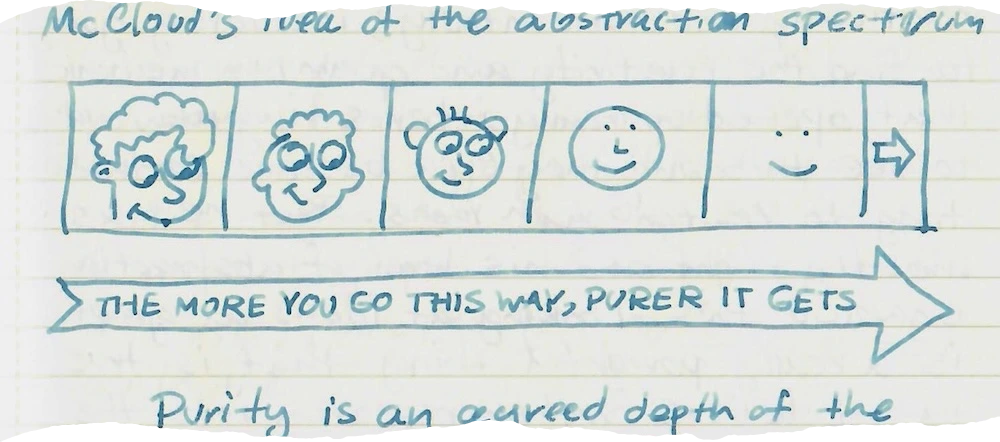
Purity is an agreed depth of the graph as it is with minimalism; as you can understand; the hubs of a graph are constructed before the other things are constructed; Or at least reinforced by the construction of the other things. And one amazing thing is that if we take to account the way a brain works; the neural nets are trained and stuff; ideas become way more interesting.
A network is responsible to save every thing in itself and so each time you add some thing new; so many weights across a whole network is changed and that is immediately a change on other concepts. Now as you know I have taken a few meta levels of abstraction in distance from touching this myself. It was better for Isaac Newton to concern himself with bodies and then others got that initial idea and expanded it in all directions vertically and horizontally; including going to find the relativity and quantum mechanics that opened up really interesting new ways to see this and they even became contradictory to Newton’s main ideas. But he was mostly right and his level of abstraction enabled this. Looking at ideas as graphs is a really powerful thing that is true; but I believe further research into the neural networks would reveal fields or more strange structures at some levels. Getting ahead of myself again; So if we think about the matter of purity; hubs; and the way graph transfer happens; we get to see really really amazing things; and they are the facts that in a group sub-graph transfer; so much Gutter happens:
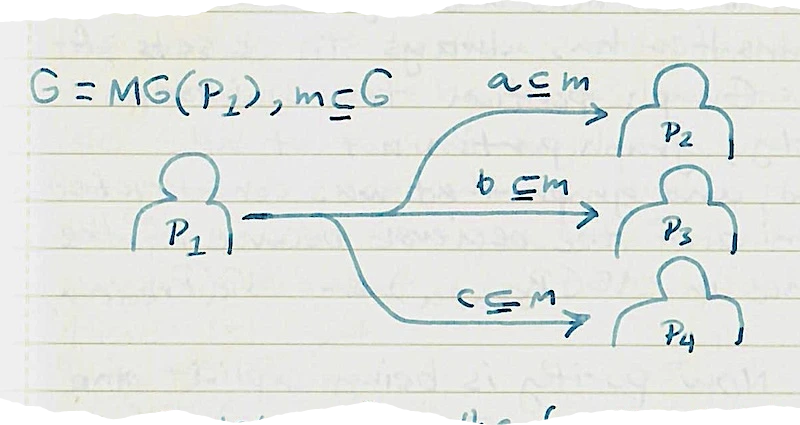
So lets define the function “MG” as the Mind Graph of person; and therefore G becomes the mind graph of P1 the person. Now the message “m” is going to be a sub-graph of graph G and therefore: m ⊆ G, where G = (V, E, W) is a weighted graph, and m = (V', E', W') where V' ⊆ V, E' ⊆ E. Now in the transmission of “m”, so much Gutter happens; and therefore a portion of the message gets “integrated” correctly and the rest is a new graph and set of edges that are the result of this transfer. For that we get:
integration(m, P) = [ I, N ]
                m = Message
                P = Person
The matrix represents two sets of nodes and edges: I = [IV, IE] => the intended vertices and edges. N = [NV, NE] => the novel set of vertices and edges. So basically the transfer has always three sets of results: Graph portion transmitted correctly; graph portion not at all received; and graph that was constructed in the mind of the receiver because of the difference in MG(Psender) and MG(Preceiver). Now purity is being explicit and that quite simply is I = (IV, IE); the portion of the graph everyone took the same;
integration(m, P2) ∩ integration(m, P3) ∩ ... ∩ integration(m, Pn)
And here is the even more crazy idea which we can now easily see by inspecting the results and comparing different LLMs. What we see in the performance of the LLMs is that the more they are trained the depth of their insights grow. That is why they are slowly and slowly advancing to the position of a master thinker. When I used to ask what do you know about the topic X, say when I had asked about Maestro Kay ; small models could only tell they know he is a Computer Scientist and would then hallucinate. As the models got better; they could say they know that he works on things like Smalltalk and e-toys. At some point they could address his quotes and the things he did. So you see what happens is that structures grow over time:
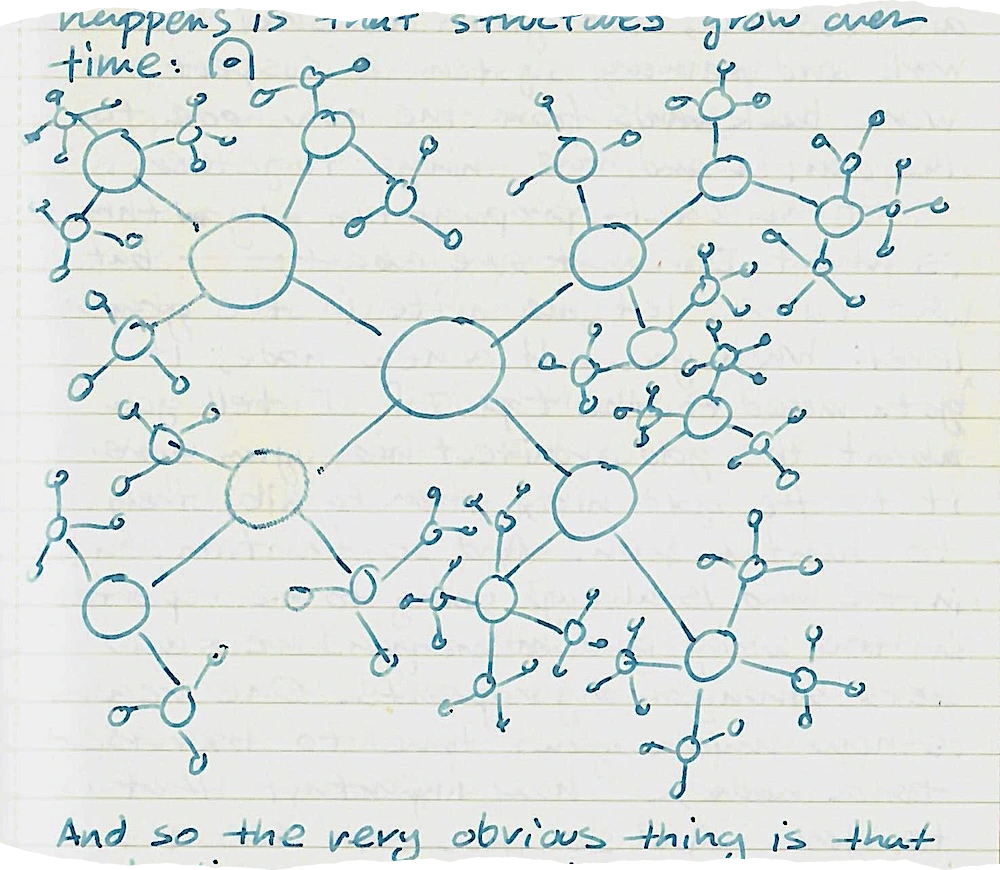
And so the very obvious thing is that each time something in your graph gets a new node; you get to add a weight to it. A weights to it.
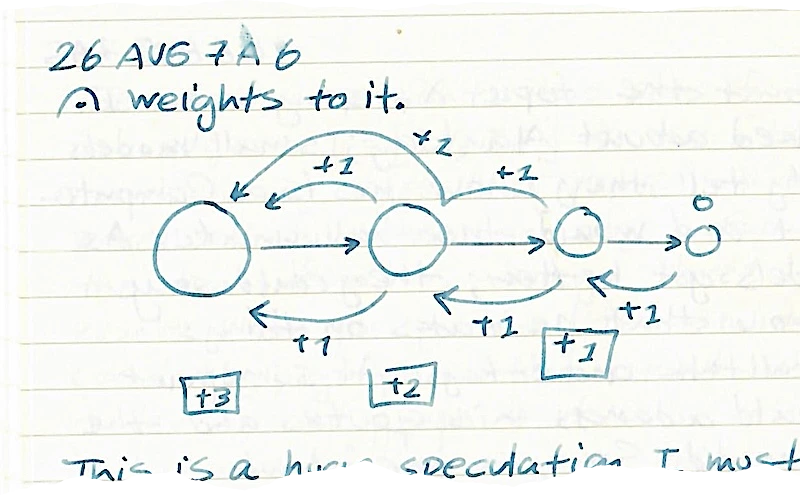
This is a huge speculation I must go and research; but given a neural network and memory system I suspect we work backwards from the new node to the center and wire things together—the back-propagation algorithm is what I’m not sure about—but who cares; let me write in the graph level: When you add a new node; it gets wired to the top. If I tell you about the gold architect nib; you wire it to the gold nib; then to nib; then to fountain pen. And so in the end it is always going to be reported in the wiring and memory as we know gets stronger by repeats. One reason is how much you have to traverse to a node; how important that is to you. And so you can see that while details may fade hubs remain. Hubs become the centers of meaning shared between people.
In the fountain pen users the Diamine Tchaikovsky may be a rare ink to know; but Herbin colors like Bleu des Profondeurs is one level more important and known—almost a good portion of ink experts know what is the “Royal Blue” color; but perhaps all know the LAMY colors and everyone in the world knows the concept of blue. And that is exactly the point. If you compare Eclat de Sapphire, Kaweco’s Royal Blue, and Pelikan 4001’s Royal Blue, what happens is you get a faint idea of the three colors; but a very profound idea of the Royal Blue color concept. This is because sim(RoyalBlue1, RoyalBlue2) > α is true for most experts; whereas sim(DiamineTchaikovsky1, Tchaikovsky2) might fail.
And I think Maestro Moeller ’s concept of purity is amazing. It is the depth of a graph that through learning process and repetition everyone has the same understanding of. It is the intersection of the shared understandings. He mentions bear and how each bear is made. He does not talk about branding; ways to drink it; packaging; it is about the core shared thing we all know exactly like each other.
We all know these signs:
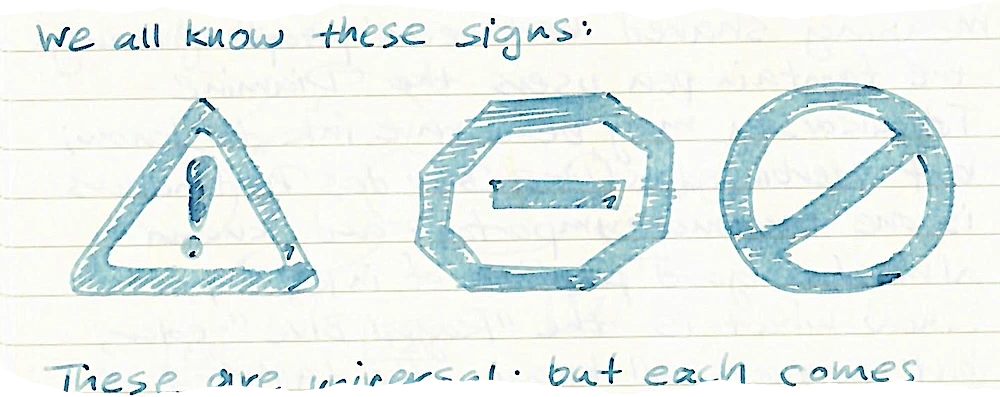
These are universal; but each comes with a little bit of variation. And also in different situations. So you see? as a machine and neural net work and a cartoon works! Each level of Scott McCloud ’s ladder is a pattern of the other pattern. And that is how neural networks work; layer by layer. So taking this into account is hard. But think of it; maybe pattern themselves are depth of graphs! And at a certain depth we all agree about the depth that purity happens.
I see this in the Archive everyday; by each detail that I add; the main concepts are understood better; while the details are mostly forgotten. And as you know the Sub-Graph Transfer is very lossy; it is like that antenna field thing where if you send a signal in ten directions they get very intensified in the middle. And so the interesting thing is how much you have to teach something for the graph to walk. Told it buddy; let me re-explain. This is the golden graph I want you to have:
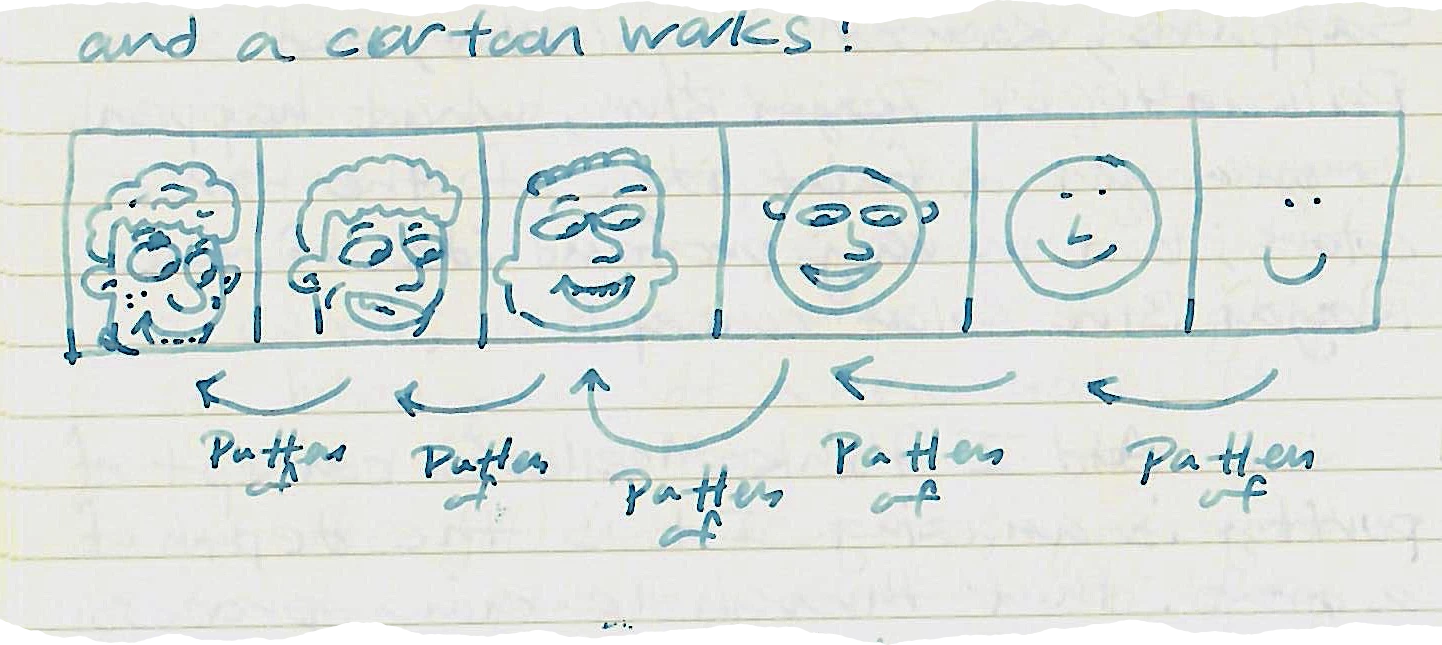
This “MR” circle is the portion of the graph that is so reinforced by the all data that has received (the whole graph radius “R”). That gap in the total graph and the usable graph (GR vs GMR) is always going to be there because of the training and the repetition required to harden a portion of the graph. People are always going to get a portion of what they are told and they are always going to understand only a portion of what they hear and read. And so the size of the understanding to the total knowledge is going to always be: πr² / πR² = r²/R².
he way we teach things in our schools is amazing. We require people to have things in their minds and then write them in tests. After that; done; thrown away because there is just too little connection.
And that is how Alzheimers happens; by too little connection. They say the best way to prevent Alzheimers is by having listened to so many songs; (Jaffa E, Wu Z, Owen A, Phyo AAZ, Woods RL, Orchard SG, T-J Chong T, Shah RC, Murray A, Ryan J) and then because it wires the brain so greatly; you get much much better paths from one thing to the other. This is also there in all places where there are hubs. You definitely know the shopping center you go all the time way better than a small shop you once found in the middle of a random place. You talk to people who you work together way more than the ones you used to work; you would go to somewhere that is more at reach than a place that is far away. Reach dictates a lot. Everyone in the world knows the JFK airport; while so little know the Kish airport. Hubs through repetition gain more permanence.
I think the memory works like a garden of graph rules. The idea here is: when you water something; you always have to water its parent as well. So; take this:
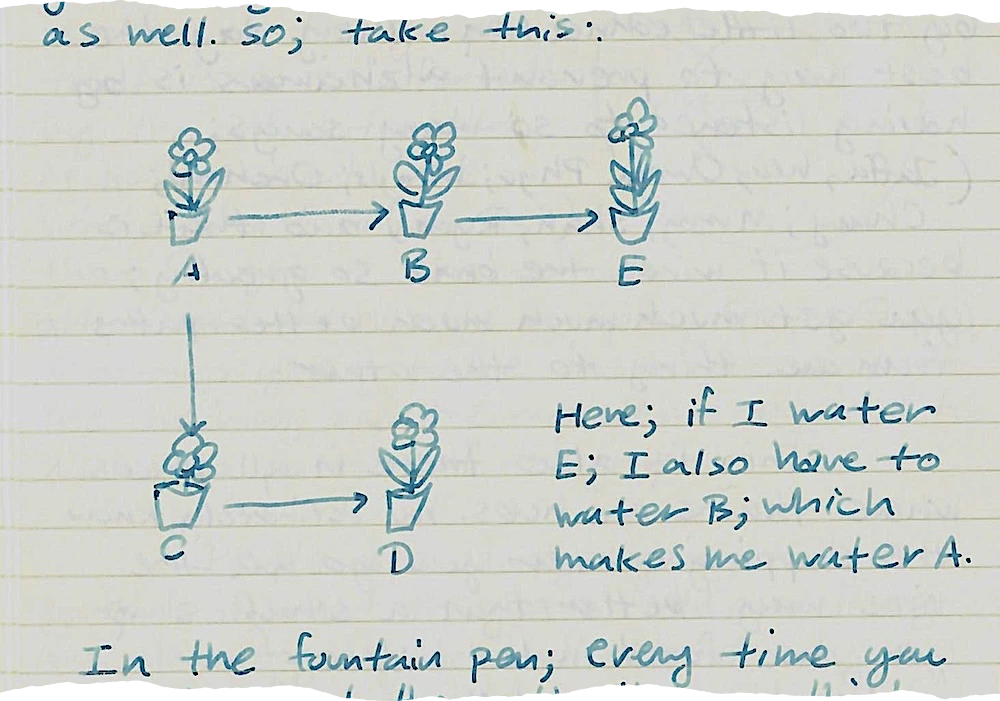
Here; if I water E; I also have to water B; which makes me water A. In the graph, each time you apply a +Δw to a leaf, a fraction of that reinforcement propagates backward to the hubs. In the fountain pen; every time you think about the gold nib; you think about the nib and you think about the fountain pen. So in the example; A will always get the most water; B and C the second; and D and E the least. Given this; what flower will last longer? A; it gets way more water. You may forget about the Music nib of Platinum or Pilot’s Scribe; SFM size; you never forget about the fountain pen.
nd to transfer the graph of a leaf “A”; you have to traverse and reinforce the chain B and C. The transfer equation is Gap = AR * (K - 1). The new concept distance must be computed relative to the receiver’s current graph. And to make sure people learn something in the size of A; you have to convey B.
My mind hurts but it is relaxed in that I have kept all of these in it and the externalization is now helping me not hold it. I can no longer write; but you get what I say here… God; is in the details.
Where did your taste come from?
No really. Where did it come from, was it genetic? Were you abducted by aliens one day that forcefully injected your sense of taste into your mind and wiped your memory?
I’ll tell you this much: it’s not from consuming good work. You cannot read a hundred excellent programs and absorb the judgement by osmosis, any more than you can become a chef by eating in good restaurants. Taste is built the slow, stupid, humiliating way: you make something bad, you are forced to live with it, it fails in front of you, and some part of you files the failure away. Then you do it again. The palate is an accretion of your own mistakes, sat with long enough to sting.
The friction was not an obstacle to developing taste. The friction was the curriculum. Every wall I cursed while climbing it was, without my noticing, teaching me which walls were worth climbing. The cost that rationed my output also educated my judgement, because paying the cost over and over is how you learn what is worth paying for.
So watch what happens when you remove the friction for the next person.
They can generate fluently from the first day. They will never ship the bad version and be forced to sit in it, because the tool offers them a competent version for free. They will climb no wall, and so they will learn nothing from the climb. They will arrive at fluency having skipped the entire apprenticeship that fluency used to require—and they will be more productive than I was at their stage, by every metric anyone bothers to measure.
They will be able to make anything, and unable to tell (or stop to think) whether they should. Not necessarily through any fault of their own. We removed the part of the process that would have taught them, and we called it progress, and by most definitions it was.
Harry Frankfurt once drew a careful line between the liar and the bullshitter. The liar at least respects the truth enough to work against it. The bullshitter does not care about the truth in either direction; he is simply indifferent to it. 4 Slop is the bullshit of engineering. It is not wrong, exactly. It is indifferent. It works, it passes, it is fine. And fine, produced without friction and shipped without judgement, is now the most abundant substance in the field.
Sturgeon said it decades ago, defending science fiction from a critic: ninety percent of everything is crap. 5 He meant it as consolation. Ninety percent of every field is bad, so do not judge the field by its bulk. But the ratio was never the danger. It held steady for centuries. What held the flood back was that producing the crap cost something. Bad novels still took a year to write. Bad software still took a month to build. The ninety percent was throttled at the source by the sheer inconvenience of making it.
We have now removed the throttle and left the ratio intact. Ninety percent of an infinite output is still infinite. The signal did not get worse. The noise became free, and free noise rises without limit, and every real thing you make now arrives into a sea of plausible nothing that looks, at a glance, exactly like it.
Which means the scarce act is no longer making. It is choosing. Deciding what, out of the endless generated plausible, deserves to exist and be kept. Curation was a minor virtue when things were expensive to make. It is the whole game when they are free.
When the factories came, they could suddenly make everything—cheaply, uniformly, by the thousand. 6 And a handful of people, Morris and Ruskin among them, looked at the flood of cheap identical goods and asked a question that sounded, at the time, sentimental and doomed: not can we make this, but should this be made, and made this way, by no one, for no reason but that the machine could.
The tools did not devalue the skill. They stripped away everything that was not the skill. All those years I thought the work was the production—the typing, the wiring, the wall—and production turns out to have been the toll. The tax you paid for the privilege of exercising judgement. Now the tax is close to zero, and what is left standing, exposed, with nowhere to hide, is the judgement itself. The part that was always the point.
Taste did not become less valuable. It became the only thing that was ever scarce. We just could not see it, because it was buried under all the labour it used to take to get to it.