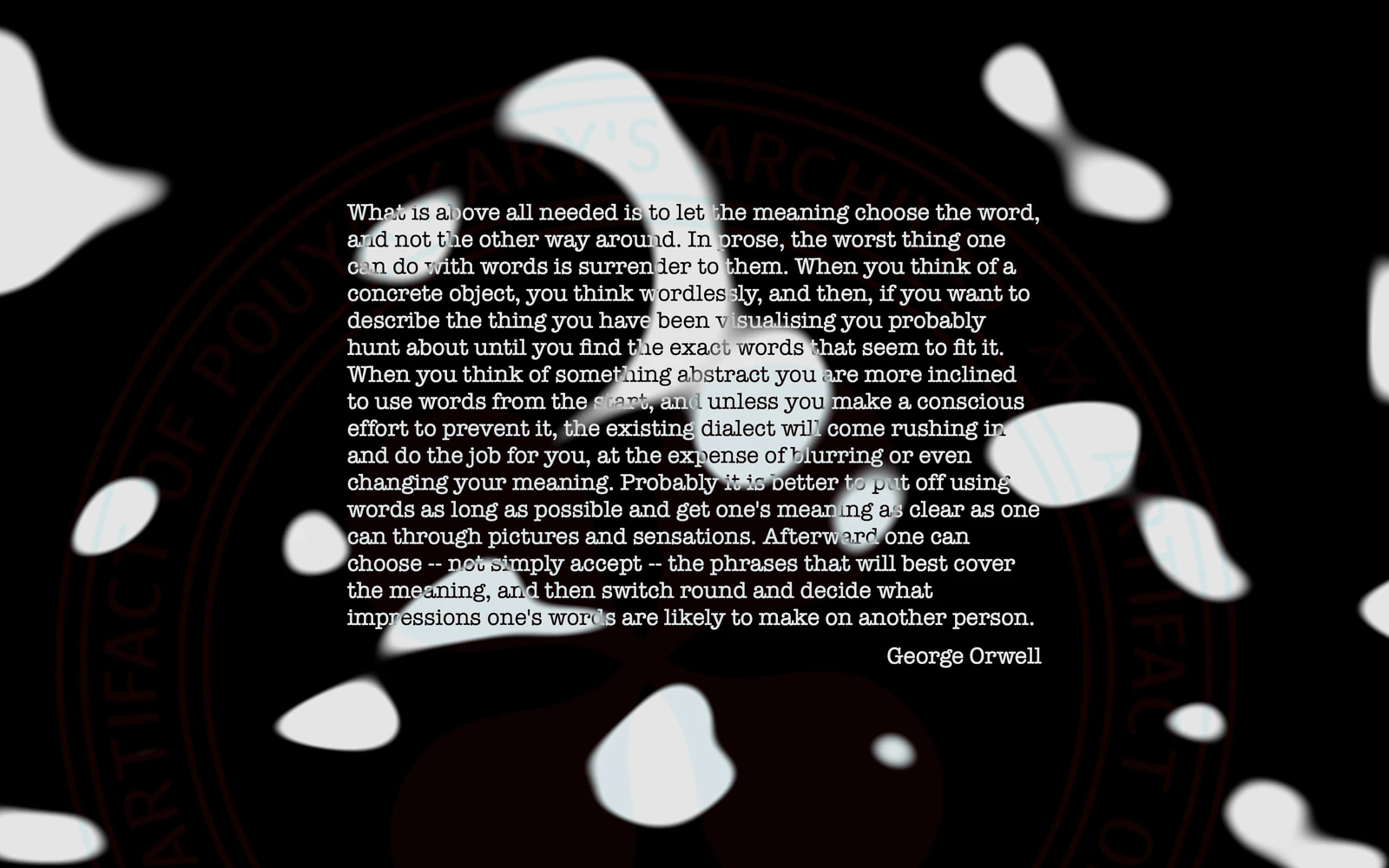
So I built this screensaver over the weekend that each time loads one of the quotes in Maestro Victor ’s collection of quotes. I was dreaming about this for a few years now, only had the time to build it today. The shader at the background makes it really nice.
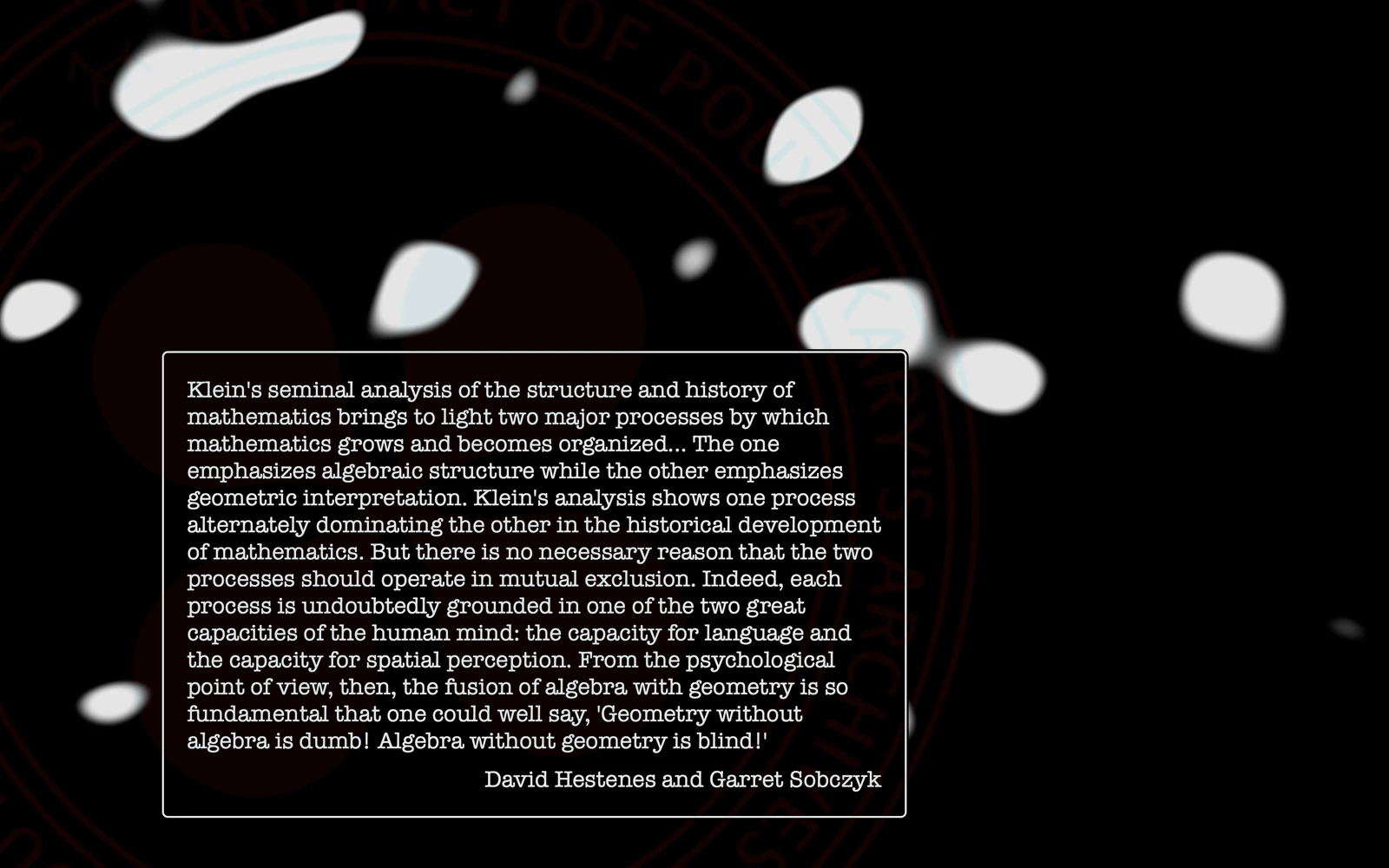
Mac OS X Screensaver for Maestro Victor ’s Quotes Collection (2/4)
Mac OS X Screensaver for Maestro Victor ’s Quotes Collection (3/4)
Mac OS X Screensaver for Maestro Victor ’s Quotes Collection (4/4)
I am going to stake my reputation as a literacy man: I believe that, using this alphabet, the illiterate will learn in one-tenth the time that it now takes; and that means that probably ten times as many people will learn to read.
Upper class: often flawlessly ethical, never moral. Working class: sometimes moral, often indifferent to formal ethics that they feel were set in place without their consent. The social language of appearing to avoid conflicts of interest and self-dealing is one in which upper-middle and upper class people are fluent. In terms of morality (avoiding harm, rather than avoiding violations of semiformal social principles) there is a negative correlation to SES, but it’s very slight because it turns out there are also scoundrels at the bottom.
Maestro Nelson had the same problem (but with way less funding than Maestro Engelbart enjoyed). He couldn’t build Xanadu because most of its parts didn’t exist, such as a way to name content that no authority issues, or storage cheap enough to never delete. His teams hand-built their own data structures for years, but the project died on the vine. Wired depicted Maestro Nelson ’s story as one of mismanagement, but I think he’d just specified Xanadu decades before its dependency tree existed.
I think it’s telling that in neither Lib/Dream nor Future did I see any instances of ‘transclusion’ on paper. Nelson could have used any amount of side-by-side layout or range-transclusion in his books, because software is no obstacle: [
Xanadu, [
To be xanalogical is to follow two rules: Never copy, always reference (also known by a Nelsonism, transclusion). Never overwrite, always version. As Nelson designed it, Xanadu would manage the system’s complexity and massive bookkeeping burden itself, so users only experienced the benefits of a system that could never forget.
I briefly poked at the Xanadu PCs, impressed that they were running at all, but I and most of the party-goers bounced off them. The UI was too alien. We really needed to see James demo them, or something like that: hypertext systems do not lend themselves to immediate exploration, especially when they are running in OSes on computers no one there has used in 25 years, if ever.
For example, he described how they prototyped Xanadu in Smalltalk (which made sense, as a highly-productive, pleasant language/OS whose object-oriented model matches hypermedia beautifully), but then had to cross-compile it to C++ and compile that… which took about a week to compile. Not a minute, or an hour, or even a day, but a week. (And I thought that Gwern.net’s multi-hour compile-times were bad for my development speed!) He also had to waste a lot of time dealing with C++ silliness and compile issues.
Like _@Engelbart_, [
I didn’t need to use them much to look at the screen displaying the stereotypical Project Xanadu demo, the opening of the Book of Genesis with its famous lines zig-zagging off to the right to denote transclusions or commentary on passages, and have a sudden realization:
“Oh my god—It’s completely unreadable.”
The lines were confusing clutter, especially as they crisscrossed (a perennial problem in sidenotes layout, made far worse by the outlines). None of the ‘sidenotes’ were readable because the screen was so small. Even as you simply scrolled, for many possible positions, due to the lines you were unable to read anything! How could a document UI where often, you could read nothing, have ever seemed like a good idea?2 The UI was just terrible—it could never have worked. Even on a large screen like my 4k monitor, I wouldn’t want that.
And then I thought about the choice of text, and I realized that the UI wasn’t the real problem; and the problem, for all these many decades, wasn’t the team either. The whole concept of side-by-side range transclusions is a solution in search of a problem.
Unified Arabic (UA) is basically a set of 30 letterforms, one for each letter of the Arabic alphabet, plus hamza and lam alef, eliminating the variant forms that make reading and writing Arabic difficult for beginners.
Xanadu wasn’t the victim of “Worse is Better”; it was just a solution in search of a problem.5 (Something similar seems to be true of Arbital: it had one real user, Eliezer Yudkowsky, who had envisioned it, but struggled to communicate the vision or create a clear prototype and set of use-cases, mocked up as necessary; and like Xanadu, it was a square peg of what ought to have been a long-term non-profit FLOSS effort shoved into the round hole of a software startup company.)
I think some disappointments in past software systems become more comprehensible when we remember how much time and ingenuity is spent working around the limitations—eg. McIlroy 1982 is justifiably proud of the months of clever algorithm design & optimization he did to get a useful spellchecker to fit in RAM in under 1MB that today we would write in a few lines of JavaScript (and done by an LLM).
The college magazines were a surprise and entertaining to leaf through: young [
There’s a tendency of ideologues to value ideological purity over fitness for use.
This is fine as long as people acknowledging their pure thought stuff is malleable.
One of Ted’s memorable issues was in say indexing documents. He’s wanted the markup to exist in a separate document that was byte addressable, not inline. So a separate index file.
I asked him “what about locales? Some systems are UTF 16.” And you know, instead of I dunno, admitting that not doing a packet, block, or inline format was a mistake, he just insisted it’ll be handled later. I asked him about cadence, how will you do versioning between the two, things are grossly inefficient if you change one byte, etc…
One of the other nice things of inline systems is you can get a partial file and still have all the context. With that system however, corruption is way too easy. There’s all these technical requirements to his grand idea that he asserts are completely absolutely necessary and have no technical equivalencies at all and do not have the obvious design and implementation limitations that can easily be overcome with very slight permutations in a way that still completely satisfies all practical usecases.
And he loves saying he’s not a programmer. It’s like come on Ted, trust the people who say you’re micromanaging of implementation is erroneous. It’s been like 50 years, some of your stuff doesn’t work.
He shouldn’t be bitter. Everyone technical in the field knows him. He’s up there with Stallman , Knuth , and Shannon in name recognition. I probably won’t even appear as a footnote no matter how hard I work. So yeah, mission fucking accomplished already Ted. Geez.
The famous Project Xanadu UI/UX is a “science fiction interface”, like the 3D gesture interfaces in the Minority Report movie or the virtual reality of Snow Crash: everyone looks at them and is dazzled and wowed by how cool they look, except they are a terrible idea which would be a misery to use and give you “gorilla arm”. You try out a prototype or mockup, and almost as soon as you start using them, you realize that no, this isn’t workable and you have to throw it out completely. This reminded me of the Hollywood director comment: you could say that Project Xanadu is a Hollywood director’s idea of what a World Wide Web should be. You can only believe in it if you never try to actually
The famous Project Xanadu UI/UX is a “science fiction interface”, like the 3D gesture interfaces in the Minority Report movie or the virtual reality of Snow Crash: everyone looks at them and is dazzled and wowed by how cool they look, except they are a terrible idea which would be a misery to use and give you “gorilla arm”. You try out a prototype or mockup, and almost as soon as you start using them, you realize that no, this isn’t workable and you have to throw it out completely.
Hearing some war stories from the horse’s mouth helped put things in proper perspective.
What makes an agent an awkward collaborator also makes it a perfect citizen for Maestro Nelson ’s system. Agents can follow more layers of subtext than people can hold in their heads at once, such as the sources behind a quotation, any discussion around it, and stack traces attached to the exact code that ran. A fragment-based representation makes those references lossless, so each layer stays attached to the same span as the text changes. Agents can read these dimensions together, cite them so humans can audit their work, and patiently follow every link, every time. But those links need to actually exist somewhere in order for an agent to find them.
When I revisit Nelson’s vision now, I recognize DeltaDB’s design goals and the promise of Delta. After decades of squashing history to meet the limits of the human attention span, we’re in a new reality that would be better served by something more… Xanalogical.
In 1932, a Lebanese architect walked into a classroom at the American University of Beirut to fill in for a professor who taught basic Arabic typing skills. In an effort to welcome the class, he started typing ahlan wa sahlan (‘welcome’), but, finding it difficult to locate the right keys for the right variation of the letter heh, he mistakenly typed an initial heh form instead of a medial one. He noticed, however, that what he had typed was still perfectly legible. He suddenly realized that by reducing the number of letter variations, the problem of finding keys on the typewriter could be easily solved without affecting the legibility of the text. He decided then and there to work on unifying all the variations of the Arabic letters. The architect’s name was Nasri Khattar, and he called his project Unified Arabic.