I have been grappling with a really really agonizing writers block for the past month. Ashkan has asked me to write a proposal and I’m stuck.
And it’s worse than I can express, my body really truly is in pain. All my muscles hurt. I’m in a bad position.
I had a horrible breakdown yesterday. And Zea was dead frustrated with me.
And for the past week I have been having a hard hard time even breathing. My body literally is in pain and I don’t know what to do about it.
The idea of ZPD has everything to do with @graphecosystems
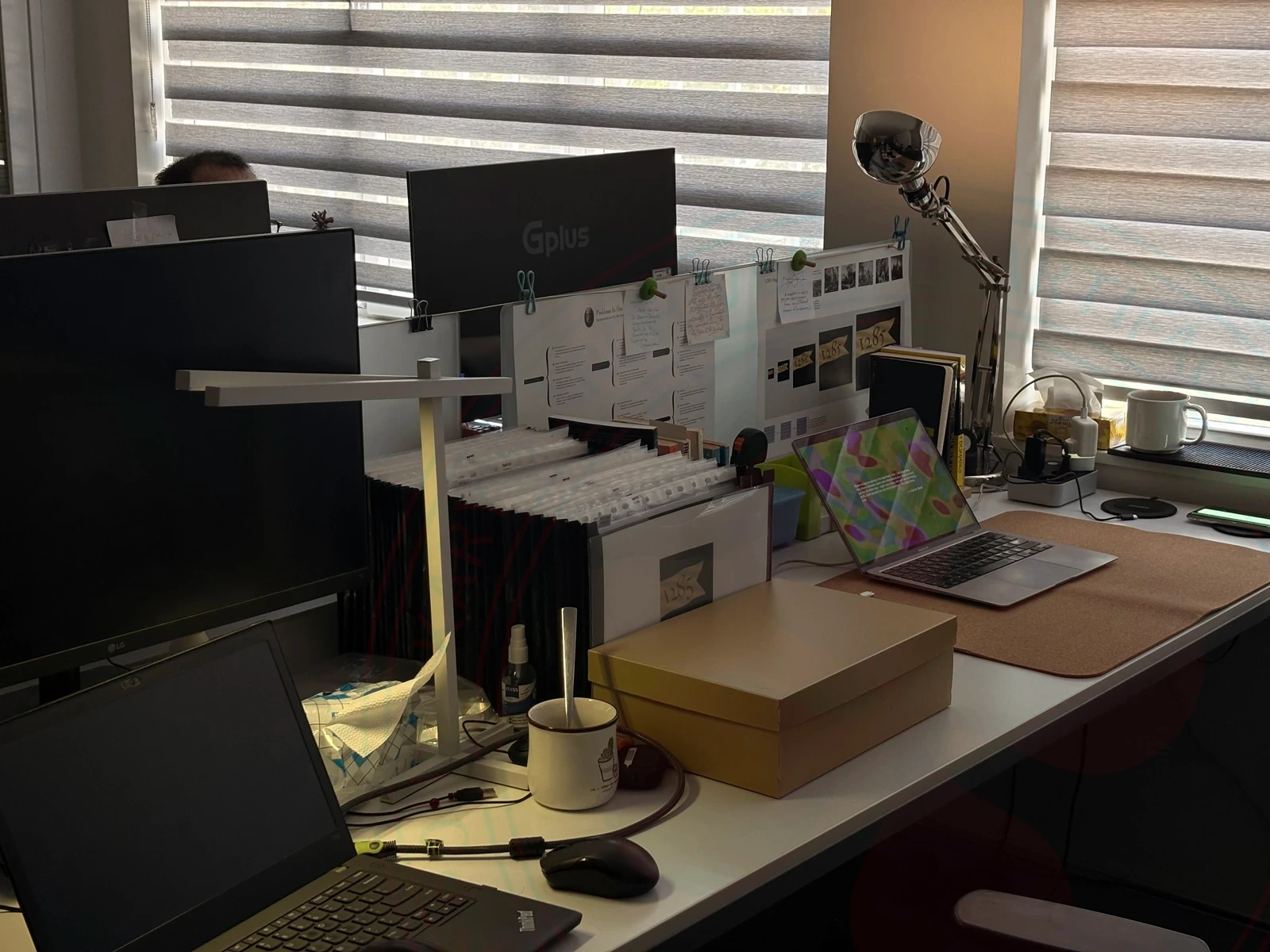
So I brought new lamps to ███████████’s place and made the lighting way way better. Also added more book shelves and chargers.
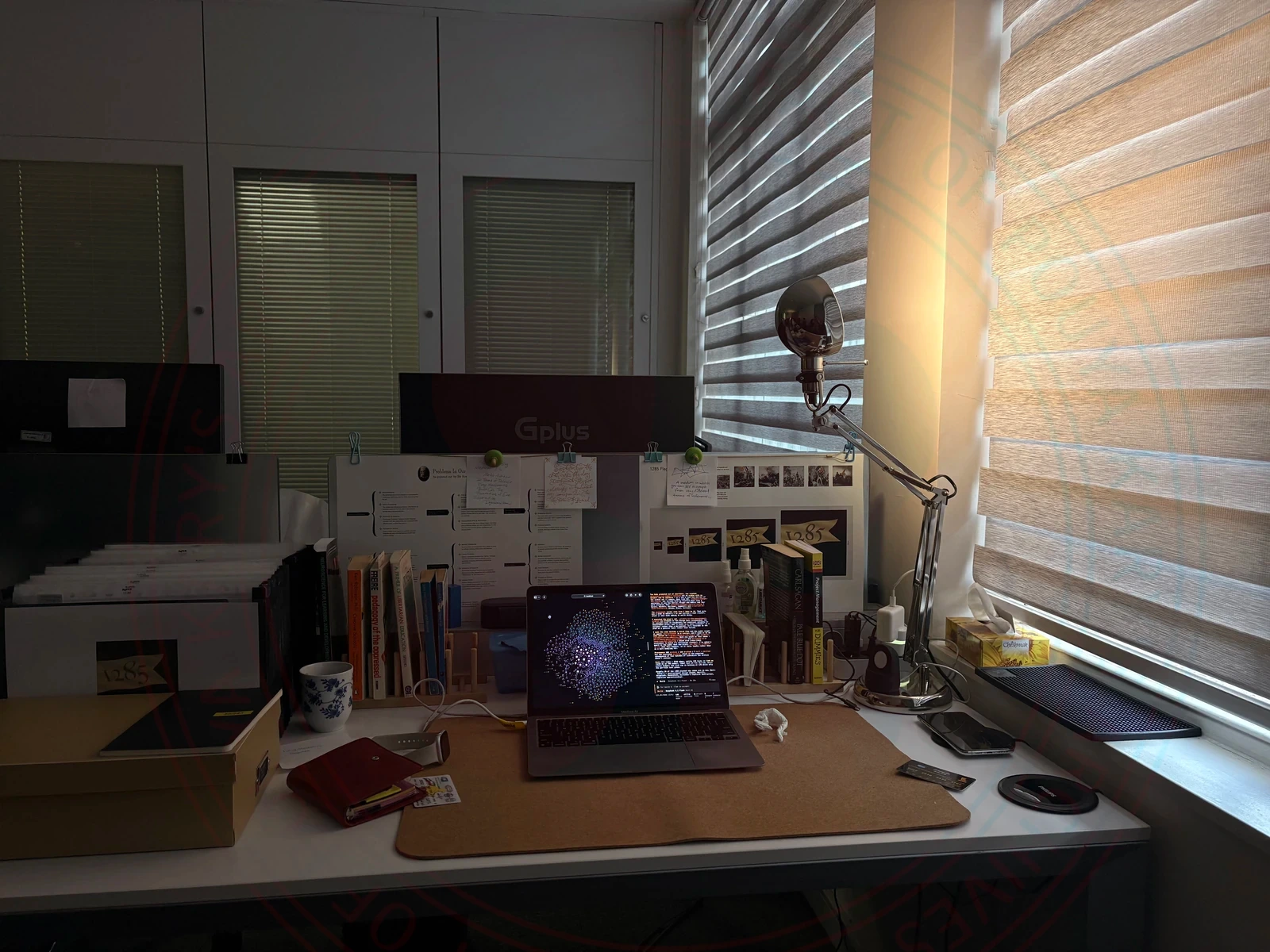
Workplace Design Updates (2/2)
I think it evolved from me being a designer and actually doing the work to then managing the work to then managing teams to then managing departments. And so I think you know my trajectory took the course of a lot of designers where you know you find yourself for a good part of the career you know fingers on the keyboards or with the mouse actually designing things moving type around and whatever um to then kind of you know art directing to then directing whole teams through conversation. So I think my trajectory probably maps to a lot of creatives where we went from doer to talker
I you know, we’re we’re really lucky here because I think we’re one of the few companies around at this scale um that was founded by designers and where the CEO and co-founder is a designer. And I think it’s it’s incredibly rare to have the chief decision maker um understand the creative process and appreciate the creative process and understand the value of it even though it’s incredibly hard to measure the value of it and the value of a brand and the emotional impact of a brand. And that that’s really credit to um Brian the CEO and co-founder who really drives a lot of the work day-to-day that he can create this environment where creatives really have a seat at the table and can succeed
I had to show Steve what the ads were gonna look like… I showed an example from Sears and I showed an example from McDonald’s, and I got about 10 minutes into the ads and everyone’s laughing except for Steve .
So Steve 's like, “I’m gonna leave for a second here. Could you guys all explain why we’re gonna kick Andy out of the room?” They’re like, “Dude, you can’t have Sears as a brand that’s going out of business. McDonald’s is like childhood obesity and a shovel. Steve is all about the high-end, the beautiful.”
I literally said, “ Steve , what the hell, man, what am I gonna do here?”
He’s like, “Do you have any design sense? Like what are you doing here? What are these brands?”
I said, “You bought an ad network, not an ad agency. I don’t have a group of designers here. I don’t have amazing artists. I don’t have a motion graphic. I don’t have anything. I got a bunch of guys from Boston who were scrappy enough to put a company together and suckered you into buying it.”
And he’s like, “You know what? Fair. I appreciate you talking back to me.”
He’s like, “Get the [
So I got my bag and I’m taking just wires… I’m all set up to take my stuff up on a laptop, mouse, but everything in my bag. He’s like, “Are you still here? I have work to do here. You’ve wasted enough of my time.”
So I go outside with my bag… I’m running, I got my bag, I got my everything, my phone’s ringing like crazy because all my guys who’ve been up all night want to know how things are going.
There’s a knock on the door about half an hour later and it’s the Executive Assistant. She comes in, she’s like, “Is there an Andy Miller here?” And I’m like, “Yeah.” She’s like, “ Steve on the phone for you. Before you pick up the phone, he sent two people over to see you.”
Door opens. Two police officers come in and I’m like, “What the hell?” And they’re like, “ Steve , please pick up the phone.”
He was like, “I have one question for you.”
I was like, “Yeah?”
He’s like, “Why did you steal my laptop?”
I was like, “What?” He’s like, “You stole my laptop.” I look in my bag. I looked at my bag like, “Oh [
So he’s like, “Tell me why you stole it.”
And I said, “Because I’m an idiot and I was scared.”
He’s like, “It’s all right, I got you. Give it back.” So I hand over to the officers. I reach my bag, I take out the laptop, I give it to him. I reach in my bag, I look around, I take out the mousepad, I give it to him. I look in my bag and there’s his mouse. I’m like, “That’s all I got.”
Because I thought I was getting fired. And I’m keeping his mouse. I still have it in my house now. I’m keeping Steve 's mouse.
Those guys made the greatest ads and we came back and I presented it and Steve was like, “Great job. Today you’re an Apple person now. You understand what we want to do.”
And that’s what he wanted. That’s the way he taught.
There’s been new infectious agents identified in this time as being cancer-causing, and even the infectious agents that we knew about in the past, the evidence has increased about the number of different cancers that they can cause,
Every word I move to the Graveyard is me averaging my own writing by hand — the same pull the training loop applies at scale, just slower, and one decision at a time. I’d been telling myself it was a defense. It isn’t.
If you work in design systems, you’ll know this by another name. We call it drift — when a system slowly stops meaning anything, because every team keeps bending it into their own one-off versions until there’s no shared standard left. What I’m describing runs the other way — instead of scattering, everything pulls toward the middle. The rare and the particular get sanded off, and what’s left is the most ordinary version of that thing. The most intricate and human parts are the first to go.
The words I’ve been burying in my Graveyard read as machine-written, because writers like her wrote that way first. In a way, I’ve been editing her out of my own sentences to keep them from sounding like the thing that I learned from her. It’s an uncomfortable thing to think about…
The influence had reversed. We taught the model, and then the model was teaching us.
And then it turned back once more.
Once “delve” became a punchline, people used it less frequently than they had before ChatGPT existed. In fact, it was used so infrequently that newer models were tuned to stop using it at all. We started editing ourselves so we wouldn’t sound like a machine, while the machine was edited so it wouldn’t sound like itself.
Researchers at Florida State wanted to understand why ChatGPT uses the word “delve” so frequently. The culprit turned out to be the feedback stage, where humans rate the model’s answers to teach it what “good” looks like.
It’s a loop I recognise from years spent in product and design systems. I’ve watched it play out plenty of times. You put a pattern into a system, people copy it, and after a while the copying is the proof: it’s everywhere, so it must’ve been right.
It is legit the most unbearable stuff you would see.
My third cousin got hit by a truck🚚💥 today! Here’s what it taught me about business management👇
That structure came from my mum. She studied writing and built a career in change management, technical writing, and e-learning — taking complicated things and breaking them into pieces a person could hold (sounds familiar, doesn’t it?)
LinkedIn is a soul-sucking hole of professionalism and a pit of hell that not even my worst enemy should spend the rest of his days in.
It’s this concoction of performative productivity and corpo speak producing cursed artifacts beyond human comprehension.
A place where normal human text goes to die and can only be kept alive by an LLM like a radiation protection suit.
Genuinely, every time I open LinkedIn, I get hit by these Computer Vision Projects of some guy waving his hand around, and it tracks them.
Like, I wouldn’t mind if it was one of these, but it is legit all I see. It is just every other post some guy waving his hand around doing NONSENSE.
Those skills are now being absorbed into tools. And I’ve been struggling to figure out what’s left of me once the work counts for less. If so much of how I see and value myself is tied to being good at this, and being good at this matters less with each passing month, it’s hard to not feel helpless. Like a part of me is disappearing alongside it.
Reading content from someone is a form of trust: I give you my attention because you gave the work your care. Hand me raw output that no one checked, tweaked, or influenced, and you’ve just spent my time to save your own.
So I tried to better understand how the detectors actually work, partly hoping I’d come away feeling silly for worrying, and that I’d be able to stop overanalysing (and overediting) everything I write. But I didn’t.
It generally comes down to two key things: whether your words are the ones a model would reach for, and whether your sentences run to a similar length. If you write cleanly, evenly, and in a way that’s easy to follow, you sit comfortably in the band these models flag. That’s the way I was taught to write. The habits my mum spent years instilling in me, are now the ones a stranger reads as a machine’s. It’s an incredibly weird and depressing thing to think about
When researchers tested it, readers rated the word “delve” lower than any other buzzword. So this wasn’t the model copying a word people loved. A specific group of human reviewers, at one moment in training, nudged it toward “delve”, and the model learned the lesson. The words we now roll our eyes at started as a snapshot of what one room of people rewarded. They came from us first.
Researchers at the Max Planck Institute listened to more than 737,000 hours of unscripted podcasts and were able to tie the rise of words like “delve” directly to the release of ChatGPT. If you spend enough time talking to a model, its words begin turning up in your own vocabulary.
A team of researchers at The International Agency for Research on Cancer (IARC), an arm of the World Health Organization, conducted the study. They found the largest number of cancer cases attributed to infections globally were caused by the bacterium Helicobacter pylori, which can increase the risk of stomach cancer and accounted for 760,000 cases, predominantly in eastern Asia. Human papillomavirus (HPV) followed close behind. HPV, which causes 100 per cent of cervical cancer cases and also anal, vulvar, vaginal, penile and some head and neck cancers, accounted for nearly 750,000 new cases globally, with high rates in sub-Saharan Africa. Hepatitis B virus (HBV) and hepatitis C virus (HCV) were also linked to a significant number of liver cancer cases.
It’s not just a software problem, either. The researchers who ran the podcast study warned that their flagged words are starting to read as an indicator of lower skill, or lazy AI use. The words they’re talking about aren’t machine inventions. They’re just good words that you pick up from years of reading. The kind of words that careful, meticulous writers reached for long before a model made them radioactive. Which is what frustrates me most — the people who learned to write, who built the vocabulary, now get to watch it read back as a machine’s.
I finished writing an article recently. I did what I always do before I queue something to be published: read it aloud, as if reading a storybook to a child. It’s how I find the rhythm: where a comma should sit, whether an em dash earns its beat, and which parenthesis a reader can skip without missing much.
Lately, though, the read-through has turned into a hunt. I take out em dashes and replace them with commas or full stops, keeping the rhythm steady while making the change less obvious. I look for words like “genuinely”, “honest”, “quiet”, “silent”, or “worth”, and swap them for something more neutral, almost as if I’m burying my own style. Those are just some of the words saved in a file on my desktop, called the Literary Graveyard. It’s full of familiar words, phrases, and patterns that make people read a piece as AI-generated rather than crafted. I found them in arguments in Slack channels, LinkedIn posts, and firsthand comments from a former boss, who was adamant that I strip the em dashes out of what I was writing, grammatically correct as they were, just in case someone assumed it was written by AI.
What irks me most is that they were mine first. I, like many others, wrote like this for years before any model did. A machine learned those words, structures, and patterns from people like me, and it repeated them back to me until they stopped feeling like my own. That’s a lot of self-surveillance for someone who just wanted to write about design tokens.