I have to write about porn, define it and prove why it is exactly like education
So the archive is no longer 130,000 words, but around 750,000 words. It is growing so fast…
There is this little tony kitten at the end of our street, today I found him dead…
And another of our cats… blind.
Cool new word I learned “Saaspocalypse”
I have been thinking about the Dunning-Kruger effect for at least two decades now. We simply know that it happens because one does not know enough about one subject; they don’t know about the hard or impossible parts and what have you. But then, why? Why do we fall into the trap of not knowing something is hard? We all know that being a doctor is extremely hard while having no medical education. Why does no one get the Dunning-Kruger of going into a hospital and saying: I can heal this person? Why does it happen to things like Graphic Design for example? Why does anyone suddenly get the rush to correct a professional designer while they know nothing about the design?
And so what I am going to write here; take with a grain of salt; think about them as guesses; speculations and loud thinking. Not as the finished product. In thinking about Dunning-Kruger; I think there is this problem of Graph Zooming . You see; I have talked about the Graph Zooming many times; but never defined the concept fully.
I see graph zooming as something like map zooming. When you have something like a map in the computer — Google Maps or Google Earth; what have you — both expose this feature where you see a unified Earth at first; then you zoom and see the label of continents; then countries; then zones and states. At some point you see the cities and then the neighborhoods and then paths;
And so graph zooming is knowing that this city exists here and that city exists there. Then you zoom and realize “Oh That City has All of These Neighborhoods”. You go one meta level down. This is not something you can have zooming here and there and not zooming elsewhere. The important part is that you think you have a very big and good picture of all that has happened.
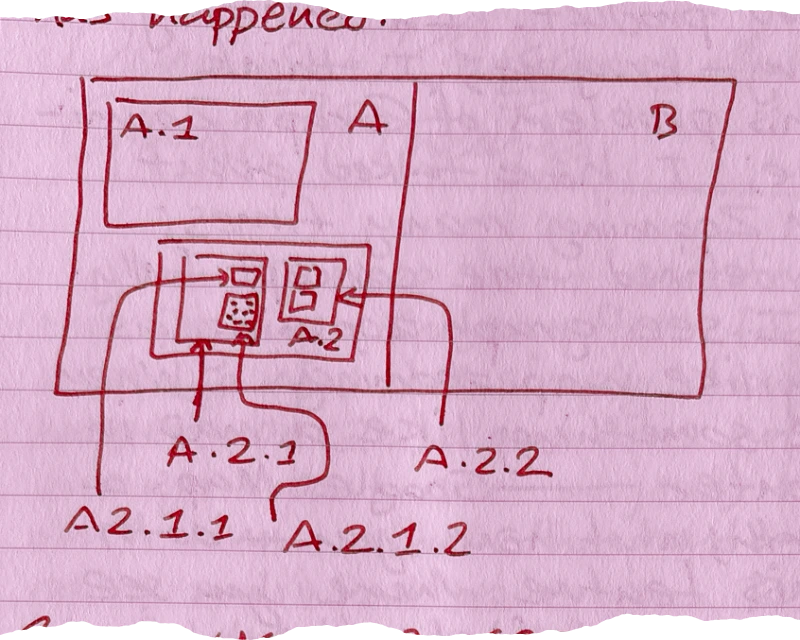
So as you can see we see the whole shape but not “all of the shape!” And this is why we get the illusion of understanding.
As someone who codes a lot; I never think of the runtime of my code. When I code in Web; I think I get it; I have done it all; I’m the one responsible. Then you dig deep and see Skia for example; you now think oh if I use Skia then now I’m doing it. Then you think oh what happens inside of the Skia . You go lower and lower. This is graph zooming. As Carl Sagan said it: “Those who wish to make an apple pie from scratch; have to invent the universe first”
And that is what we see with people at one level higher than us: The vibe coders. To me they are people who have no clue; but then they are doing things that work. My work is also a joke to one who writes assembly.
This is something that we can see as Graph Zooming . How much of something are we loading to our mind and at what abstraction layer are we working with the thing.
So here is my guess; take it or leave it: A portion of the Dunning-Kruger happens because of Graph Zooming . You think you know a city and everything about it till you pay a visit and see me…
The other is what I wrote about the news about ████ vs ████ from inside. The real graph vs what you see in the media are way way different. Paris to me is Eiffel Tower; a bunch of streets; palaces; a river and… To the citizens there it is way way more. And so it gives us the comfort that I know; but do I really?
I was talking with GPT, and I saw that they have problem understanding a portion of my ideas. So let me add a few clarifications to my work:
In the sub-graph transfer , what I mean is that one sender, creates a message that is a sub-graph of their own mind graph . They know the meaning of the message by the graph dependencies they have in their mind. (this has to do with inconspicuous foundations ) and when they send the message to the receiver, the receiver has to connect the nodes of the message to their own mind graph and given how they have different nodes defining the message nodes, they way they reconstruct that sub-graph in their heads will be different. I asked many people what Apple means to them, Zea said the fruit, green, and the company apple, Ashkan said Adam and Eve, I was thinking about Newton and a tree above a hill with shadows. This is just one word, now think about a whole sentence or a book or so. So this is not
graph → sub graph transfer → graph reconstruction, it isgraph → sub graph transfer → graph.By Mind Kernel I mean the hardware. the literal brain. and we don’t know exactly what this hardware is right now so I cannot define it, but I know that each of us is genetically different, have our brain grown into different activation regions, and we have different muscle memories.
GPT said the idea of Threshold of The Reverse Viewpoint is arbitrary. What does 50%/50% mean, why 50%? - Yeah I get it. By 50% I meant the portion of the graph that defines one thing. What I think actually happens is in the embedding space you have a gravity by a token by one or a neighborhood of tokens that have trapped one token by their gravity. Now only one way changes the meaning of that token and it is to move it to another neighborhood. Where is that turning point? After the 50% of moving between the space. I think you get me here
GPT told me that the Hyper-Message has a danger of becoming unfalsifiable, because everything belongs to it. Um, No! What I say is that hyper-message is the dream people live inside. that is the whole definition, the other parts, I don’t see it like this. Hyper-Message is what a cat won’t see when they look at us. It is the cloths, the house, the meaning of inside and outside, love, responsibility… all these abstract ideas that we all understand and cannot live without understanding them, but are not natural. And there is very precise definition on what is in it and what is not.
GPT says “The Ruliad connection is intellectually exciting, but currently it is a correspondence, not a derivation”. Well, If I have been unclear, this is only a fascination. Nothing more than that. I’m just excited and inspired by the fact that something so arbitrary could be mapped this amazingly here. but I don’t give a damn about it. What I can say I took from Wolfram was his work in the New Kind Of Science that I knew by the time I was thinking about the theories. I was very much aware about the computational irreducibility and equivalence. The latter, we learned at school about all sorts of functions, but the irreducibility was something that I partially learned by observing ecosystems and partially by things like cellular automata.
GPT said that I must be careful with the quantum language. In that I fully disagree. You see, first of all I did not say the mind is actually a quantum machine (well everything is, but you get my point), It is the best metaphor I could find. You see, I’m not an academic, and I’m not familiar with the right words. I’m trying my best just to describe what I think, with the best of tools I have. I still feel the quantum part and this is not part of the theory but lived experience. And I have no better metaphor than the measurement of the quantum state. I see my work as a patch work of the best tools I have to express something I have found that I just wish to share with the word. I try so much to find similarities but I hardly manage to find them. When I find something, you see in the archive that I use them, when I don’t I have to invent metaphors, terms, use anything I find anywhere to describe it. It’s hard.
I have thought about the matter of a whole revolutionary system of thinking for the past many years — at least 2 decade by my visible metering. And the very interesting part of it has been the fact what ever system it turns out to be; this system has to work with many agents working together on a shared space. Think about it like this: you have the dynamic paper of the metanotation; and there you are :fermata: facing with the problem that these dynamic things has to be working together first and then they have to be all working separately.
When we think about this architecture; immediately the idea of actors and separate processes comes to my mind. We are basically surfacing a world in which there is one giant representation and many things that modify it.
Inside of the Web today; we have something of the same nature:
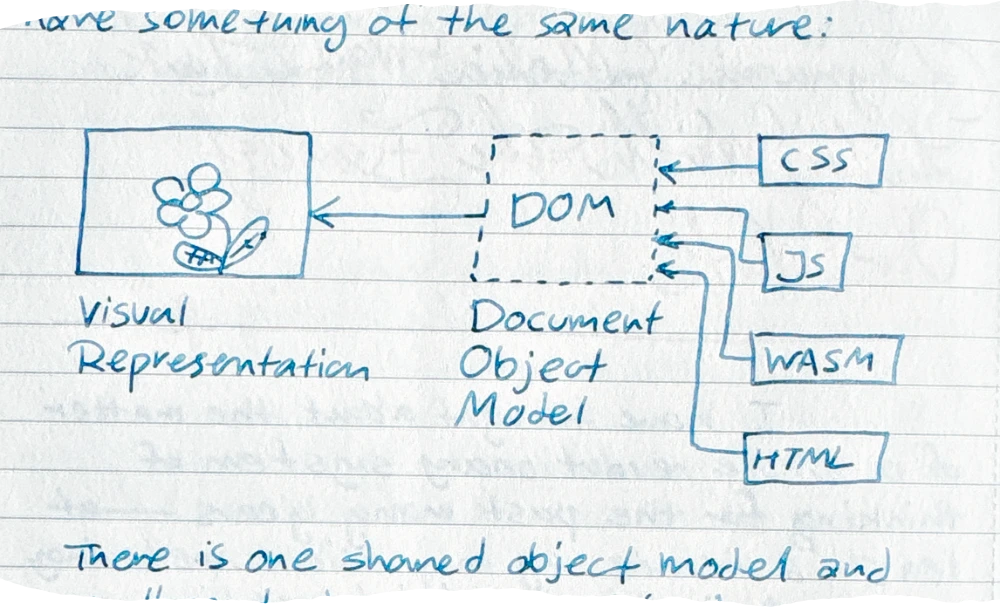
There is one shared object model and one thread where everything happens inside; Then you have many different actors like many JavaScript files, iframes different frameworks working on different places of the page; and some WebAssembly code all working in different terms to each other and all on the same web page.
While all of this is good; you must be looking at the fact that at no time these systems worked nicely together. In web today you have really complicated framework engines like the React; Elm; Svelte … all of which create very horrible code to interact with other codes and with bundling and minimization that becomes even more horrible. But even many years ago where you had all of these embeddings on the web and stuff like that; you could not interact with an iframe or things like that.
And then on the other side of all of this; you have the fact that web is fundamentally a broken thing to make apps with. If it wasn’t; there would be no React and all the revolution that came with it. You have everyone trying to give it a little bit of sanity.
Left undone.
Until recently we accepted that aging of cells was due to “wear and tear” like rusting out a car. The idea that accumulated damage is the principal pathway for cell aging is now complemented by the loss of cell identity model.
In embryonic and early development, our cells establish an identity. It’s locked in throughout our lives, except when it’s lost during the aging process. Although the DNA of every cell of our body is the same (or very close, if interested, see), the epigenetic structure, that includes methylation side chains, histones, nucleosomes and chromatin, is 3-dimensional and differs as a function of cell type. This is happening in the cell’s “mission control,” the nucleus. The epigenetic structure is the bedrock for our cell-specific identity.
There’s a 3-tier regulatory “grammar” that maintains the cell identity, […] The fast layer responds to acute stress in a matter of minutes to hours and relies on production of transcription factors, like AP-1. The intermediate layer takes days to weeks to respond, going through cell state transitions such as activating a cell to promote healing and return to its basal state. The key is the slow layer, he one that locks and insulates the cell identity, the hard boundary, relying on chromatin architecture.
That gets us to Waddington’s epigenetic landscape model for how cells differentiate or de-differentiate, a model that has held up well from Conrad Waddington in 1957! A cell sitting down in the valley (Figure below, culled together from the Nature paper) represents a distinct specialized cell. The deep slope indicates the robustness, also called canalization, accompanied by a deep basin, maintains the identity of the cell, promotes its stability. The differentiated cell is “staying in its lane” in the landscape model and is constrained from sliding out, shifting identity. But with aging, the valleys lose their slope, the basin becomes shallow, there is loss of epigenetic constraints, and there is instability of cell identity. That sets up drift of cell identity, or what can be regarded as mesenchymal drift.
Over the lifespan, as shown on the right side of the Figure below, after peak maturation with the specialized cells (brain, liver heart,kidney, etc) fully and irrevocably differentiated (peak functional state below), the valleys are losing slope and the basins are progressively getting shallower, known as decanalization. The problem is that there is no evolutionary pressure to keep the grooves, valleys and basin in their youthful state, because the “selection shadow” is a post-reproductive trajectory.
I hope your prints arrived safe. I was in a perfect whirlwind of dust & confusion, when I sent them off, else I should have written with the box.— The Canary scheme goes on very prosperously. I am working like a tiger for it, at present Spanish & Geology, the former I find as intensely stupid, as the latter most interesting. I am trying to make a map of Shrops: but dont find it so easy as I expected.—
I rather think we shall send him to Bruce C. School.—2 Your own system of Education sounds capital, & why you sh_ould_. Think I sh_ould_. Laugh at it, I cannot conceive: I believe a good deal of diversity an immense advantage. It is one good point at Bruce Castle: that no one subject exceeds an hour & if a Boy can do it quicker, he may go out before the hour is over.
I beg many pardons for my stupidity in having put wrong note in envelope.
Shall you be at Epperstone in the Autumn, & if you are, would be convenient, if I could manage to pay you a visit—answer this sincerely.— Cannot you pay me a visit at Shrewsbury, is it impossible?