Why is dictatorship bad, but when it reaches to a result it is not bad?
I mean why a horrible person like Steve Jobs is good for everyone and mostly those who he hurt the most? Why do they adore him?
There is a problem with my work and it is that it breaks Hyper-Message for you and forces you to see humans as animals who are pretending, and that is as genuinely hard to bare.
Working with ███████████ is actually not bad. I don’t work with him, but sitting in this space, I have become compatible.
I just renamed “Essays” to “Lab Notes” in the @achive. LLMs took the word too seriously, and well I always hated the name.
I like Jony Ive ’s design as well as his design studio as well as the office in the iA company and perhaps my Father 's office and Ashkan ’s office. But all of this also maps to another world in which I like very maximalist things. I very much adore the Down House where Maestro Darwin used to reside; I love old French palaces; I love ornaments; and all sorts of things. I love Madar ’s maximalist guild design and I love our modern cozy home with IKEA like furniture and minimal things. And so does others. Ive also loves this sorts of places; look at his own house. So why does such a thing happens? Why do we love those things; those sorts of things and things that are in direct contradiction to each other?
I guess there is a very good answer that one can find only if they try to look the right things in the spectrum of findable things. There is the concept of query-agnostic vector. Perhaps the coolest thing I have seen in recent discoveries: A pattern turned into numbers; vectors. You see the actual separation of abstract from the things that can not be reduced into abstraction.
And so that is the exact thing in here: You have three different parts:
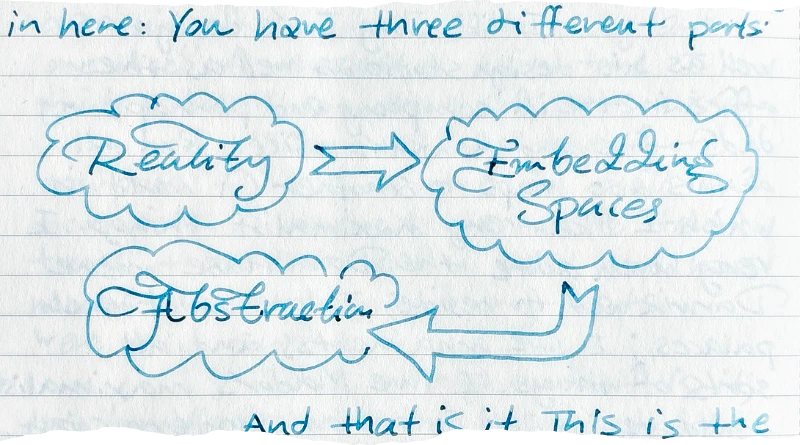
And that is it. This is the whole separation. We see the reality; and our embedding space captures as much as it can. Then it starts to align its weights. Of course that itself is banded to the dimensions of its space—who knows how man—and then you have the layers above the embedding space; the abstraction.
Now I think you see what happens here. If you plot the two sides as this:
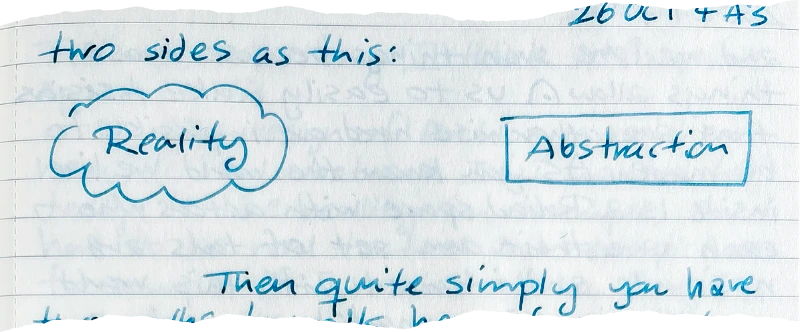
Then quite simply you have two paths to walk here; from reality to creation or from abstraction to creation:
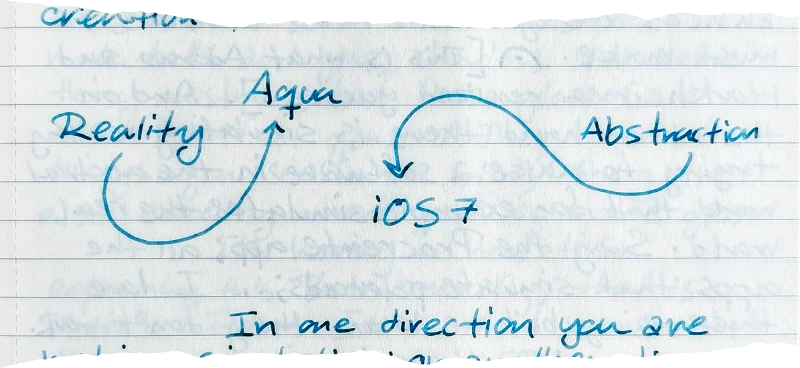
In one direction you are making simulations; on another direction you are making more abstraction. Now given the fact that our brain has different modes for thinking and layers of abstraction we crave all of them. We need the natural element because we are natural beings and we love abstraction because we also are cyborgs. Now it is very interesting that when you are working in the abstract sense; you have rules that can easily be measured and we love such things because those things allow us to easily make decisions that are otherwise hard or impossible to be made. As you know the world we live inside is a Ruliad ( Wolfram ) space with actors who each have their own set of tools and navigate and interact with this world accordingly. Thus what happens is a space in which we don’t know what choices are good and what decisions we must make. [This is what Adorno and Horkheimer realized you see…]. And on the other hand there is simulating reality trying to make a software in the abstract world that for example simulates the real world. Say the Procreate app; all the apps that simulate polaroids;… I love these things but we know they don’t work.
Now there is another class of things. One that I had felt before; one that I love more than anything in this world. One that until this very moment was never known; noticed or had a word. One that I will define and I know for a long time no one will believe is true; and one that I chased for almost my entire life. I guess that thing is neither the Maximalist nor the minimalist; it IS something from the Embedding Space; From The Compound Feelings ; something I think is “ Compound Approximate ”.
The design of Archive is neither realistic nor abstract. If I wanted to design it like reality for example; I had to use real textures and real pictures for example; if I wanted abstraction I had to write with lines and minimal things. But my design is neither. I have a LavaScroll that has like metaballs and glass shaders. Not some thing abstract; but those glasses are also “perfect glasses”. They are not things you see in the wild; they are also exactly what you see in the glass.
I’m having a hard time explaining this. But honestly; that is Plato’s Forms. It is what we see in the embedding space. There are two factors here:
- These things are not abstract; but then they come from our mind which has a limited capacity.
- They are way better than reality. You see a world where if it was real you didn’t like it; while its whole reason to exist is to be an approximation of the real.
This is why Mac OS X Leopard was that legendary; this is why the more Pixar invests in the reality of the Renderman the less interesting their animations became. It is quite something.
I don’t like LAMY pens; they are way too abstract. But then take the Esties and all other Esterbrook things. You have a texture that is supposed to be representing reality “Botanical Gardens” and “Tortoise…” and… But they are somehow abstract and you can never explain them in abstraction; and they are more beautiful than reality. Why? Because—as I’m going to claim here—they resemble the signature of the embedding space and not the abstraction and not the reality. They are things optimized for the architecture of our mind. And I guess this is that signature I used to search for in everything. That is because in gravity and spectrums when you have two sides; everything is defined by their distance to the sides. Until you realize there was a center and so many people operated at that scale without even realizing. This is—if I can prove it—so fucking nice.
I pay maniacal attention to where an idea comes from, and I even keep notebooks filled with my ideas, […] So it hurts when he takes credit for one of my designs.