0
1
2
3
4
5
6
7
8
9
0
1
2
3
4
5
6
7
8
9
0
1
2
3
4
5
6
7
8
9
0
1
2
3
4
5
6
7
8
9
–
0
1
2
3
4
5
6
7
8
9
0
1
2
3
4
5
6
7
8
9
–
0
1
2
3
4
5
6
7
8
9
0
1
2
3
4
5
6
7
8
9
0
1
2
3
4
5
6
7
8
9
0
1
2
3
4
5
6
7
8
9
0
1
2
3
4
5
6
7
8
9
0
1
2
3
4
5
6
7
8
9
/
0
1
2
3
4
5
6
7
8
9
0
1
2
3
4
5
6
7
8
9
/
0
1
2
3
4
5
6
7
8
9
0
1
2
3
4
5
6
7
8
9
ANNO·​TRICESIMO·​DIE·​DVCENTESIMO·​SEPTVAGESIMO·​TERTIO·​VITÆ·​POVYA
Quotes & Excerpts

I wrote FANGS in its entirety, without ever seeing a response from someone else. And I think that kinda took some pressure off, and allowed me to work in a style that was a bit edgier, and a bit more macabre. And that really made the writing flow for me, and was very exciting.

[The] thesis for fangs was very important to me. For example Jimmy’s empathy and patience is really important in allowing the characters to feel like they can be themselves around each other. And on the flip side, you have Elsie’s kind of intense self-confidence and self-acceptance, and I really tried to emphasize those qualities because it was what made the thesis work.

I’m a big believer in starting messy. So my sketchbooks and my notebooks are very sloppy, and I tend to write just with sick figures,
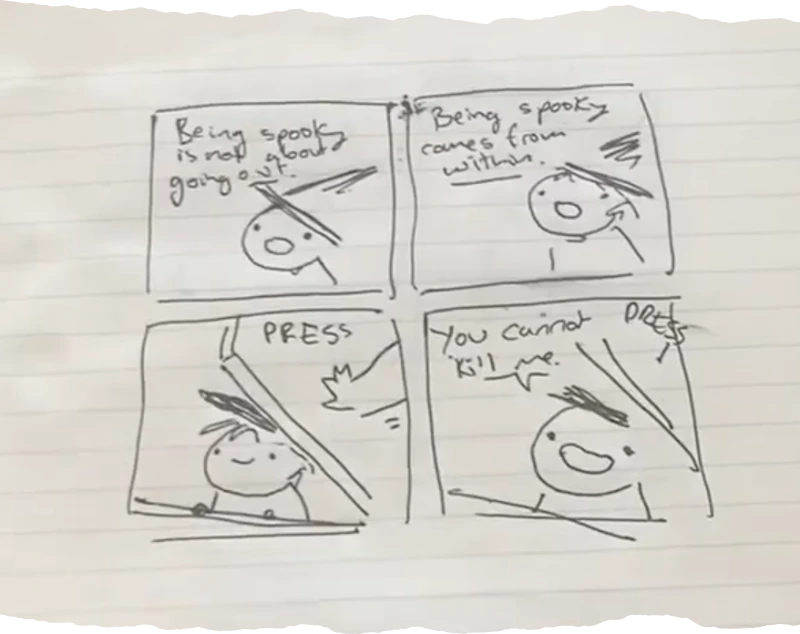
and I’ll even go in with scissors, and like cut and paste panels.
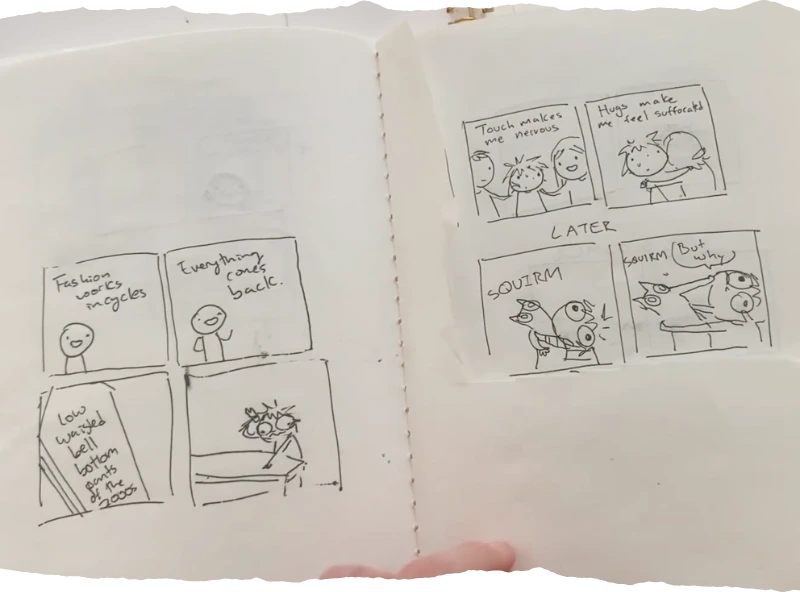
And being that sloppy at the beginning is really a way for me to leave my perfectionism at the door and, let just very pure ideas flow.

Day's Context
Open Books
Sarah Andersen's Comic Process for FANGS | Tapas Creator Spotlight Counterblast
Written byMaestro McLuhan
&Harley Parker
Creative SchoolsThe Grassroots Revolution That's Transforming Education
Written byKen Robinson
&Lou Aronica
Leonardo Da Vinci
Written byWalter Isaacson
Project Management for DummiesSecond Edition
Written byNick Graham
RachmaninoffComposer, Pianist, Conductor
Written byBarrie Martyn
Year 30, day 273 of Pouya's Life Sarah C. Andersen Sarah C. Andersen 30⟡111Exact Music, Ambiguity, Creativity, And Sub-Graph TransferDefines GutterThe negative space or gap between the nodes transmitted during communication. The receiver actively fills this space (often subconsciously) with their own concepts, leading to interpretation, creativity, and inevitable misunderstanding. Sub-Graph TransferThe fundamental mechanism of communication. A sender transmits a partial graph (a scaffold of nodes), and the receiver reconstructs it using their own Mind Graph, actively filling the gaps. Sarah C. Andersen Mind GraphThe internal, weighted network of concepts, memories, tools, and emotions unique to an individual. The fundamental structure of the mind.