I saw a dream where ███████████ was a very nice person in.
Last time those cranes fucked me up such that this time I slept like a baby.
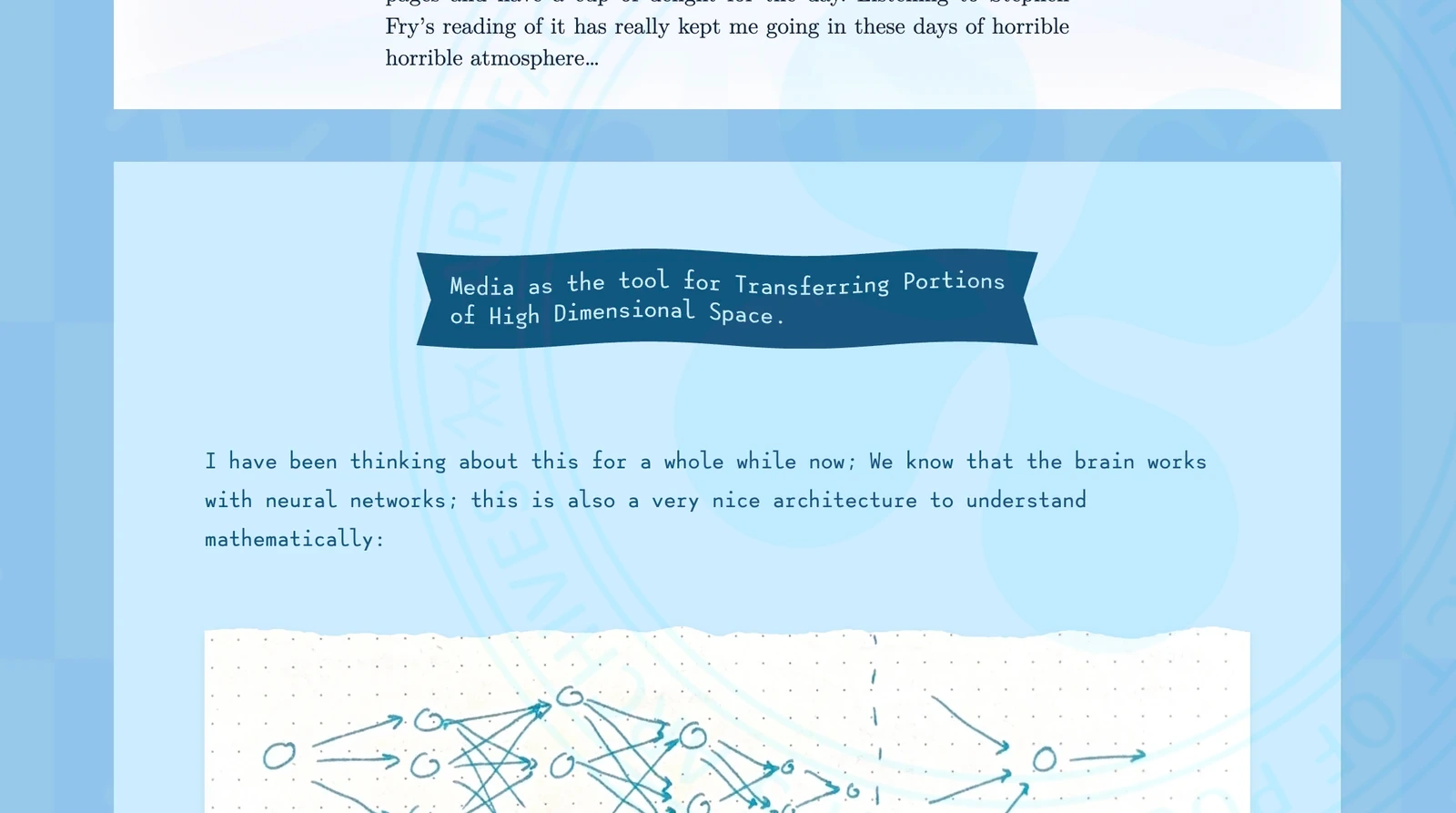
Media should be designed in reverse. Instead of making something and see how its attributes shape society, we have to see what society we want and set the attributes of the media.
Brassed Off’s version of Concerto de Aranjuez is so perfect that for a few days now I cannot help but listen to it on repeat and be amazed each time.
My theories happened because of my life being exactly like this.
If I had not have a very very huge family, if I had not have parents who had connections to many people, if I had not been exposed to greatest works of science and art…
If I had not went to therapy, if my relationship with Zea was not long distance for a year and a half at first, and that way of getting to each other never happened.
If I had not jumped between so many fucking things, not ever having a clear definition of my work and life.
If therapy had not made me try to build myself again from first principles, brick by brick.
If @sina had not made me learn about neuroscience and limitations of the mind.
If so many many many many many things… If I had not not known about all of these specific quotes that made me think like this.
If I had never learned about Maestro Victor , and then Maestro Moeller , and then about his theories and the media theories…
If M. ██████ gave me music listens any other ways.
If I had not been forced to reverse-engineer everything, if there was no limitations in my life, if I was not bored at school, had a great computer that was fast…
Andy Warhol loved that the poor and the president both drank the same cola. I hate it that the same LLMs are doing all the work everywhere.
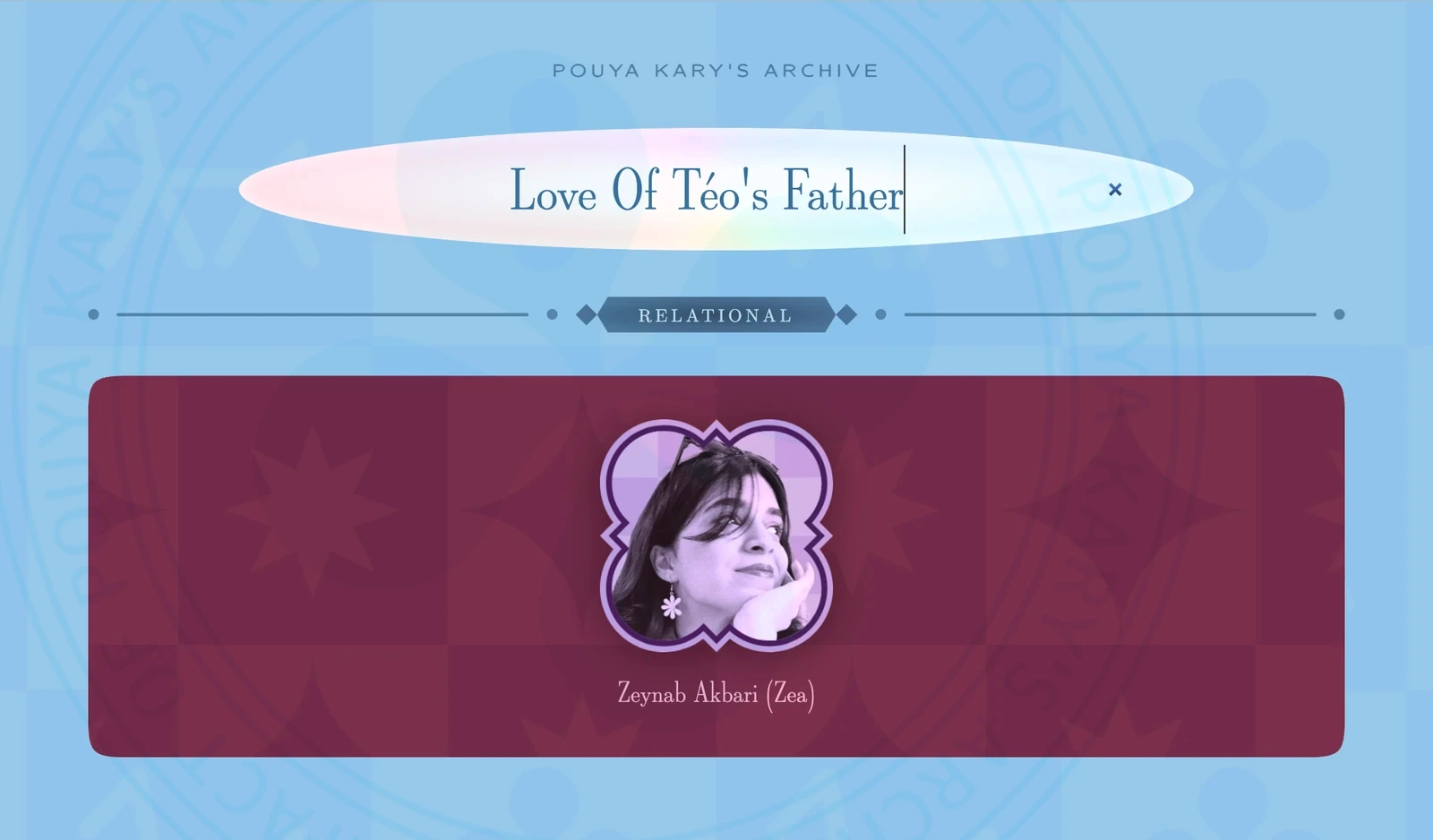
So, in the weekend I made a prolog language for Archive , and added it to the search. With this, you can define exact graph connections and query them. For example, look at the query in here which says Love Of Téo's Father. I have described one level of relations to the Archive , and it has things like: male(pouya), and that I’m Téo ’s parent. parent(pouya, teo). From here, given that teo is male, it has: son(?b, ?a) = male(?a), parent(?a, ?b), and I’m his father because father(?a, ?b) = male(?a), parent(?a, ?b). It can also deduce that love(?a, ?b) = partner(?a, ?b), and since it can even combine these queries, the result is shown as Zea .
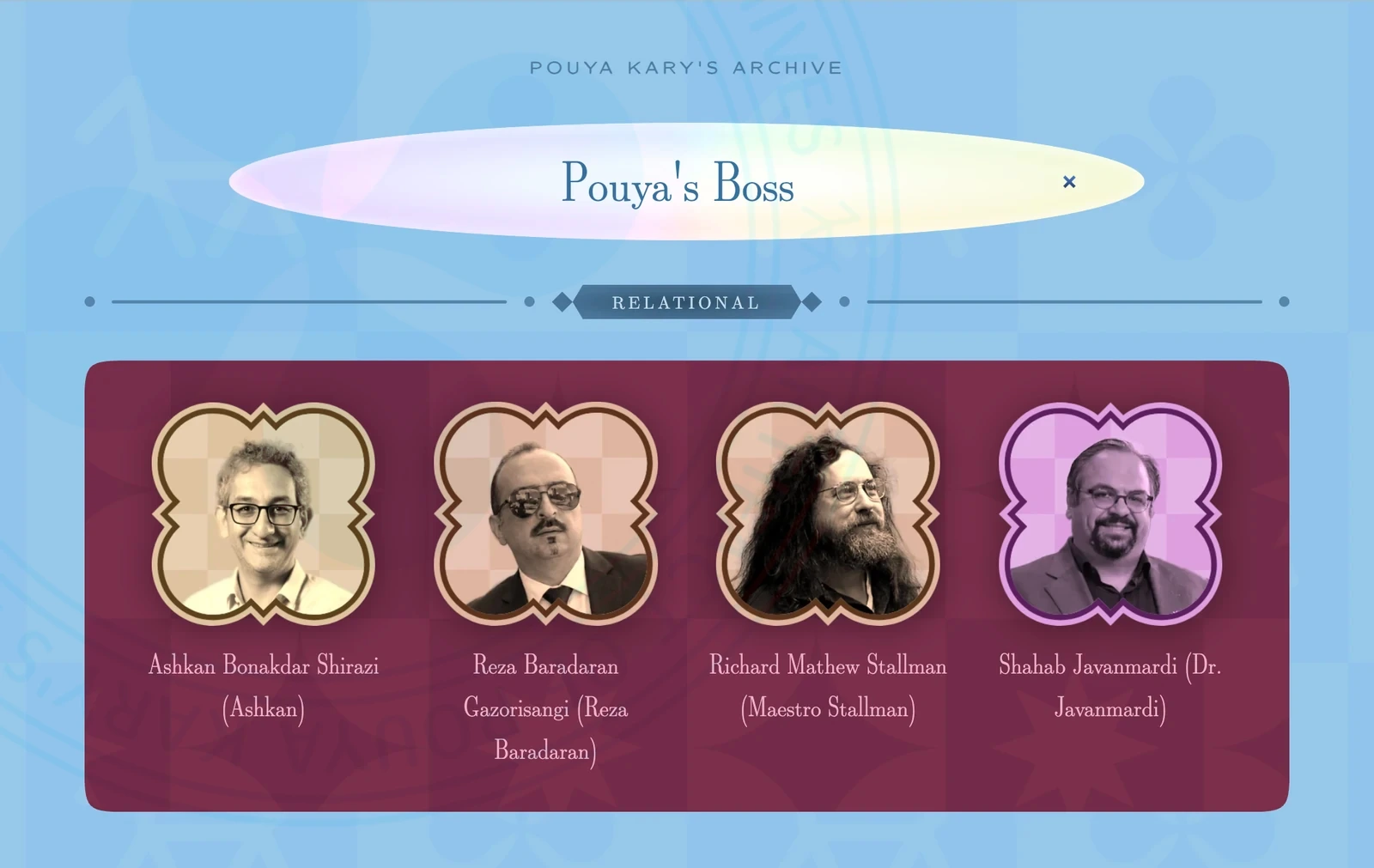
In another example of this, I have searched for pouya's boss. Ashkan is my boss, Maestro Stallman and Reza Baradaran used to be my bosses, and the interesting thing is that because: boss(?a, ?c) = boss(?a, ?b), boss(?b, ?c), Dr. Javanmardi is also my boss.
I was thinking about having 1285 Logo-style headings for Archive ’s lab note headings. But I didn’t want to have a shader and a picture of the heading, I wanted to have a vector one in high quality. And this is where the magic happens. Thanks to LLMs doing all the heavy lifting, I now open a typeface, render it into path shapes, then apply a sine field and distort the whole control points of the letters and the flag, and voila. This should have been illegal few years ago, but well its 2026.
This is possible thanks to Aryabhata and Leonhard Euler , whose work on the sine function provides the mathematical basis for the wave distortion; Sergei Bernstein, Pierre Bézier, and Paul de Casteljau, who gave us the Bernstein polynomials and Bézier curves that define how the glyph outlines are represented and warped; Thomas Sederberg and Scott Parry for formalizing free-form deformation, and Richard Bartels and John Beatty for their work on the direct manipulation of Bézier control points; Camille Jordan and Oswald Veblen for the Jordan curve theorem, which underpins the even-odd fill rule used to subtract the text from the flag; John Warnock and Charles Geschke, whose PostScript and Type 1 font technology established the modern framework for digital typography; Sampo Kaasila, who invented the TrueType font format at Apple; the teams at Microsoft and Adobe who developed OpenType as a unified successor; Maestro Knuth , whose Metafont system pioneered the mathematical description of typefaces; the inventors of font hinting, including Doug Brotz and John Warnock, for making outlines render cleanly at any size; Bala R. Vatti, Francisco Martínez, Antonio Jesús Rueda, and Francisco Ramón Feito, whose polygon clipping algorithms make robust path boolean operations possible; and Behdad Esfahbod , whose HarfBuzz text-shaping engine turns Unicode text into the positioned glyphs that are ultimately warped and subtracted—along with the countless others who advanced computer typography, OpenType, and text shaping.
Real Vector Distorted Flag Heading Titles For Archive (3/3)
I have been feeling sick for the past two days. My body hurts and I have little energy. While most people resent this state, each time I get sick, I rediscover in myself that it gives me a really better time. What do I mean by this?
Back in the days, when I went into school; each time I got sick, my grades went up. I used to ace all the tests when I was sick, and then downgrade to something horrible when I got better. It never registered with me why, but I knew the effect was there. Now today, I want back home and after a while Zea told me: Why are you so overly nice today? what is it with you? And I realized that man this is me being sick.
You probably know about my body being in a state of constant physical pain. I always feel tension everywhere to the point that I cannot concentrate, sleep, do basic things, and it is killing me. You have no idea how this pain is. And then, when I become sick, the pain gets lower and today when Zea told me that, I realized I have not felt that pain.
I think my body just cuts that dämonisch thing for energy saving and it frees me. This is exactly like getting drunk, only it doesn’t make you sick because you already are, and it gives me a tiny window into knowing what happiness looks like before I get healed and the taste goes away… Fucked up right?
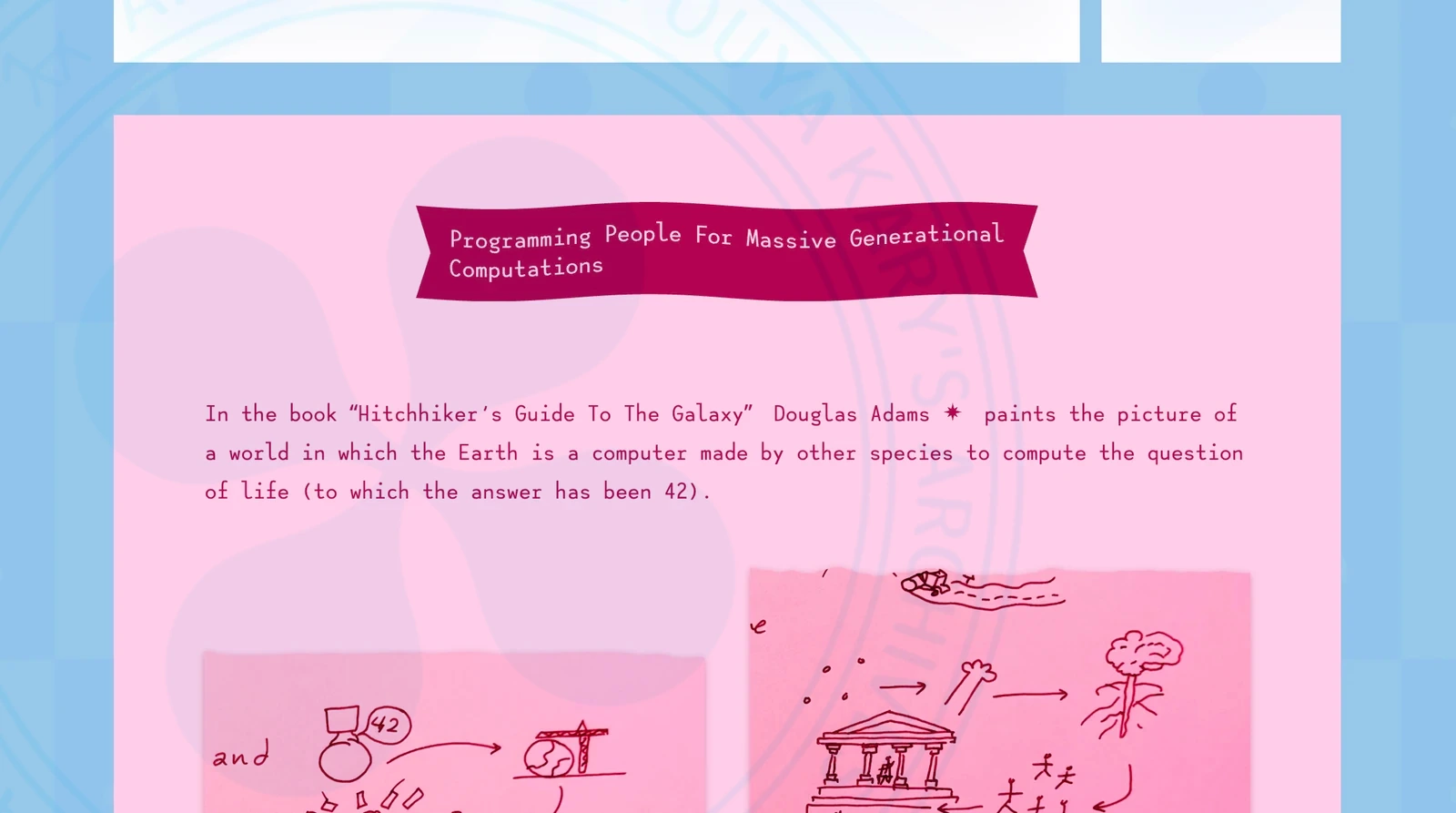
Mr. Edison says That the radio will supplant the teacher. Already one may learn languages by means Of Victrola records. The moving picture will visualize What the radio fails to get across. Teachers will be relegated to the backwoods. With fire-horses, And long-haired women; Or, perhaps shown in museums. Education will become a matter Of pressing the button. Perhaps I can get a position at the switchboard.
In 1981 Donald Knuth and Michael Plass published a different method. It does not look at one line at a time, but at the whole paragraph. Each possible break point gets a cost: the badness of the line that ends there, plus penalties for hyphens and for hyphens in consecutive lines. Then the algorithm searches for the break points with the lowest total cost, the demerits. So a decision in the first line can depend on the last line.
Knuth and Plass describe this as a graph. Each feasible break is a node, and each possible line between two breaks is an edge. The edge has the demerits of this line as its weight. The best paragraph is the cheapest path from the start to the end. Here is the graph for the first sentence of “The Frog King”, the fairy tale that is also used in their paper. Boxes and glue computed the numbers:
Neil Postman offers a few suggestions for positive purposes for education that I found heartening, not mainly for their content, but for the fact that it’s possible to make up new purposes for education and advocate for them. My favorite suggestions of Postman’s are:
Spaceship Earth – we’re all in this together; let’s take care of each other and our planet.
The American Experiment – let’s revive our sense of wonder, curiosity, and responsibility about what America is and can be.
The World Makers – as a student of McLuhan , Postman would be remiss if he didn’t invite students to make the tools and narratives that thereafter make us.
Nassim Nicholas Taleb has helped me appreciate the staying power of staying power, sometimes called The Lindy Effect. Merely staying alive implies some anti-fragility to adapt and survive. Consider that Harvard, Yale, and Princeton were founded to educate the clergy.
The Lindy effect (also known as Lindy’s law) is a theorized phenomenon by which the future life expectancy of some non-perishable thing, like a technology or an idea, is proportional to its current age. Thus, the Lindy effect proposes the longer a period something has survived to exist or be used in the present, the longer its remaining life expectancy. Longevity is a resistance to change, obsolescence, or competition, and greater odds of continued existence into the future. Where the Lindy effect applies, mortality rate decreases with time. Mathematically, the Lindy effect corresponds to lifetimes following a Pareto probability distribution.
I once tried to come up with a single-word purpose for education, and I landed upon the word “resourceful”, because I reasoned that if you “were able to use arbitrary resources to uncover and solve problems”, you had no more need for schooling. In the age of Google, email, and the internet, a person was educated when they could wield them. But now I see my vision of resourcefulness perfected in the AI agent and its tool loop. Maybe resourcefulness will go the way of the Dewey Decimal System which in turn supplanted memorization and an oral tradition.
TEX has a page builder. It collects lines until the page is full and then calls the output routine. This is a piece of code that gets the material and decides what to do with it. It is very powerful, but also very hard to use. The speedata Publisher never used it.
Yesterday, my 3 year old daughter was very upset because she wanted to wear her very dirty top from the day to bed. I took exactly the approach described. I didn’t scold her for being upset about something that doesn’t matter - it did to her! - I sympathised about how she felt, but also explained that it had to be changed. This didn’t result in her refusing and a big fight. She agreed and changed her top without any physical force.
As she did, she was still crying, but with hugs from me. Instead of me being the adversary imposing the rules, she got to have emotional support through what was, for her, a hard time.
She will not grow up to be an emotionally fragile adult, upset every time she needs to change her top. (At least, not because of that interaction.) That’s giving your actions too much credit! She will learn for herself that it’s not important. But she’ll grow up feeling supported.
The concept is named after Lindy’s delicatessen in New York City, where the concept was informally theorized by comedians: a show running only two weeks would be expected to last another two weeks, while a show that has lasted two years could expect a further two-year run. The Lindy effect has subsequently been theorized by mathematicians and statisticians. Nassim Nicholas Taleb has expressed the Lindy effect in terms of “distance from an absorbing barrier”.
In the Western world, beginning in the thirteenth century and for five hundred years afterward, that God was sufficient justification for the founding of institutions of learning, from grammar schools, where children were taught to read the Bible, to great universities, where men were trained to be ministers of God.
I believe in Dr. Alfie Kohn’s notion that we should relate to our educational charges as humans, not objects – “doing with” vs “doing to”. Thus, I believe it may be most honest and effective to invite our children to help us craft the purpose for their education as we figure it out together.
Schools survived what happened to religion. It should be no surprise that they’ve survived the radio, motion pictures, and the internet.
We typically confuse why something claims it exists, ie to glorify God, vs the forces that actually perpetuate it, which are subtler, we’d prefer not spoken aloud, and more prosaic, ie endowments, prestige, and needing someone to watch one’s kids.
Footnotes look like the easiest thing on a page, but they are among the hardest. A footnote must be on the same page as its reference. But the footnote takes space from the main text, so maybe the line with the reference does not fit on the page anymore. Then the reference moves to the next page, and the footnote has to move with it. A long footnote sometimes has to be split across two pages, while the reference stays on the first one.
TEX solves this with insertions. This is a separate mechanism next to the page builder that keeps track of the space the inserted material needs.