0
1
2
3
4
5
6
7
8
9
0
1
2
3
4
5
6
7
8
9
0
1
2
3
4
5
6
7
8
9
0
1
2
3
4
5
6
7
8
9
–
0
1
2
3
4
5
6
7
8
9
0
1
2
3
4
5
6
7
8
9
–
0
1
2
3
4
5
6
7
8
9
0
1
2
3
4
5
6
7
8
9
0
1
2
3
4
5
6
7
8
9
0
1
2
3
4
5
6
7
8
9
0
1
2
3
4
5
6
7
8
9
0
1
2
3
4
5
6
7
8
9
/
0
1
2
3
4
5
6
7
8
9
0
1
2
3
4
5
6
7
8
9
/
0
1
2
3
4
5
6
7
8
9
0
1
2
3
4
5
6
7
8
9
ANNO·TRICESIMO·DIE·DVCENTESIMO·OCTOGESIMO·NONO·VITÆ·POVYA
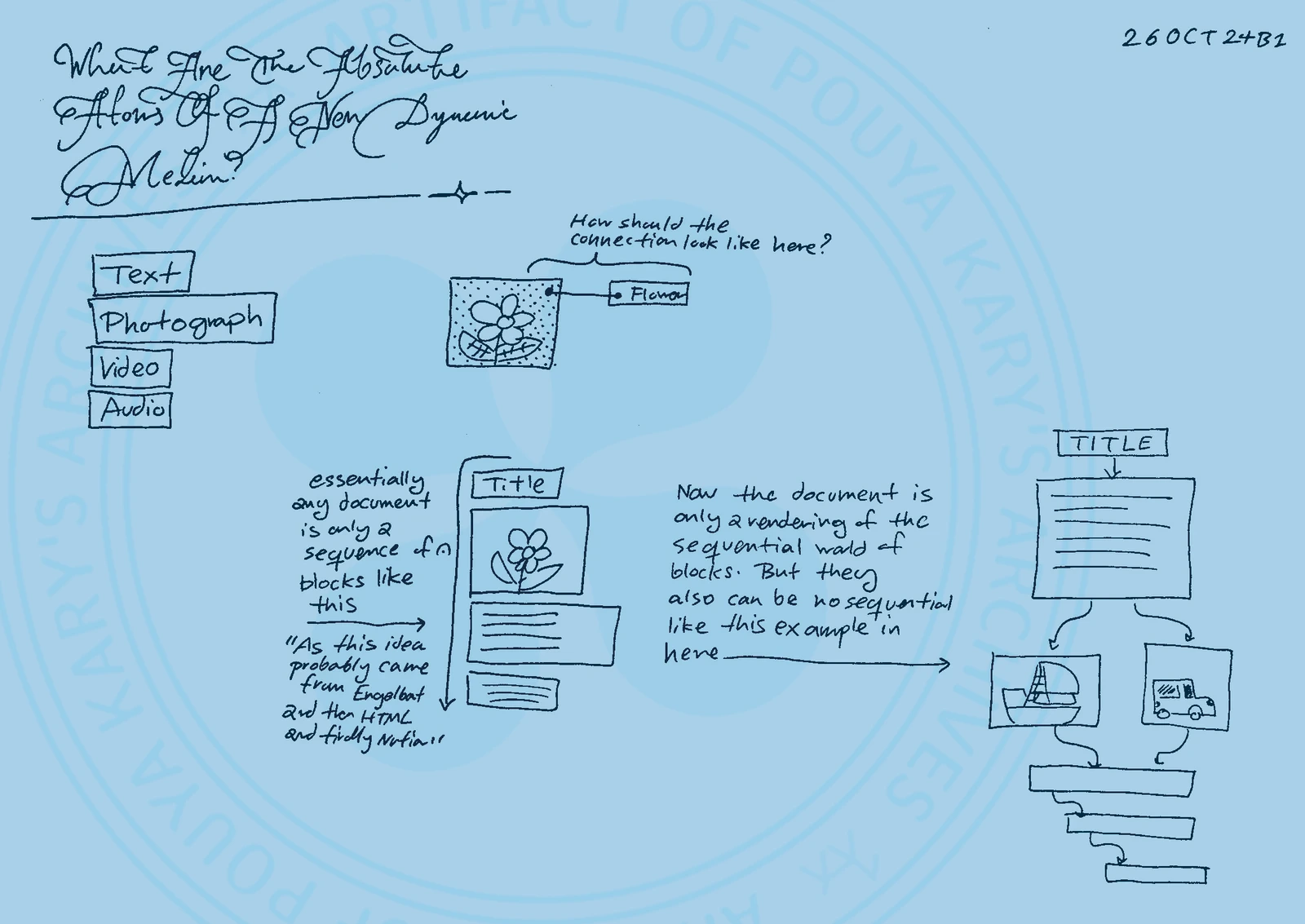
![Page 1: 26OCT24-B1
Description: A handwritten lab note exploring the fundamental
nature of a new dynamic medium and how documents are constructed. On
the left, a vertical list categorizes media into four boxed types:
Text, Photograph, Video, and Audio. Next to it is a
drawing of a photograph (a flower) with a line pointing to a small box
labeled 'Flower' and the question 'How should the connection look like
here?'. Below this, a sequential block diagram shows a document built
as a stack of elements (Title, Image, Text) with the note:
'essentially any document is only a sequence of blocks like this,'
adding in the margin, 'As this idea probably came from Engelbart and
his HTML and finally Nota!'. On the bottom right, the text explains
that a document is a rendering of these blocks, but they can also be
non-sequential. This is illustrated by a branching tree diagram where
a 'TITLE' points downward to two parallel images (a sailboat and a
truck), which then merge back into stacked text blocks below.
Transcription:
Header: What Are The Absolute efforts of a New Dynamic Medium?
Left List: Text, Photograph, Video, Audio Top Right: [Drawing
of a flower photo] -> Flower. 'How should the connection look like
here?' Middle Left: [Vertical block diagram: Title -> Image ->
Text]. 'essentially any document is only a sequence of blocks like
this' / 'As this idea probably came from Engelbart and his HTML and
finally Nota!' Middle Right: 'Now the document is only a rendering
of the sequential world of blocks. But they also can be no sequential
like this example in here' Bottom Right: [Tree diagram: TITLE
points to two images (Sailboat, Truck) which branch down into
text blocks].](/photographs/automatic/2026/10/24/what-are-the-absolute-atoms-of-a-new-dynamic-medium-1.webp)
What Are The Absolute Atoms Of A New Dynamic Medium? (1/5)
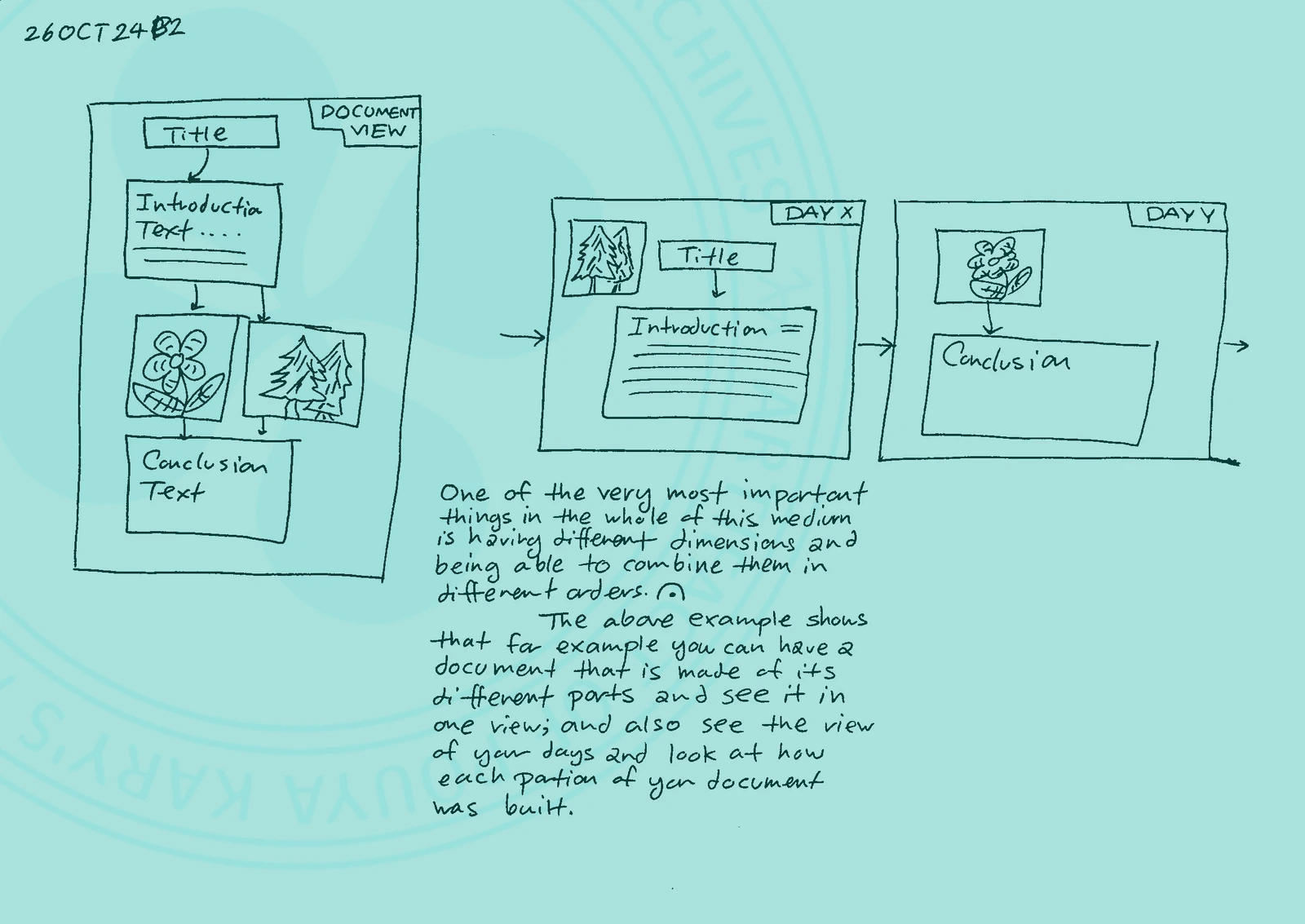
![Page 2: 26OCT24-B2
Description: A handwritten lab note detailing how the medium
handles multi-dimensional views of the same content. On the left, a
large document layout labeled DOCUMENT VIEW shows a 'Title'
leading to 'Introduction Text...', which branches into two parallel
images (a flower and a forest), which then converge into 'Conclusion
Text'. On the right, an arrow points to a different way of viewing the
exact same data: a chronological sequence. This is shown as two pages,
DAY X (containing a forest image, title, and introduction) and
DAY Y (containing a flower image and a conclusion). The text below
explains that the most important part of this medium is having
different dimensions and combining them in different orders—allowing
one to see a document as a holistic structural piece, or to see how it
was built chronologically over days.
Transcription:
Left: DOCUMENT VIEW [Diagram: Title -> Introduction Text ->
[Flower Image | Forest Image] -> Conclusion Text] Right: [Diagram:
DAY X (Forest Image, Title, Introduction =) -> DAY Y (Flower Image,
Conclusion)] Text: 'One of the very most important things in the
whole of this medium is having different dimensions and being able to
combine them in different orders. The above example shows that for
example you can have a document that is made of its different parts
and see it in one view; and also see the view of your days and look at
how each portion of your document was built.'](/photographs/automatic/2026/10/24/what-are-the-absolute-atoms-of-a-new-dynamic-medium-2.webp)
What Are The Absolute Atoms Of A New Dynamic Medium? (2/5)
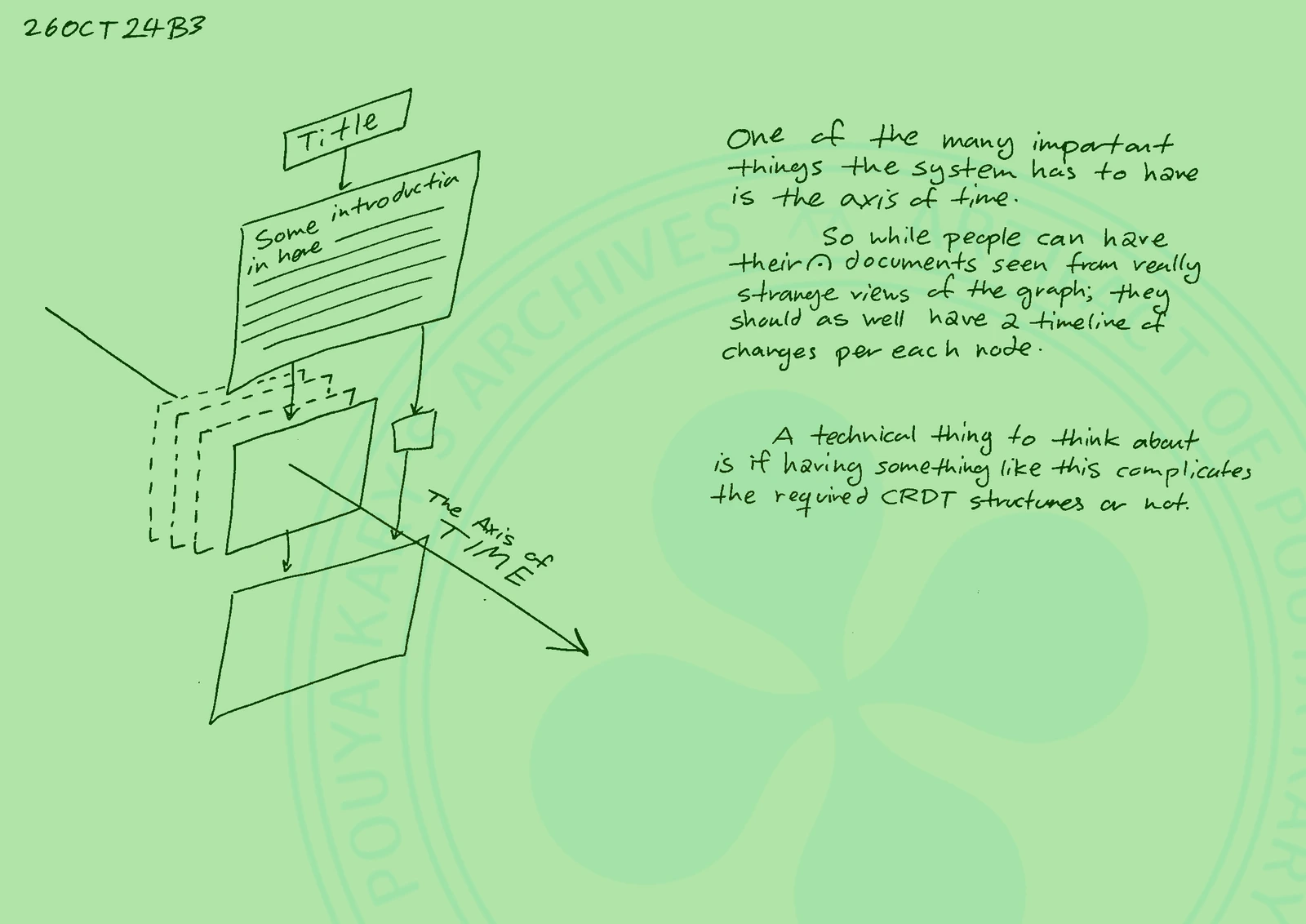
![Page 3: 26OCT24-B3
Description: A handwritten lab note exploring the intersection of
spatial document layout with the dimension of time. On the left, an
isometric 3D sketch shows a 'Title' pointing downward to an
'introduction' text plane, which then points to a lower square plane.
To the left are stacked dashed planes. A diagonal arrow cuts through
the entire 3D space, labeled The Axis of TIME. On the right, the
text states that the system must have an axis of time. It explains
that while people can view documents from strange spatial views of the
graph, they must also have a timeline of changes for each individual
node. The note ends with a technical question for the implementation:
'A technical thing to think about is if having something like this
complicates the required CRDT structures or not.'
Transcription:
Left: [Isometric 3D diagram of document planes: Title ->
Introduction -> Image/Text blocks, intersected by an arrow labeled
'The Axis of TIME'] Right: 'One of the many important things the
system has to have is the axis of time. So while people can have their
documents seen from really strange views of the graph; they should as
well have a timeline of changes per each node. A technical thing to
think about is if having something like this complicates the required
CRDT structures or not.'](/photographs/automatic/2026/10/24/what-are-the-absolute-atoms-of-a-new-dynamic-medium-3.webp)
What Are The Absolute Atoms Of A New Dynamic Medium? (3/5)
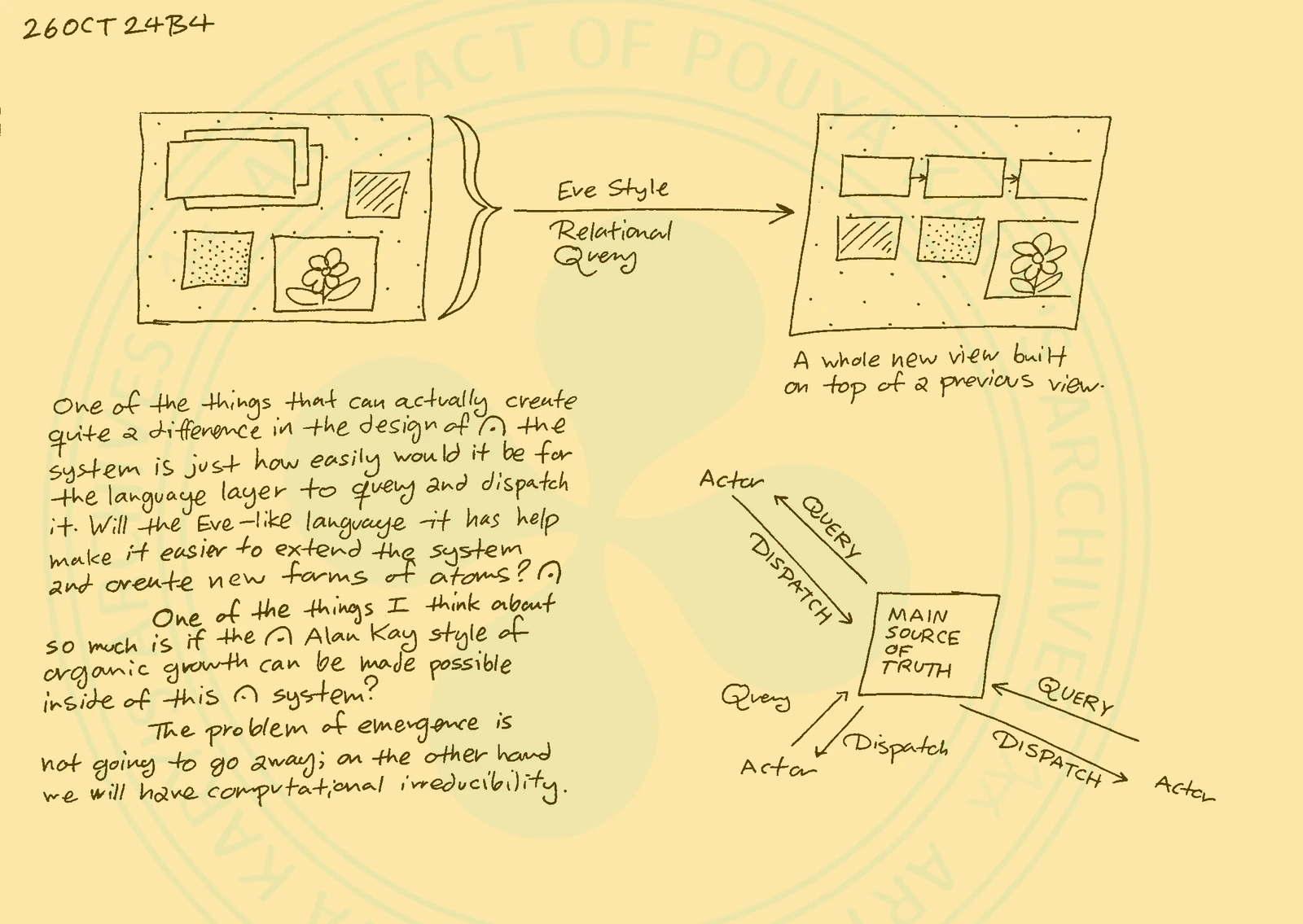
![Page 4: 26OCT24-B4
Description: A handwritten lab note focusing on the relational
query engine and the architectural philosophy of the system. At the
top, a visual transformation is shown: a chaotic, scattered set of
blocks (text, images, a dotted square) is passed through an 'Eve
Style Relational Query' arrow, resulting in a neatly structured,
connected graph of the same elements. The caption reads: 'A whole new
view built on top of a previous view.' Below, the text discusses the
importance of the language layer for querying and dispatching,
wondering if an Eve-like language will help users extend the system
and create new atoms. It ponders if Alan Kay's style of organic growth
can exist here, noting that the problem of emergence will persist
alongside computational irreducibility. A diagram on the bottom right
illustrates the architecture: multiple Actors send QUERIES to
a central box labeled MAIN SOURCE OF TRUTH, which then sends
DISPATCHES back out to the Actors.
Transcription:
Top Diagram: [Scattered blocks] -> 'Eve Style Relational Query' ->
[Connected block diagram]. 'A whole new view built on top of a
previous view.' Text: 'One of the things that can actually create
quite a difference in the design of the system is just how easily
would it be for the language layer to query and dispatch it. Will the
Eve-like language it has help make it easier to extend the system and
create new forms of atoms? One of the things I think about so much is
if the Alan Kay style of organic growth can be made possible inside of
this system? The problem of emergence is not going to go away; on the
other hand we will have computational irreducibility.' Bottom Right
Diagram: [Architecture Diagram: Actors <-> QUERY / DISPATCH <-> MAIN
SOURCE OF TRUTH].](/photographs/automatic/2026/10/24/what-are-the-absolute-atoms-of-a-new-dynamic-medium-4.webp)
What Are The Absolute Atoms Of A New Dynamic Medium? (4/5)
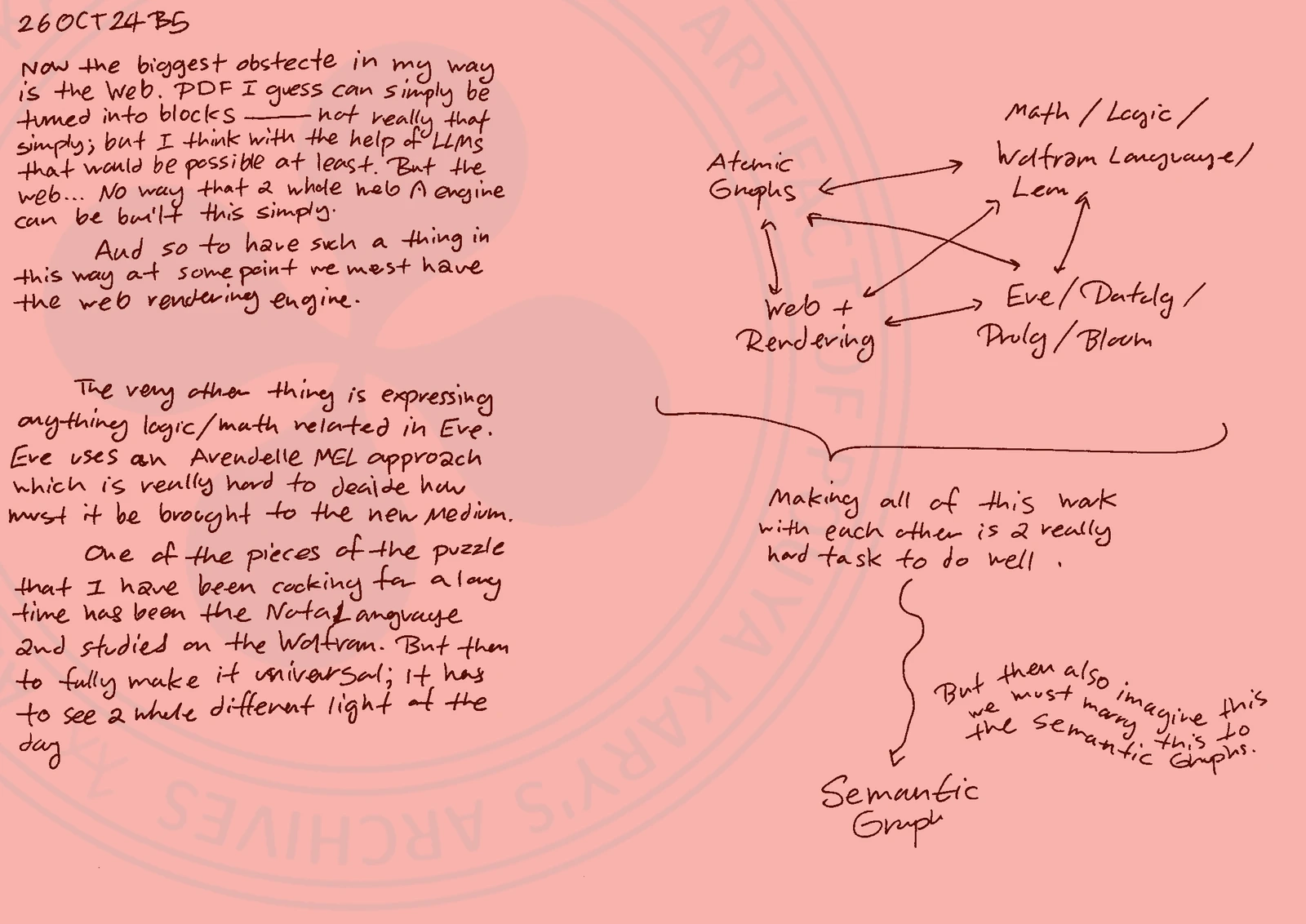
![Page 5: 26OCT24-B5
Description: A handwritten lab note discussing the technical
obstacles of the medium and the ambition to unify logic, math, and web
rendering. On the left, the text identifies the 'web' as the biggest
obstacle, noting that while PDFs can be turned into blocks (with the
help of LLMs), building a whole web rendering engine is incredibly
complex. It also discusses the difficulty of expressing logic/math in
Eve (which uses an Arendelle MEL approach) and reflects on the
long-standing goal of making the Nota Language (influenced by
Wolfram) universal, stating it 'has to see a whole different light of
the day.' On the right, a diagram shows arrows connecting Atomic
Graphs, Math / Logic / Wolfram Language / Lean, Web +
Rendering, and Eve / Datalog / Prolog / Bloom. A bracket groups
these fields with the note: 'Making all of this work with each other
is a really hard task to do well.' Finally, an arrow points from this
group to Semantic Graphs, with the note: 'But then also we must
imagine this to the Semantic Graphs.'
Transcription:
Left Text: 'Now the biggest obstacle in my way is the web. PDF I
guess can simply be turned into blocks — not really that simply; but I
think with the help of LLMs that would be possible at least. But the
web... No way that a whole web A engine can be built this simply. And
so to have such a thing in this way at some point we must have the web
rendering engine.' 'The very other thing is expressing anything
logic/math related in Eve. Eve uses an Arendelle MEL approach which is
really hard to decide how must it be brought to the new medium. One of
the pieces of the puzzle that I have been cooking for a long time has
been the Nota Language and studied on the Wolfram. But then to fully
make it universal; it has to see a whole different light of the day'
Right Diagram: [Atomic Graphs] <-> [Math / Logic / Wolfram
Language / Lean] [Web + Rendering] <-> [Eve / Datalog / Prolog /
Bloom] Bracket Text: 'Making all of this work with each other is a
really hard task to do well.' Bottom Text: 'But then also we must
imagine this to the Semantic Graphs.' -> [Semantic Graphs]](/photographs/automatic/2026/10/24/what-are-the-absolute-atoms-of-a-new-dynamic-medium-5.webp)
What Are The Absolute Atoms Of A New Dynamic Medium? (5/5)
Day's Context