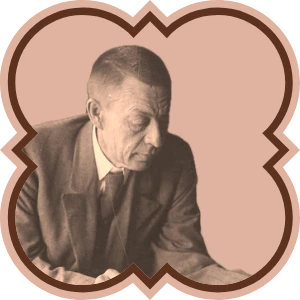
The case of Maestro Rachmaninoff helps to confirm the opinion of those who assert the importance of inheritance in the possession of musical gifts, for three generations of Rachmaninoffs on the composer’s father’s side were musically talented to an unusual degree. Rachmaninoff’s great-grandfather Alexander Gerasimovich and his wife Mariya Arkadyevna, to whom the minor composer and Intendant of the Imperial Chapel Nikolay Bakhmetev (1807-1891) was related and who is said to have studied music ‘with the best teachers of that time’, instituted a choir and orchestra on their Znamenskoye estate. Alexander Gerasimovich died young and Mariya Arkadyevna remarried, but the children of both marriages seem to have shared her musical talent. Her son, Arkady Alexandrovich Rachmaninoff, the composer’s grandfather, was a devoted amateur musician, whose wealth deprived him of the necessity of turning his hobby into a profession. A pupil of John Field and a prolific composer of light piano pieces and songs, he played the piano every day of his life and often took part in charity concerts. Rachmaninoff dimly recalled once playing duets with him when he was four years old. The composer’s father, Vasily Arkadyevich Rachmaninoff, was another enthusiastic pianist who may also have composed or at least improvised. One of his sisters wrote: ‘He used to play the piano for hours, not familiar pieces but God knows what’, and Rachmaninoff himself carried away the mistaken impression that the polka by Franz Behr he had heard him play, and of which many years later he made a concert arrangement, the Polka de W.R., was his father’s own work. No-one, then, should have been altogether surprised when Rachmaninoff, like his sister Elena before him, showed a precocious talent in the family tradition.
Maestro Rachmaninoff ’s first music teacher was his mother. Despite being better placed than anyone to recognize her son’s preternatural gift, she seems to have failed to do so, but when it was brought to her attention by the children’s governess, she engaged a friend of hers who happened also to be a student of St Petersburg Conservatoire, Anna Ornatskaya, to give formal piano lessons.
The earliest surviving piano piece of Maestro Rachmaninoff is probably the so-called ‘Song Without Words’ in D minor, reproduced from memory by the composer in 1931 for Riesemann’s biography and described there as one of ten written as an exercise for Arensky’s harmony class at the end of the academic year 1886-87, though the examination at the end of the course, at which Rachmaninoff played these pieces for Tchaikovsky, did not take place until a year later, in May 1888. Unlike the orchestral Scherzo, whose key it shares, far from having the Mendelssohnian overtones its title implies, the piece is imbued with Russian melancholy to a degree perhaps unnatural in a boy so young, though in retrospect this can be seen as a portent of the kind of emotional world the mature composer was to make so much his own.
A composer who may just possibly be a distant influence on all these early pieces [
In 1890 and 1891 Maestro Rachmaninoff wrote two six-hand piano pieces for the Skalon sisters. The first, a brief Waltz, based on a theme composed by Natalya Skalon and dedicated to her, is no more than agreeable salon music, but the extended Romance of a year later is of a very different character, for this touching love song is the first example in Rachmaninoff’s work of the kind of tender, lyrical outpouring that became characteristic of the mature composer. Moreover, it contains clear musical pointers to this later style, for not only is the introductory accompaniment figuration identical to the opening of the slow movement of the Second Concerto, written nine years later, in 1900-01, but a harmonic sequence in the coda was borrowed, not quite so literally, for the similarly named Romance of the Second Suite for Two Pianos, written at the same time as the concerto. It is interesting that some twenty years after the composition of these two pieces of juvenilia, when their existence was still known only to the dedicatees, the composer asked Natalya Skalon to return the manuscripts so that they could be destroyed, but the sisters kept them for sentimental reasons and the works were published only after Rachmaninoffs death perhaps Rachmaninoff, by then married to the formidable Natalya Alexandrovna, feared that the existence of what might be seen as a youthful musical love letter might be a source of embarrassment.
April is something of a curiosity in that it was set to a French text. Although we know from the Recollections that Maestro Rachmaninoff became quite proficient in the language even in his childhood, and he was later to make settings of both German and Ukrainian poems in translation […]